Torus palatinus
Editor-In-Chief: C. Michael Gibson, M.S., M.D. [1]; Associate Editor(s)-in-Chief: Kiran Singh, M.D. [2]
Overview
| Torus palatinus | |
 | |
|---|---|
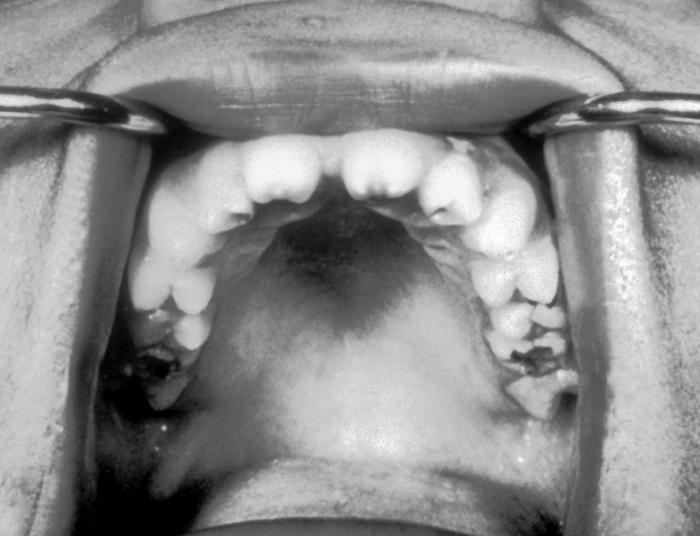
| This is an example of palatal torus. | |
| ICD-10 | K10.0 |
|
WikiDoc Resources for Torus palatinus |
|
Articles |
|---|
|
Most recent articles on Torus palatinus Most cited articles on Torus palatinus |
|
Media |
|
Powerpoint slides on Torus palatinus |
|
Evidence Based Medicine |
|
Clinical Trials |
|
Ongoing Trials on Torus palatinus at Clinical Trials.gov Trial results on Torus palatinus Clinical Trials on Torus palatinus at Google
|
|
Guidelines / Policies / Govt |
|
US National Guidelines Clearinghouse on Torus palatinus NICE Guidance on Torus palatinus
|
|
Books |
|
News |
|
Commentary |
|
Definitions |
|
Patient Resources / Community |
|
Patient resources on Torus palatinus Discussion groups on Torus palatinus Patient Handouts on Torus palatinus Directions to Hospitals Treating Torus palatinus Risk calculators and risk factors for Torus palatinus
|
|
Healthcare Provider Resources |
|
Causes & Risk Factors for Torus palatinus |
|
Continuing Medical Education (CME) |
|
International |
|
|
|
Business |
|
Experimental / Informatics |
Torus palatinus (pl. palatal tori) is a bony growth on the palate. Palatal tori are usually present on the midline of the hard palate.[1] Most palatal tori are less than 2 cm in diameter, but their size can change throughout life.
The prevalence of palatal tori ranges from 9% - 60% and are more common than bony growths occurring on the mandible, known as torus mandibularis. Palatal tori are more common in Asian and Inuit populations, and twice more common in females. In the United States, the prevalence is 20% - 35% of the population with similar findings between blacks and whites.
Although some research suggest palatal tori to be an autosomal dominant trait, it is generally believed that palatal tori are caused by several factors.[1] They are more common in early adult life and can increase in size. In some older people, the size of the tori may decrease due to bone resorption. Consequently, it is believed that mandibular tori are the result of local stresses and not solely on genetic influences.
Sometimes, the tori are categorized by their appearance.[1] Arising as a broad base and a smooth surface, flat tori are located on the midline of the palate and extend symmetrically to either side. Spindle tori have a ridge located at their midline. Nodular tori have multiple bony growths that each have their own base. Lobular tori have multiple bony growths with a common base.
Palatal tori are usually a clinical finding with no treatment necessary.[2] It is possible for ulcers to form on the area of the tori due to repeated trauma. Also, the tori may complicate the fabrication of dentures. If removal of the tori is needed, surgery can be done to reduce the amount of bone present.
Diagnosis
Physical Examination
Oral cavity
-
![Torus palatinus. Adapted from Dermatology Atlas.[3]](/images/1/15/Torus_palatinus01.jpg) Torus palatinus. Adapted from Dermatology Atlas.[3]
Torus palatinus. Adapted from Dermatology Atlas.[3]
![Torus palatinus. Adapted from Dermatology Atlas.[3]](/index.php/File:Torus_palatinus01.jpg)
Differential diagnosis
Torus palatinus must be differentiated from other mouth lesions such as oral candidiasis and aphthous ulcer
| Disease | Presentation | Risk Factors | Diagnosis | Affected Organ Systems | Important features | Picture |
|---|---|---|---|---|---|---|
| Diseases predominantly affecting the oral cavity | ||||||
| Oral Candidiasis |
|
|
|
Localized candidiasis
Invasive candidasis |
|
 |
| Herpes simplex oral lesions |
|
|
|
|
 | |
| Aphthous ulcers |
|
|
|
|
|
 |
| Squamous cell carcinoma |
|
|
 | |||
| Leukoplakia |
|
|
|
|
a.jpg) | |
| Melanoma |
|
|
|
|
 | |
| Fordyce spots |
|
|
|
|
 | |
| Burning mouth syndrome |
|
|
||||
| Torus palatinus |
|
 | ||||
| Diseases involving oral cavity and other organ systems | ||||||
| Behcet's disease |
|
|
|
 | ||
| Crohn's disease |
|
|
|
|||
| Agranulocytosis |
|
|
||||
| Syphilis[6] |
|
|
|
 | ||
| Coxsackie virus |
|
|

| |||
| Chicken pox |
|
|
|
|
 | |
| Measles |
|
|
|
 | ||


References
- ↑ 1.0 1.1 1.2 Neville, B.W., D. Damm, C. Allen, J. Bouquot. Oral & Maxillofacial Pathology. Second edition. 2002. Page 20. ISBN 0-7216-9003-3.
- ↑ Tori Mandibular, Maxillary, and Palatal. Study guide for Oral Pathology students at the University of Oklahoma College of Dentistry.
- ↑ "Dermatology Atlas".
- ↑ Ann M. Gillenwater, Nadarajah Vigneswaran, Hanadi Fatani, Pierre Saintigny & Adel K. El-Naggar (2013). "Proliferative verrucous leukoplakia (PVL): a review of an elusive pathologic entity!". Advances in anatomic pathology. 20 (6): 416–423. doi:10.1097/PAP.0b013e3182a92df1. PMID 24113312. Unknown parameter
|month=ignored (help) - ↑ Andrès E, Zimmer J, Affenberger S, Federici L, Alt M, Maloisel F. (2006). "Idiosyncratic drug-induced agranulocytosis: Update of an old disorder". Eur J Intern Med. 17 (8): 529–35. Text "pmid 17142169" ignored (help)
- ↑ title="By Internet Archive Book Images [No restrictions], via Wikimedia Commons" href="https://commons.wikimedia.org/wiki/File:A_manual_of_syphilis_and_the_venereal_diseases%2C_(1900)_(14595882378).jpg"
- ↑ Feikin DR, Lezotte DC, Hamman RF, Salmon DA, Chen RT, Hoffman RE (2000). "Individual and community risks of measles and pertussis associated with personal exemptions to immunization". JAMA. 284 (24): 3145–50. PMID 11135778.
- ↑ Ratnam S, West R, Gadag V, Williams B, Oates E (1996). "Immunity against measles in school-aged children: implications for measles revaccination strategies". Can J Public Health. 87 (6): 407–10. PMID 9009400.
_(14595882378).jpg)