Mouth
Template:Infobox Anatomy Editor-In-Chief: C. Michael Gibson, M.S., M.D. [1]
The human mouth (or oral cavity) is covered by an upper and lower lip.
The mouth starts digestion by physically chewing the food and breaking it down with saliva.
The average male mouth holds a volume of about 100mL.
Function
They play an important role in speech (it is part of the vocal apparatus), facial expression, kissing, eating, drinking (especially with a straw), breathing, and smoking.
Infants are born with a sucking reflex, by which they instinctively know to suck for nourishment using their lips and jaw.
Cultural aspects
According to general etiquette, the mouth is kept closed, especially when chewing.
Lips are often adorned with lipstick or lip gloss although in most human cultures this is an affectation for females only.
Piercings have been made popular by the younger generations. Lip, tongue, and the 'Monroe' (Monroe piercing is a stud piercing placed on one's face in the same area as Marilyn Monroe's well known and prominent birthmark was) are piercings seen in many varieties. Piercings of any sort besides two subtle earrings are seen as rebellious to the norm in many western cultures.
Development
The philtrum is the vertical groove in the upper lip, formed where the nasomedial and maxillary processes meet during embryo development. When these processes fail to fuse fully, a hare lip and/or cleft palate can result.
The nasolabial folds are the deep creases of tissue that extend from the nose to the sides of the mouth. One of the first signs of age on the human face is the increase in prominence of the nasolabial folds.
See also
Additional images
-
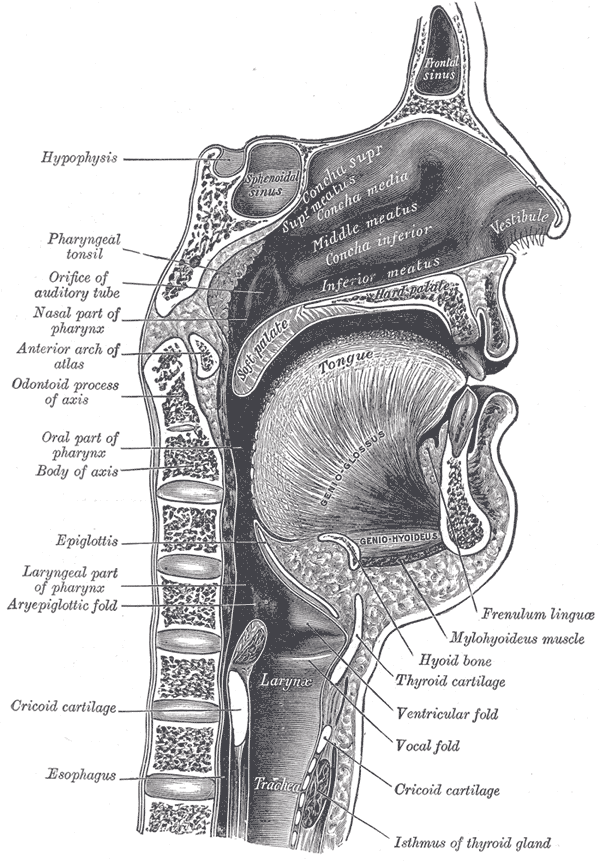 Sagittal section of nose mouth, pharynx, and larynx.

External links
Template:Human anatomical features
Template:Digestive system
Template:Head and neck general
Template:Oral pathology
ml:വായ