Bone marrow

|
WikiDoc Resources for Bone marrow |
|
Articles |
|---|
|
Most recent articles on Bone marrow Most cited articles on Bone marrow |
|
Media |
|
Powerpoint slides on Bone marrow |
|
Evidence Based Medicine |
|
Clinical Trials |
|
Ongoing Trials on Bone marrow at Clinical Trials.gov Clinical Trials on Bone marrow at Google
|
|
Guidelines / Policies / Govt |
|
US National Guidelines Clearinghouse on Bone marrow
|
|
Books |
|
News |
|
Commentary |
|
Definitions |
|
Patient Resources / Community |
|
Patient resources on Bone marrow Discussion groups on Bone marrow Patient Handouts on Bone marrow Directions to Hospitals Treating Bone marrow Risk calculators and risk factors for Bone marrow
|
|
Healthcare Provider Resources |
|
Causes & Risk Factors for Bone marrow |
|
Continuing Medical Education (CME) |
|
International |
|
|
|
Business |
|
Experimental / Informatics |
Editor-In-Chief: C. Michael Gibson, M.S., M.D. [1]
Overview
Bone marrow (or medulla ossea) is the soft tissue found in the hollow interior of bones. In adults, marrow in large bones produces new blood cells. It constitutes 4%[1] of total body weight, i.e. approximately 2.6 kg (5.7 lbs.) in adults.
Anatomy
Marrow types
There are two types of bone marrow: red marrow (consisting mainly of myeloid tissue) and yellow marrow (consisting mainly of fat cells). Red blood cells, platelets and most white blood cells arise in red marrow; some white blood cells develop in yellow marrow.
Both types of bone marrow contain numerous blood vessels and capillaries.
At birth, all bone marrow is red. With age, more and more of it is converted to the yellow type. About half of the bone marrow is red. [1] Red marrow is found mainly in the flat bones, such as the hip bone, breast bone, skull, ribs, vertebrae and shoulder blades, and in the cancellous ("spongy") material at the proximal ends of the long bones femur and humerus. Yellow marrow is found in the hollow interior of the middle portion of long bones.
In cases of severe blood loss, the body can convert yellow marrow back to red marrow in order to increase blood cell production.
Stroma
The stroma of the bone marrow is all tissue that isn't directly involved in the primary function of hematopoiesis. The yellow bone marrow belongs here, and makes the majority of the bone marrow stroma, in addition to stromal cells located in the red bone marrow.
Still, the stroma is indirectly involved in hematopoiesis, since it provides the hematopoietic microenvironment that facilitates hematopoiesis by the parenchymal cells. For instance, they generate colony stimulating factors, affecting hematopoiesis.
Cells that constitute the bone marrow stroma are:
- fibroblasts (reticular connective tissue)
- macrophages
- adipocytes
- osteoblasts
- blood vessels (sinusoid)
Macrophages contribute especially to red blood cell production. They deliver iron for hemoglobin-production.
Bone marrow barrier
The blood vessels constitute a barrier, inhibiting immature blood cells from leaving the bone marrow. Only mature blood cells contain the membrane proteins required to attach to and pass the blood vessel endothelium.
Hematopoietic stem cells may also cross the bone marrow barrier, and may thus be harvested from blood.
Stem cells
The bone marrow stroma contain mesenchymal stem cells (also called marrow stromal cells). These cells are multipotent stem cells that can differentiate into a variety of cell types. Cell types that MSCs have been shown to differentiate into in vitro or in vivo include osteoblasts, chondrocytes, myocytes, adipocytes, and, as described lately, beta-pancreatic islets cells. They can also transdifferentiate into neuronal cells.
Compartmentalization
There is biologic compartmentalization in the bone marrow, in that certain cell types tend to aggregate in specific areas. For instance, erythrocytes, macrophages and their precursors tend to gather around blood vessels, while granulocytes gather at the borders of the bone marrow.
Types of stem cells
Bone marrow contains three types of stem cells:[2]
- Hematopoietic stem cells give rise to the three classes of blood cells that are found in the circulation: white blood cells (leukocytes), red blood cells (erythrocytes), and platelets (thrombocytes).
- Mesenchymal stem cells are found arrayed around the central sinus in the bone marrow. They have the capability to differentiate into osteoblasts, chondrocytes, myocytes, and many other types of cells. They also function as "gatekeeper" cells of the bone marrow.
- Endothelial stem cells
Diseases involving the bone marrow
Click here to read more about bone marrow disorders.
The normal bone marrow architecture can be displaced by malignancies or infections such as tuberculosis, leading to a decrease in the production of blood cells and blood platelets. In addition, cancers of the hematologic progenitor cells in the bone marrow can arise; these are the leukemias.
To diagnose diseases involving the bone marrow, a bone marrow aspiration is sometimes performed. This typically involves using a hollow needle to acquire a sample of red bone marrow from the crest of the ilium under general or local anesthesia. The average amount of cells in a leg bone is 4410783 00000.
Exposure to radiation or chemotherapy will kill many of the rapidly dividing cells of the bone marrow and will therefore result in a depressed immune system. Many of the symptoms of radiation sickness are due to damage to the bone marrow cells.
Examination
Bone marrow examination is the pathologic analysis of samples of bone marrow obtained by bone marrow biopsy and bone marrow aspiration. Bone marrow examination is used in the diagnosis of a number of conditions, including leukemia, multiple myeloma, anemia, and pancytopenia. The bone marrow produces the cellular elements of the blood, including platelets, red blood cells and white blood cells. While much information can be gleaned by testing the blood itself (drawn from a vein by phlebotomy), it is sometimes necessary to examine the source of the blood cells in the bone marrow to obtain more information on hematopoiesis; this is the role of bone marrow aspiration and biopsy.
(Images shown below are courtesy of Melih Aktan MD, Istanbul Medical Faculty - Turkey, and Kyoto University - Japan, and Hospital Universitario La Fe Servicio Hematologia)
-
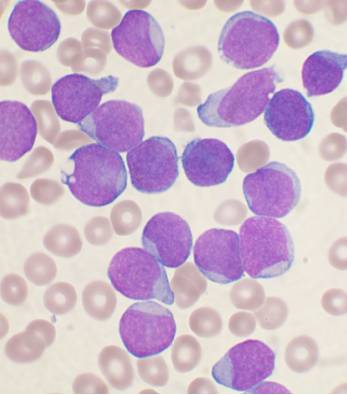 A Wright's stained bone marrow aspirate smear from a patient with leukemia.
 -
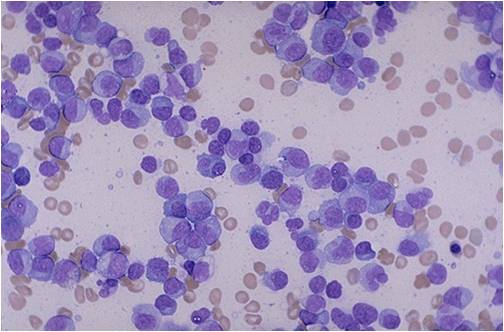 Bone marrow aspiration in multiple myeloma
 -
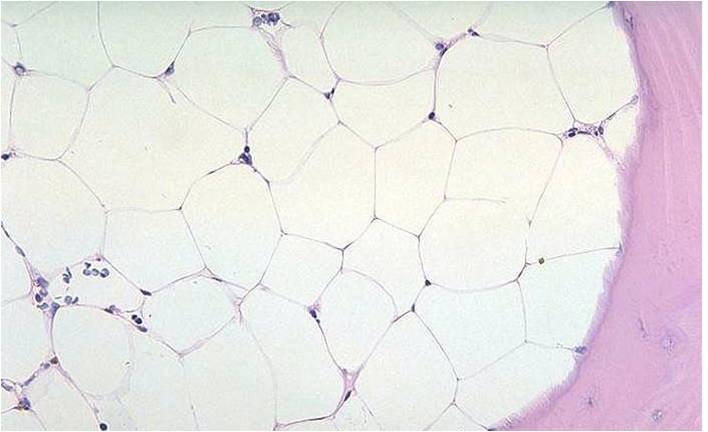 Bone marrow biopsia in aplastic anemia


-
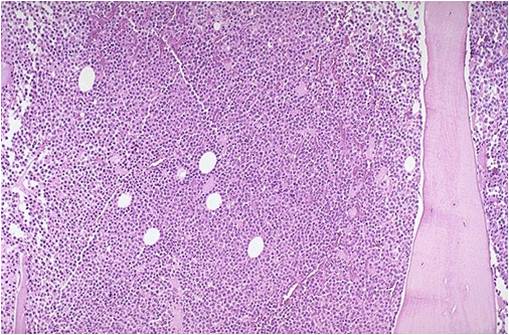 Bone marrow biopsy in multiple myeloma
 -
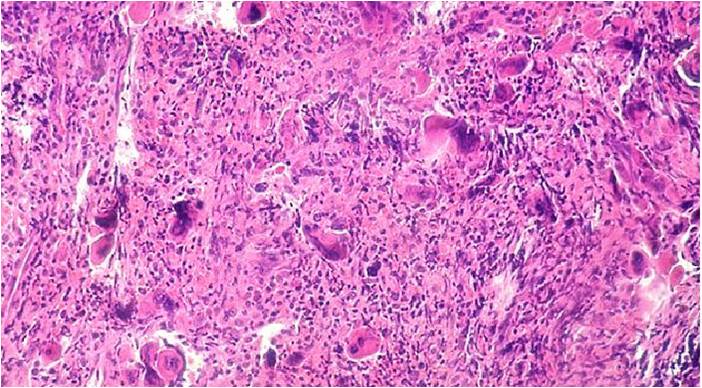 Bone marrow in idiopathic myelofibrosis
 -
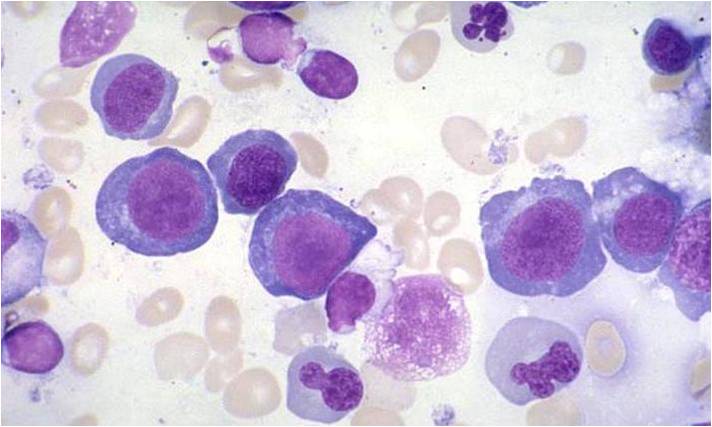 Bone marrow in megaloblastic anemia


-
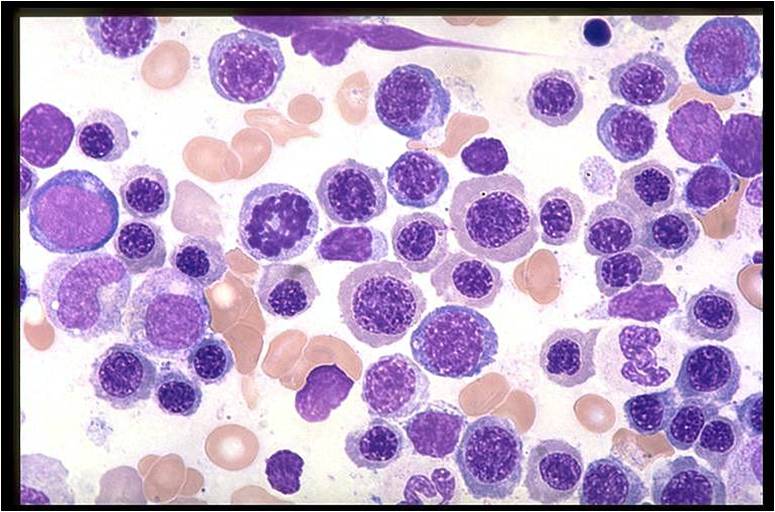 Bone marrow in megaloblastic anemia
 -
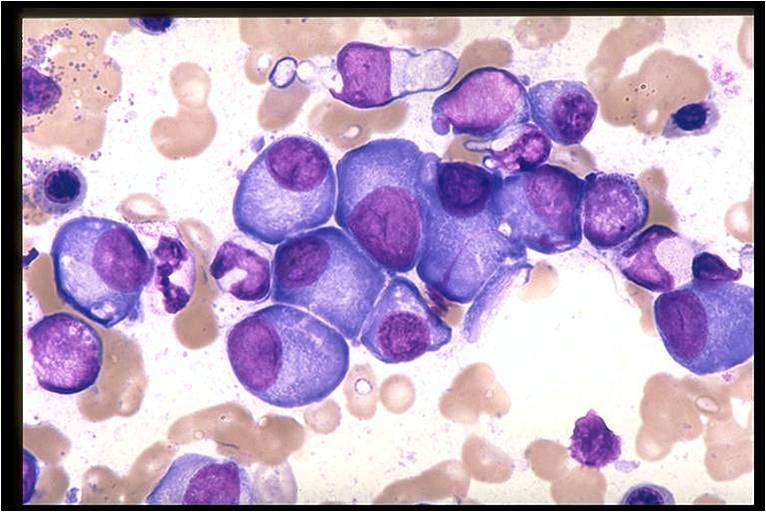 Bone marrow in multiple myeloma
 -
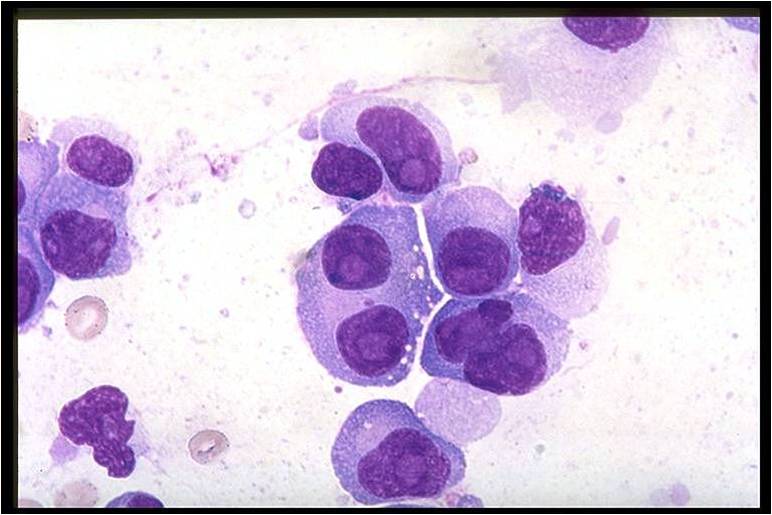 Bone marrow in multiple myeloma


Donation and transplantation of bone marrow
It is possible to take hematopoietic stem cells from one person and then infuse them into another person (Allogenic) or into the same person at a later time (Autologous). If donor and recipient are compatible, these infused cells will then travel to the bone marrow and initiate blood cell production.
Transplantation from one person to another is performed in severe cases of disease of the bone marrow. The patient's marrow is first killed off with drugs or radiation, and then the new stem cells are introduced.
Before radiation therapy or chemotherapy in cases of cancer, some of the patient's hematopoietic stem cells are sometimes harvested and later infused back when the therapy is finished to restore the immune system.

Harvesting
The stem cells are harvested directly from the red marrow in the crest of the ilium, usually under general anesthesia. Contrary to popular belief, it is a minimally invasive outpatient procedure with only minor discomfort. Another option is to administer certain drugs that stimulate the release of stem cells from the bone marrow into circulating blood. An IV is inserted into the donor's arm, and the stem cells are filtered out of the blood. The procedure is similar to donating blood or platelets.
It may also be taken from the sternum. The tibia may seem a good source, since it is very superficial. However, except in children, this bonemarrow doesn't contain any substantial amount of red bone marrow, but rather only yellow bone marrow. [1]
In newborns, stem cells may be retrieved from the umbilical cord.
Bone marrow: Metastatic Adenocarcinoma
{{#ev:youtube|nuPvQ8QCQOs}}
Bone marrow as a food
Though once used in various preparations, including pemmican, bone marrow for human consumption in America has recently fallen out of favor as a food. Now, it is commonly used only as a flavoring for soups and sauces, although dishes with intact bone marrow can still be found in some European restaurants. Bone marrow is a source of protein and high in monounsaturated fats. These fats are known to decrease LDL cholesterol levels resulting in a reduced risk of cardiovascular disease, prompting some to make bone marrow a dietary staple. The actual health effects of the addition of bone marrow to the diet remain unclear.
References
See also
- Leukemia
- Bone marrow transplant
- Bone marrow examination
- Aplastic anemia
- John Raymond Hobbs (Professor)
External links
Template:Lymphatic system Template:Bone and cartilage
ar:نقي bs:Koštana srž ca:Medul·la òssia cs:Kostní dřeň da:Knoglemarv de:Knochenmark et:Luuüdi eo:Ostmedolo hr:Koštana srž id:Sumsum tulang it:Midollo osseo he:מוח עצם la:Medulla ossium lt:Raudonieji kaulų čiulpai mk:Коскена срж nl:Beenmerg no:Benmarg nn:Beinmerg sk:Kostná dreň sr:Коштана срж su:Sungsum tulang fi:Luuydin sv:Benmärg ta:எலும்பு மச்சை yi:מארך ביין