Nucleus ambiguus
Template:Infobox Brain Editor-In-Chief: C. Michael Gibson, M.S., M.D. [1]
The nucleus ambiguus (literally "ambiguous nucleus") is a region of histologically disparate cells located just dorsal (posterior) to the inferior olivary nucleus in the lateral portion of the upper (rostral) medulla.
This nucleus gives rise to the efferent motor fibers of the vagus nerve (CN X) terminating in the laryngeal and pharyngeal muscles, as well as to the efferent motor fibers of the glossopharyngeal nerve (CN IX) terminating in the stylopharyngeus.
Areas supplied
The muscles supplied by the vagus (included with this is the cranial part of the accessory nerve), such as levator veli palatini, are also necessary to swallow properly through integration by the nucleus of the solitary tract. The vagus also supplies the upper part of the esophagus, and other parts of the pharynx and larynx.
As well as motor functions, nucleus ambiguus also contains the preganglionic neurons for the heart.
Additional images
-
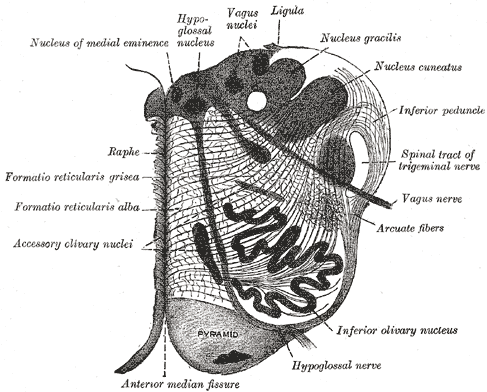 Section of the medulla oblongata at about the middle of the olive.
 -
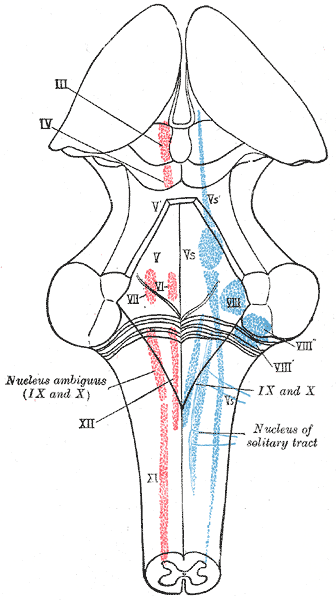 The cranial nerve nuclei schematically represented; dorsal view. Motor nuclei in red; sensory in blue.
 -
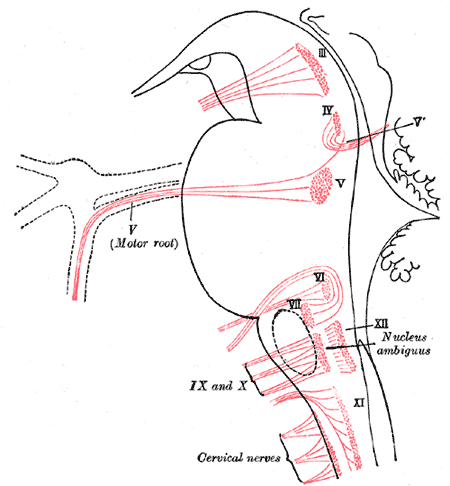 Nuclei of origin of cranial motor nerves schematically represented; lateral view.
 -
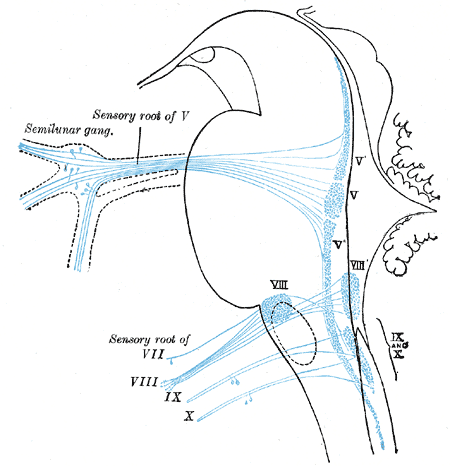 Primary terminal nuclei of the afferent (sensory) cranial nerves schematically represented; lateral view.
 -
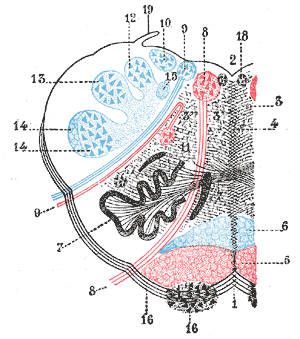 The formatio reticularis of the medulla oblongata, shown by a transverse section passing through the middle of the olive.


External links
- Medical Neurosciences discuss the nucleus ambiguus.
- Template:GPnotebook