Jugular vein
Jump to navigation
Jump to search
Editor-In-Chief: C. Michael Gibson, M.S., M.D. [1]
The jugular veins are veins that bring deoxygenated blood from the head back to the heart via the superior vena cava.
Internal and external
There are two sets of jugular veins: external and internal.
- The internal jugular vein is formed by the anastomosis of blood from the sigmoid sinus of the dura mater and the common facial vein. The internal jugular runs with the common carotid artery and vagus nerve inside the carotid sheath. It provides venous drainage for the contents of the skull.
- The external jugular runs superficially to sternocleidomastoid.
Both connect to the brachocephalic veins, the external jugular joining more laterally than the internal. The brachicephalic veins then join the subclavian veins from both sides then join to form the superior vena cava.[1]
There is also another, minor, jugular vein, the anterior jugular vein, draining the the submaxillary region.
Cultural references
- The jugular vein is the major point of damage when performing Jigai, a traditional way for Japanese women to commit suicide. This method was most commonly used because of its quick, painless, and certain outcome.
- In popular culture, the jugular is stereotypically what dogs and other animals are thought to go after with the intent of killing another animal, generally because of the awareness that it will incapacitate the opponent with little effort. In reality the injury that does this is to the carotid artery, as the flow from venial bleeding is easily stopped.
- It is also the Islamic method of slaughtering animals. Muslims traditionally pronounce "God is Great" before pulling a sharpened blade from a concealed place, and then slicing through both veins in the neck, as this numbs creatures and brings about instant death. The resulting Halal meat is made from the animal to consume after all the blood is drained from the openings.
Additional images
-
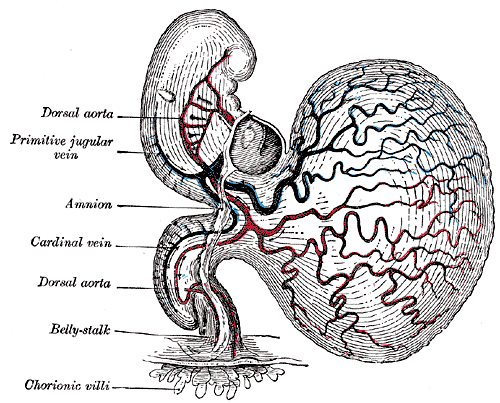 Human embryo of about fourteen days, with yolk-sac.
 -
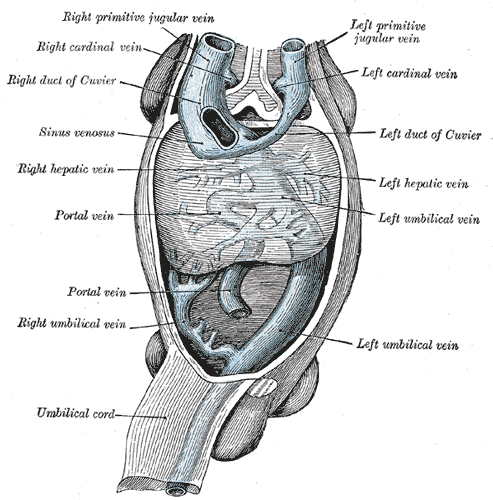 Human embryo with heart and anterior body-wall removed to show the sinus venosus and its tributaries.

