Medial longitudinal fasciculus
You don't need to be Editor-In-Chief to add or edit content to WikiDoc. You can begin to add to or edit text on this WikiDoc page by clicking on the edit button at the top of this page. Next enter or edit the information that you would like to appear here. Once you are done editing, scroll down and click the Save page button at the bottom of the page.
| Brain: Medial longitudinal fasciculus | ||
|---|---|---|
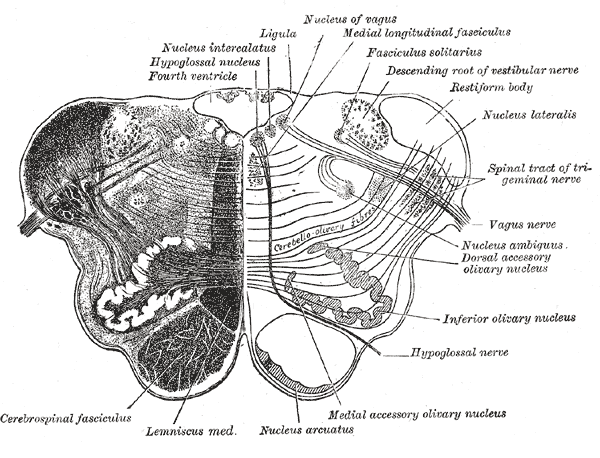
| Transverse section of mid-brain at level of inferior colliculi. (Medial longitudinal fasciculus labeled at center right.) | ||
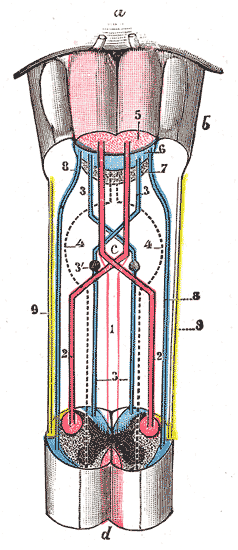
| Coronal section through mid-brain. 1. Corpora quadrigemina. 2. Cerebral aqueduct. 3. Central gray stratum. 4. Interpeduncular space. 5. Sulcus lateralis. 6. Substantia nigra. 7. Red nucleus of tegmentum. 8. Oculomotor nerve, with 8’, its nucleus of origin. a. Lemniscus (in blue) with a’ the medial lemniscus and a" the lateral lemniscus. b. Medial longitudinal fasciculus. c. Raphé. d. Temporopontine fibers. e. Portion of medial lemniscus, which runs to the lentiform nucleus and insula. f. Cerebrospinal fibers. g. Frontopontine fibers. | ||
| Latin | fasciculus longitudinalis medialis | |
| Gray's | subject #188 803 | |
| NeuroNames | ancil-743 | |
| Dorlands/Elsevier | f_03/12356052 | |
The medial longitudinal fasciculus (MLF) is a pair of crossed fiber tracts (group of axons), one on each side of the brainstem.
Function
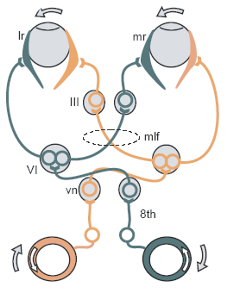
The MLF carries information about the direction that the eyes should move.
It yokes the cranial nerve nuclei III, IV and VI together, as well as the gaze centres and information about head movement (from cranial nerve VIII).
It also descends into the cervical spinal cord, and innervates some muscles of the neck.
Inputs
The MLF arises from the Vestibular nucleus (VN) and is thought to be involved in the maintenance of gaze. This is achieved by inputs to the VN from
- the Vestibulocochlear (8th cranial) nerve about head movements,
- gain adjustments from the flocculus of the cerebellum,
- head and neck propioceptors and foot and ankle muscle spindle, via the fastigial nucleus.
Pathology
Lesions of the MLF produce internuclear ophthalmoplegia. Lesions to the MLF are very common manifestations of the disease multiple sclerosis.where it most commonly presents as diplopia. These lesions cause damage to the ipsilateral (same side) eye.
History
In 1846 neurologist Benedict Stilling first referred to what is now known as the MLF as the acusticus, followed by Theodor Meynert in 1872 calling it posterior. But in 1891, Heinrich Schutz chose the name dorsal to describe the longitudinal bundle, "for brevity's sake". This name stuck despite other authors attempting further renaming (Ramon y Cajal's periependymal in 1904, Theodor Ziehen's nubecula dorsalis in 1913). But finally, it was Wilhelm His, Sr. who changed the name to medial for the sake of the Basle nomenclature to end the confusion.
Additional images
External links
- Medial+longitudinal+fasciculus at eMedicine Dictionary
- Atlas of anatomy at UMich n2a4p4 - "Brainstem, Cranial Nerve Nuclei, Sagittal Section, Medial View"
Brain: rhombencephalon (hindbrain) | |
|---|---|
| Myelencephalon/medulla | anterior/ventral: Arcuate nucleus of medulla • Pyramid (Decussation) • Olivary body • Inferior olivary nucleus • Anterior median fissure • Ventral respiratory group posterior/dorsal: VII,IX,X: Solitary/tract • XII, X: Dorsal • IX,X,XI: Ambiguus • IX: Inferior salivatory nucleus • Gracile nucleus/Cuneate nucleus/Accessory cuneate nucleus • Area postrema • Posterior median sulcus • Dorsal respiratory group raphe/reticular: Sensory decussation • Reticular formation (Gigantocellular nucleus, Parvocellular reticular nucleus, Ventral reticular nucleus, Lateral reticular nucleus, Paramedian reticular nucleus) • Raphe nuclei (Obscurus, Magnus, Pallidus) tracts: Corticospinal tract (Lateral, Anterior) • Inferior cerebellar peduncle • Olivocerebellar tract • Spinocerebellar (Dorsal, Ventral) • Spinothalamic tract • PCML (Posterior external arcuate fibers, Internal arcuate fibers, Medial lemniscus) • Extrapyramidal (Rubrospinal tract, Vestibulospinal tract, Tectospinal tract) |
| Metencephalon/pons | anterior/ventral: Superior olivary nucleus • Basis pontis (Pontine nuclei, Middle cerebellar peduncles) posterior/dorsal: Pontine tegmentum (Trapezoid body, Superior medullary velum, Locus ceruleus, MLF, Vestibulocerebellar tract, V Principal Spinal & Motor, VI, VII, VII: Superior salivary nucleus) • VIII-c (Dorsal, Anterior)/VIII-v (Lateral, Superior, Medial, Inferior) raphe/reticular: Reticular formation (Caudal pontine reticular nucleus, Oral pontine reticular nucleus, Tegmental pontine reticular nucleus, Paramedian pontine reticular formation) • Median raphe nucleus |
| Metencephalon/cerebellum | Vermis • Flocculus • Arbor vitae • Cerebellar tonsil • Inferior medullary velum Molecular layer (Stellate cell, Basket cell, Parallel fiber) • Purkinje cell layer (Purkinje cell) • Granule cell layer (Golgi cell) • Mossy fibers • Climbing fiber |
| Fourth ventricle | apertures (Median, Lateral) • Rhomboid fossa (Vagal trigone, Hypoglossal trigone, Obex, Sulcus limitans, Facial colliculus, Medial eminence) • Lateral recess |
Acknowledgement and Attribution Regarding Sources of Content
Some of the initial content on this page may be incorporated in part from copyleft sources in the public domain including wikis such as Wikipedia and AskDrWiki. Drug information for patients came from the The National Library of Medicine. Infectious disease information may have come from the Centers for Disease Control (CDC). Differential Diagnoses are drawn from clinicians as well as an amalgamation of 3 sources: 1.The Disease Database; 2. Kahan, Scott, Smith, Ellen G. In A Page: Signs and Symptoms. Malden, Massachusetts: Blackwell Publishing, 2004:3; 3. Sailer, Christian, Wasner, Susanne. Differential Diagnosis Pocket. Hermosa Beach, CA: Borm Bruckmeir Publishing LLC, 2002:7 .