Olivary body
|
WikiDoc Resources for Olivary body |
|
Articles |
|---|
|
Most recent articles on Olivary body Most cited articles on Olivary body |
|
Media |
|
Powerpoint slides on Olivary body |
|
Evidence Based Medicine |
|
Clinical Trials |
|
Ongoing Trials on Olivary body at Clinical Trials.gov Clinical Trials on Olivary body at Google
|
|
Guidelines / Policies / Govt |
|
US National Guidelines Clearinghouse on Olivary body
|
|
Books |
|
News |
|
Commentary |
|
Definitions |
|
Patient Resources / Community |
|
Patient resources on Olivary body Discussion groups on Olivary body Patient Handouts on Olivary body Directions to Hospitals Treating Olivary body Risk calculators and risk factors for Olivary body
|
|
Healthcare Provider Resources |
|
Causes & Risk Factors for Olivary body |
|
Continuing Medical Education (CME) |
|
International |
|
|
|
Business |
|
Experimental / Informatics |
Overview
In anatomy, the olivary bodies or simply olives (Latin oliva and olivae, singular and plural, respectively) are a pair of prominent oval structures in the medulla oblongata, the lower portion of the brainstem. They contain the olivary nuclei.
External anatomy
The olivary body is located on the anterior surface of the medulla lateral to the pyramid, from which it is separated by the antero-lateral sulcus and the fibers of the hypoglossal nerve.
Behind, it is separated from the postero-lateral sulcus by the ventral spinocerebellar fasciculus. In the depression between the upper end of the olive and the pons lies the vestibulocochlear nerve.
In humans, it measures about 1.25 cm. in length, and between its upper end and the pons there is a slight depression to which the roots of the facial nerve are attached.
The external arcuate fibers wind across the lower part of the pyramid and olive and enter the inferior peduncle.
Olivary nuclei
The olivary nuclei consist of the following nuclei:
- The medial accessory olivary nucleus lies between the inferior olivary nucleus and the pyramid, and forms a curved lamina, the concavity of which is directed laterally. The fibers of the hypoglossal nerve, as they traverse the medulla, pass between the medial accessory and the inferior olivary nuclei.
- The dorsal accessory olivary nucleus is the smallest, and appears on transverse section as a curved lamina behind the inferior olivary nucleus.
- The superior olivary nucleus is considered part of the pons.
Additional images
-
 Schematic representation of the chief ganglionic categories (I to V).
 -
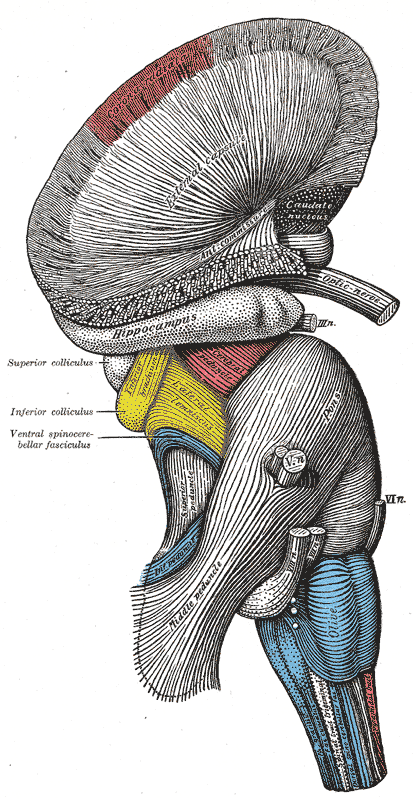 Superficial dissection of brain-stem. Lateral view.
 -
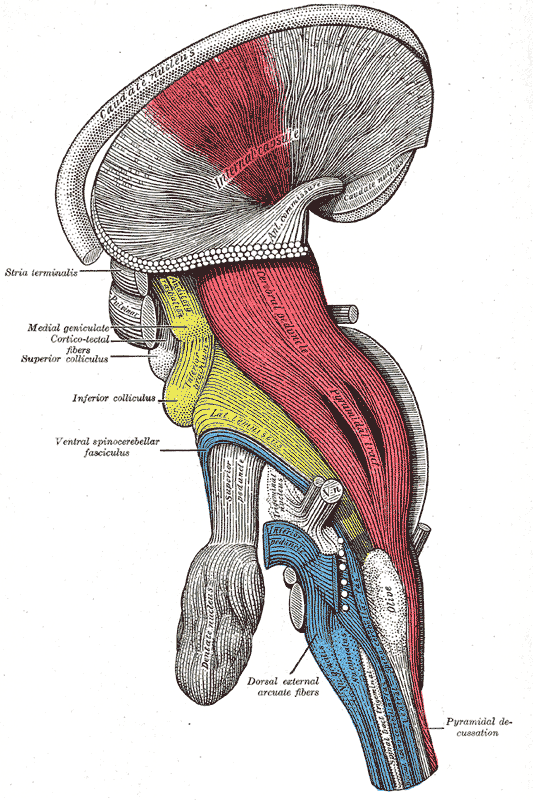 Deep dissection of brain-stem. Lateral view.
 -
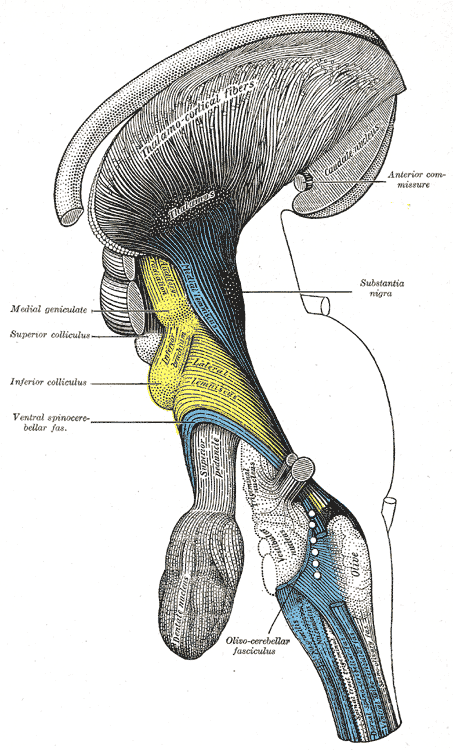 Deep dissection of brain-stem. Lateral view.
 -
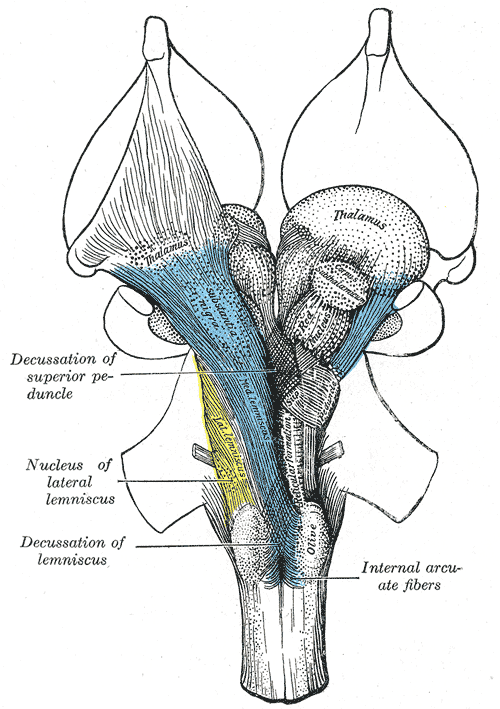 Deep dissection of brain-stem. Ventral view.
 -
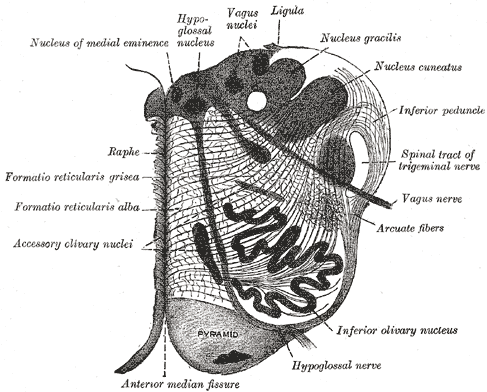 Section of the medulla oblongata at about the middle of the olive.
 -
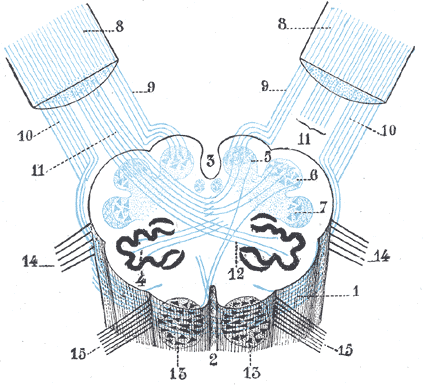 Diagram showing the course of the arcuate fibers.
 -
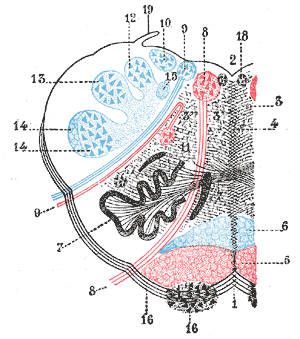 The formatio reticularis of the medulla oblongata, shown by a transverse section passing through the middle of the olive.
 -
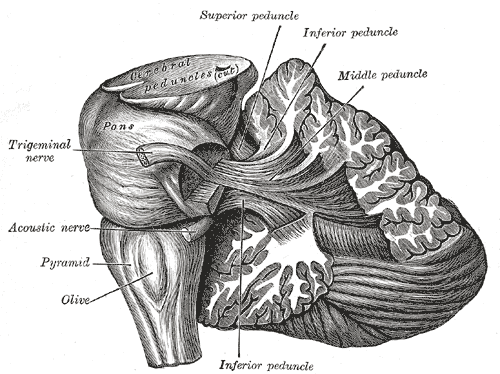 Dissection showing the projection fibers of the cerebellum.


External links
- Template:GraySubject (primary source for article)
- Template:BrainMaps