Phrenic nerve
|
WikiDoc Resources for Phrenic nerve |
|
Articles |
|---|
|
Most recent articles on Phrenic nerve Most cited articles on Phrenic nerve |
|
Media |
|
Powerpoint slides on Phrenic nerve |
|
Evidence Based Medicine |
|
Clinical Trials |
|
Ongoing Trials on Phrenic nerve at Clinical Trials.gov Trial results on Phrenic nerve Clinical Trials on Phrenic nerve at Google
|
|
Guidelines / Policies / Govt |
|
US National Guidelines Clearinghouse on Phrenic nerve NICE Guidance on Phrenic nerve
|
|
Books |
|
News |
|
Commentary |
|
Definitions |
|
Patient Resources / Community |
|
Patient resources on Phrenic nerve Discussion groups on Phrenic nerve Patient Handouts on Phrenic nerve Directions to Hospitals Treating Phrenic nerve Risk calculators and risk factors for Phrenic nerve
|
|
Healthcare Provider Resources |
|
Causes & Risk Factors for Phrenic nerve |
|
Continuing Medical Education (CME) |
|
International |
|
|
|
Business |
|
Experimental / Informatics |
Editor-In-Chief: C. Michael Gibson, M.S., M.D. [1]
Please Take Over This Page and Apply to be Editor-In-Chief for this topic: There can be one or more than one Editor-In-Chief. You may also apply to be an Associate Editor-In-Chief of one of the subtopics below. Please mail us [2] to indicate your interest in serving either as an Editor-In-Chief of the entire topic or as an Associate Editor-In-Chief for a subtopic. Please be sure to attach your CV and or biographical sketch.
Overview
The phrenic nerve arises from the third, fourth, and fifth cervical spinal nerves (C3-C5) in humans. It arises from the fifth, sixth and seventh cervical spinal nerves (C5-7) in most domestic animals.
Function
The phrenic nerve is made up mostly of motor nerve fibres for producing contractions of the diaphragm. In addition, it provides sensory innervation for many components of the mediastinum and pleura, as well as the upper abdomen, especially the liver and gall bladder.
Path
Both phrenic nerves run from C3, C4 and C5 along the anterior scalene muscle deep to the carotid sheath.
- The right phrenic nerve passes over the brachiocephalic artery, posterior to the subclavian vein, and then crosses the root of the right lung and then leaves the thorax by passing through the vena cava hiatus opening in the diaphragm at the level of T8. The right phrenic nerve passes over the right atrium.
- The left phrenic nerve passes over the left ventricle and pierces the diaphragm separately.
Both these nerves supply motor fibres to the diaphragm and sensory fibres to the fibrous pericardium, mediastinal pleura and diaphragmatic peritoneum.
The pericardiacophrenic artery and vein(s) travel with the phrenic nerve.
Clinical relevance
Pain arising from structures served by the phrenic nerve is often "referred" to other somatic regions served by spinal nerves C3-C5. For example, a subphrenic abscess (beneath the diaphragm) might cause a patient to feel pain in the right shoulder.
Irritation of the phrenic nerve (or the tissues supplied by it) leads to the hiccup reflex. A hiccup is a spasmodic contraction of the diaphram, which pulls air against the closed folds of the larynx.
The phrenic nerve must be identified during thoracic surgery and preserved. It passes anterior to the hilum of the corresponding lung, and therefore can be identified easily. Severing the phrenic nerve will paralyse that half of the diaphragm. Breathing will be made more difficult but will continue provided the other nerve is intact.
Additional images
-
 Transverse section of thorax, showing relations of pulmonary artery.
 -
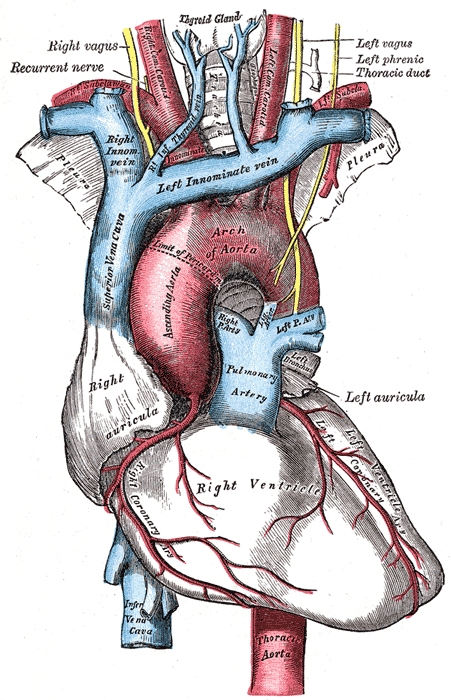 The arch of the aorta, and its branches.
 -
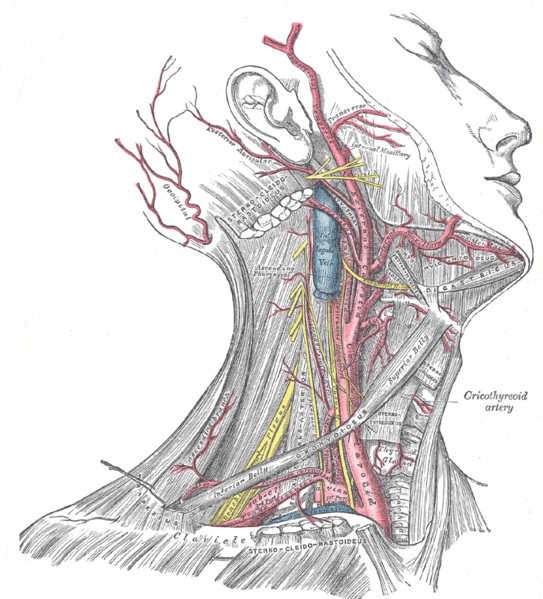 Superficial dissection of the right side of the neck, showing the carotid and subclavian arteries.
 -
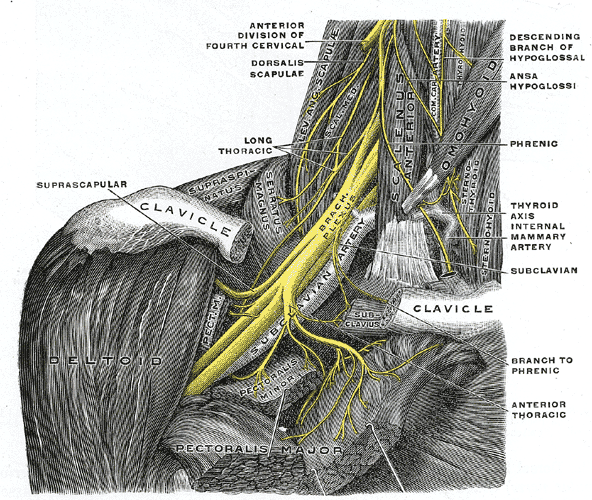 The right brachial plexus with its short branches, viewed from in front.


External links
- Template:GPnotebook
- Template:EMedicineDictionary
- Template:SUNYAnatomyFigs - "Left side of the mediastinum."
- Template:SUNYAnatomyFigs - "Diagram of the cervical plexus."