Maxillary artery
Editor-In-Chief: C. Michael Gibson, M.S., M.D. [1]
The maxillary artery (or internal maxillary artery in older texts) is an artery that supplies deep structures of the face.
Structure

The maxillary artery, the larger of the two terminal branches of the external carotid artery, arises behind the neck of the mandible, and is at first imbedded in the substance of the parotid gland; it passes forward between the ramus of the mandible and the sphenomandibular ligament, and then runs, either superficial or deep to the lateral pterygoid muscle, to the pterygopalatine fossa.
It supplies the deep structures of the face, and may be divided into mandibular, pterygoid, and pterygopalatine portions.
First portion
The first or mandibular portion passes horizontally forward, between the ramus of the mandible and the sphenomandibular ligament, where it lies parallel to and a little below the auriculotemporal nerve; it crosses the inferior alveolar nerve, and runs along the lower border of the lateral pterygoid muscle.
Branches include:
- Deep auricular artery
- Anterior tympanic artery
- Middle meningeal artery
- Inferior alveolar artery
- Accessory meningeal artery
Second portion
The second or pterygoid portion runs obliquely forward and upward under cover of the ramus of the mandible and insertion of the temporalis, on the superficial (very frequently on the deep) surface of the lateral pterygoid muscle; it then passes between the two heads of origin of this muscle and enters the fossa.
Branches include:
- Masseteric artery
- Pterygoid branches
- Deep temporal arteries (anterior and posterior)
- Buccal artery
Third portion
The third or pterygopalatine portion lies in the pterygopalatine fossa in relation with the pterygopalatine ganglion.
Branches include:
- Sphenopalatine artery, terminal branch
- Descending palatine artery
- Infraorbital artery
- Posterior superior alveolar artery
- Pharyngeal artery
- Artery of pterygoid canal
Nomenclature
- Formerly, the term "external maxillary artery" was used to describe what is now known as the facial artery (per Terminologia anatomica.) Currently, the term "external maxillary artery" is less commonly used, and the terms "internal maxillary artery" and "maxillary artery" are equivalent.
Additional images
-
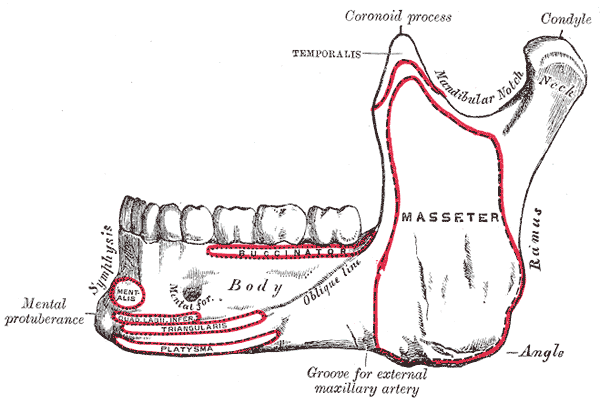
Mandible. Outer surface. Side view.

External links
- Template:EMedicineDictionary
- Template:NormanAnatomy (Template:NormanAnatomyFig)
- Template:SUNYAnatomyLabs - "Infratemporal Fossa: Branches of the Maxillary Artery"
- Template:MedicalMnemonics
- Overview at tufts.edu