Ischemic cascade
| Ischemic cascade |
|
WikiDoc Resources for Ischemic cascade |
|
Articles |
|---|
|
Most recent articles on Ischemic cascade Most cited articles on Ischemic cascade |
|
Media |
|
Powerpoint slides on Ischemic cascade |
|
Evidence Based Medicine |
|
Clinical Trials |
|
Ongoing Trials on Ischemic cascade at Clinical Trials.gov Trial results on Ischemic cascade Clinical Trials on Ischemic cascade at Google
|
|
Guidelines / Policies / Govt |
|
US National Guidelines Clearinghouse on Ischemic cascade NICE Guidance on Ischemic cascade
|
|
Books |
|
News |
|
Commentary |
|
Definitions |
|
Patient Resources / Community |
|
Patient resources on Ischemic cascade Discussion groups on Ischemic cascade Patient Handouts on Ischemic cascade Directions to Hospitals Treating Ischemic cascade Risk calculators and risk factors for Ischemic cascade
|
|
Healthcare Provider Resources |
|
Causes & Risk Factors for Ischemic cascade |
|
Continuing Medical Education (CME) |
|
International |
|
|
|
Business |
|
Experimental / Informatics |
Template:WikiDoc Cardiology News Editor-In-Chief: C. Michael Gibson, M.S., M.D. [1]
The ischemic (ischaemic) cascade is a series of biochemical reactions that take place in the brain and other aerobic tissues after seconds to minutes of ischemia (inadequate blood supply).[1] This is typically secondary to stroke, injury, or cardiac arrest due to heart attack. Most ischemic neurons that die do so due to the activation of chemicals produced during and after ischemia.[2] The ischemic cascade usually goes on for two to three hours but can last for days, even after normal blood flow returns.[3]
A cascade is a series of events in which one event triggers the next, in a linear fashion. Thus "ischemic cascade" is actually a misnomer, since in it, events are not always linear: in some cases, they are circular, and sometimes one event can cause or be caused by multiple other events.[4] In addition, cells receiving different amounts of blood may go through different chemical processes. Despite these facts, the ischemic cascade can be generally characterized as follows:
- Lack of oxygen causes the neuron's normal process for making ATP for energy to fail.
- The cell switches to anaerobic metabolism, producing lactic acid.
- ATP-reliant ion transport pumps fail, causing the cell to become depolarized, allowing ions, including calcium (Ca++), to flow into the cell.
- The ion pumps can no longer transport calcium out of the cell, and intracellular calcium levels get too high.
- The presence of calcium triggers the release of the excitatory amino acid neurotransmitter glutamate.
- Glutamate stimulates AMPA receptors and Ca++-permeable NMDA receptors, which open to allow more calcium into cells.
- Excess calcium entry overexcites cells and causes the generation of harmful chemicals like free radicals, reactive oxygen species and calcium-dependent enzymes such as calpain, endonucleases, ATPases, and phospholipases in a process called excitotoxicity.[5][6] Calcium can also cause the release of more glutamate.
- As the cell's membrane is broken down by phospholipases, it becomes more permeable, and more ions and harmful chemicals flow into the cell.
- Mitochondria break down, releasing toxins and apoptotic factors into the cell.
- The caspase-dependent apoptosis cascade is initiated, causing cells to "commit suicide."
- If the cell dies through necrosis, it releases glutamate and toxic chemicals into the environment around it. Toxins poison nearby neurons, and glutamate can overexcite them.
- If and when the brain is reperfused, a number of factors lead to reperfusion injury.
- An inflammatory response is mounted, and phagocytic cells engulf damaged but still viable tissue.
- Harmful chemicals damage the blood brain barrier.
- Cerebral edema (swelling of the brain) occurs due to leakage of large molecules like albumins from blood vessels through the damaged blood brain barrier. These large molecules pull water into the brain tissue after them by osmosis. This "vasogenic edema" causes compression of and damage to brain tissue.
The fact that the ischemic cascade involves a number of steps has led doctors to suspect that neuroprotectants such as calcium channel blockers or glutamate antagonists could be produced to interrupt the cascade at a single one of the steps, blocking the downstream effects. Though initial trials for such neuroprotective drugs led many to be hopeful, until recently, human clinical trials with neuroprotectants such as NMDA receptor antagonists were unsuccessful. However, NXY-059, the disulfonate derivative of the radical-scavenging spintrap phenylbutylnitrone, has been reported to give neuroprotection in Phase III human trials.[7]
Acute Arterial Insufficiency
-
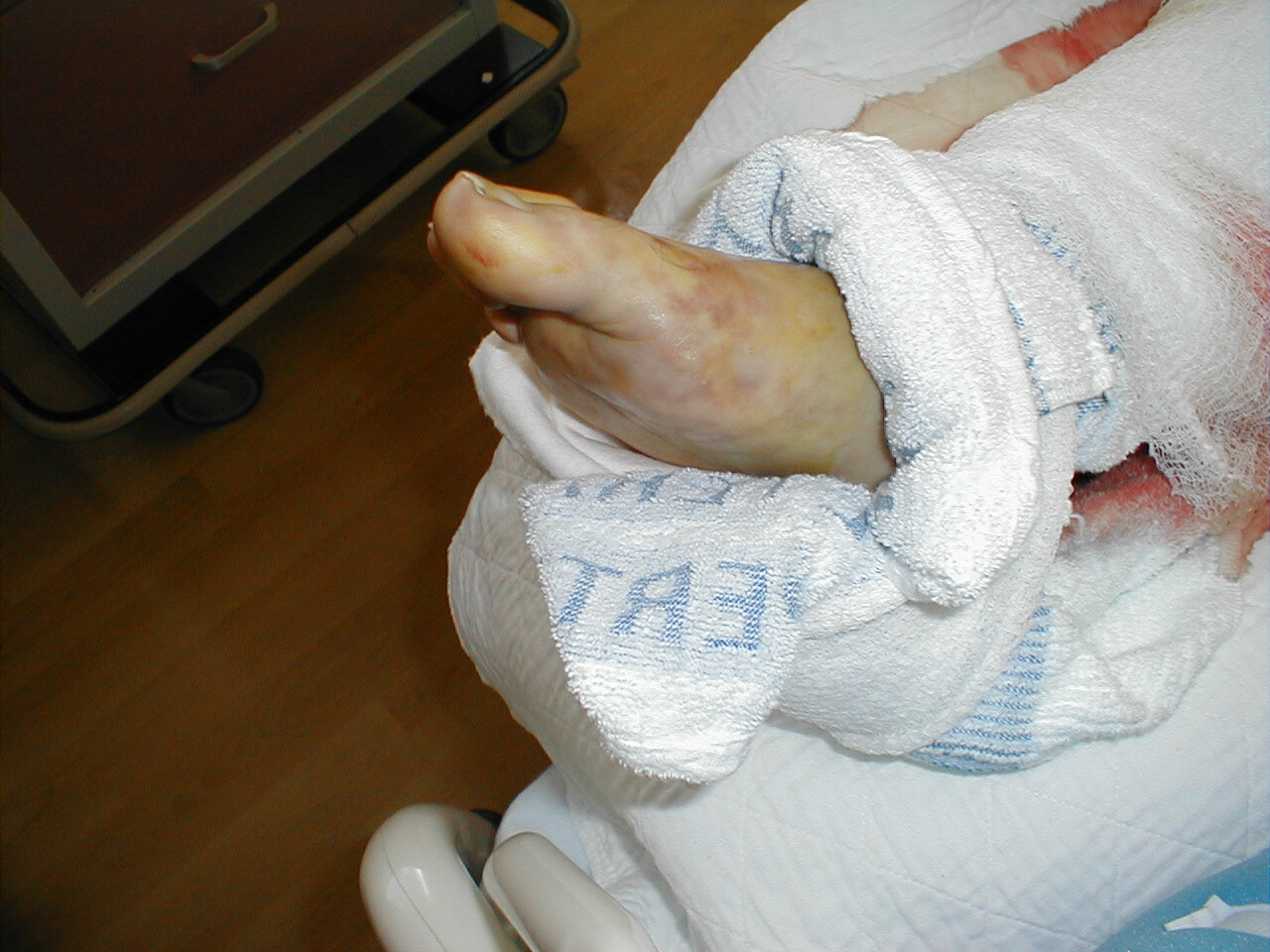 Acute Arterial Insufficiency: Embolus to right lower extremity resulted in acute vascular insufficiency to foot. Note mottled appearance. (Image courtesy of Charlie Goldberg, M.D., UCSD School of Medicine and VA Medical Center, San Diego, California)

Chronic Arterial Insufficiency
-
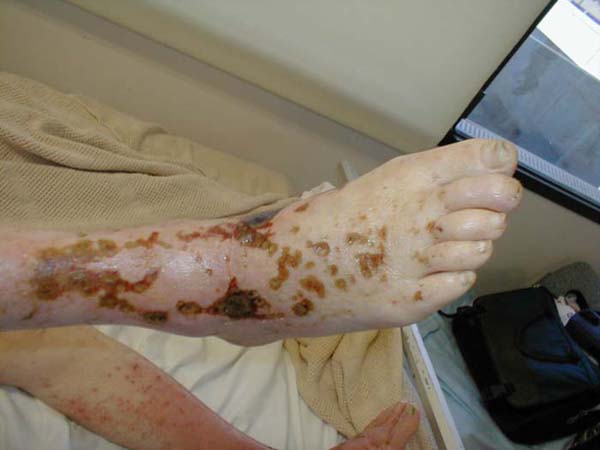 Chronic arterial insufficiency has resulted in pale, hairless, and somewhat shiny appearing lower extremity. Superficial ulcers are also apparent. (Image courtesy of Charlie Goldberg, M.D., UCSD School of Medicine and VA Medical Center, San Diego, California)

References
- ↑ Joseph Becker and Charles Wira. 2006. "Stroke, Ischemic eMedicine.com. Retrieved on January 23, 2007.
- ↑ Stroke Center of the Washington University School of Medicine.
- ↑ National Institute of Neurological Disorders and Stroke (NINDS). 1999. Stroke: Hope Through Research. Bethesda, Maryland: National Institutes of Health. Retrieved on January 9, 2007.
- ↑ Janice Hinkle and Lisa Bowman. 2003. "Neuroprotection for Ischemic Stroke." Journal of Neuroscience Nursing. Volume 35, Number 2, Pages 114-118. Retrieved on January 9, 2007.
- ↑ Jill Conway. 2000. "Diseases at the Cellular Level Lecture Handout" and Inflammation and Repair Lecture Handout" University of Illinois College of Medicine. Retrieved on January 9, 2007.
- ↑ Edward C Jauch. 2005. “Acute Stroke Management.” eMedicine.com, Inc. Retrieved on January 9, 2007.
- ↑ Kennedy R. Lees, Justin A. Zivin, Tim Ashwood, Antonio Davalos, Stephen M. Davis, Hans-Christoph Diener, James Grotta, Patrick Lyden, Ashfaq Shuaib, Hans-Göran Hårdemark, Warren W. Wasiewski, for the Stroke–Acute Ischemic NXY Treatment (SAINT I) Trial Investigators. 2006. NXY-059 for Acute Ischemic Stroke. New England Journal of Medicine. Volume 354, Pages 588-600. Retrieved on January 9, 2007.