Hepatic vein
|
WikiDoc Resources for Hepatic vein |
|
Articles |
|---|
|
Most recent articles on Hepatic vein Most cited articles on Hepatic vein |
|
Media |
|
Powerpoint slides on Hepatic vein |
|
Evidence Based Medicine |
|
Clinical Trials |
|
Ongoing Trials on Hepatic vein at Clinical Trials.gov Clinical Trials on Hepatic vein at Google
|
|
Guidelines / Policies / Govt |
|
US National Guidelines Clearinghouse on Hepatic vein
|
|
Books |
|
News |
|
Commentary |
|
Definitions |
|
Patient Resources / Community |
|
Patient resources on Hepatic vein Discussion groups on Hepatic vein Patient Handouts on Hepatic vein Directions to Hospitals Treating Hepatic vein Risk calculators and risk factors for Hepatic vein
|
|
Healthcare Provider Resources |
|
Causes & Risk Factors for Hepatic vein |
|
Continuing Medical Education (CME) |
|
International |
|
|
|
Business |
|
Experimental / Informatics |
Editor-In-Chief: C. Michael Gibson, M.S., M.D. [1]
Overview
In human anatomy, the hepatic veins are the blood vessels that drain de-oxygenated blood from the liver and blood cleaned by the liver (from the stomach, pancreas, small intestine and colon) into the inferior vena cava.
They arise from the substance of the liver, more specifically the central vein of the liver lobule.
None of the hepatic veins have valves.
Groups
They can be differentiated into two groups, the upper group and lower group.
- The upper group typically arises from the posterior aspect of the liver, are three in number, and drain the quadrate lobe and left lobe.
- The lower group arise from the right lobe and caudate lobe, are variable in number, and are typically smaller than those in the upper group.
Pathology
Occlusion of the hepatic veins is known as Budd-Chiari syndrome.
External links
- Hepatic Histology: The Lobule - Describes the liver lobule and central vein.
- Hepatic veins - definition - medterms.com
- Template:EMedicineDictionary
Images of the hepatic veins
- Hepatic veins - Ultrasound - University of the Health Sciences in Bethesda, Maryland
- 3-D reconstruction of the liver anatomy (for transplantation) - MeVis Distant Services
- Hepatic veins - CT angiogram - Contrast Techniques for Hepatic Multidetector CT Angiography - Havard Medical School.
- Template:ViennaCrossSection
Additional images
-
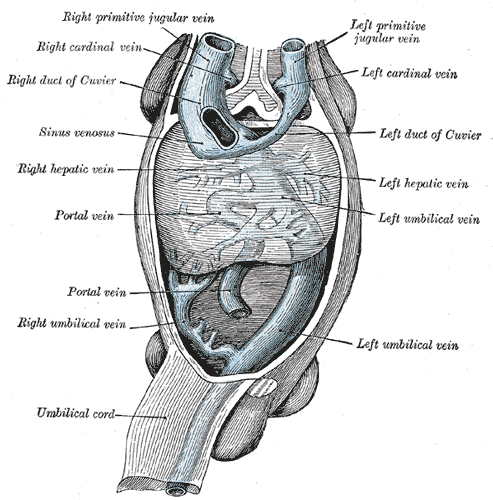 Human embryo with heart and anterior body-wall removed to show the sinus venosus and its tributaries.
 -
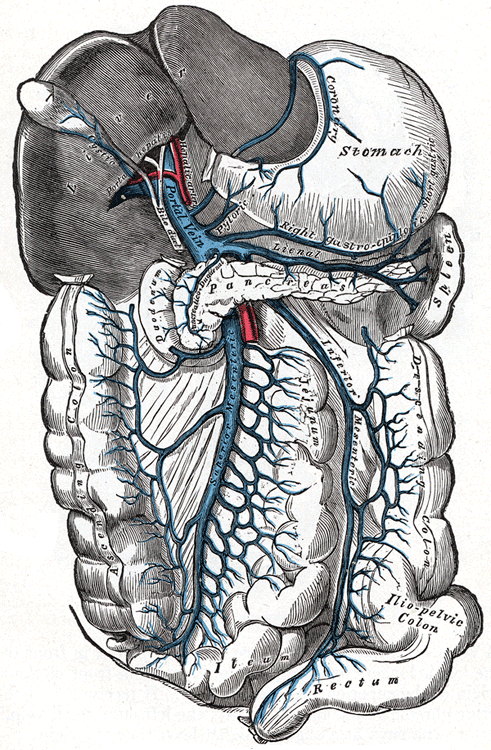 The portal vein and its tributaries.
 -
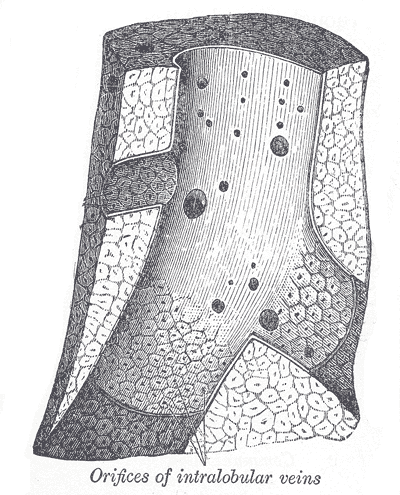 Longitudinal section of a hepatic vein.


