Tibialis anterior muscle
Editor-In-Chief: C. Michael Gibson, M.S., M.D. [1]
Overview
In human anatomy, the tibialis anterior is a muscle in the shin that spans the length of the tibia. It originates in the upper two-thirds of the lateral surface of the tibia and inserts into the medial cuneiform and first metatarsal bones of the foot. Its acts to dorsiflex and invert the foot.
It is situated on the lateral side of the tibia; it is thick and fleshy above, tendinous below.
This muscle overlaps the anterior tibial vessels and deep peroneal nerve in the upper part of the leg.
The tibialis anterior muscle is the source of the common pain of 'shin splints' affecting many runners, either because they are underconditioned or have not yet warmed up properly.
Function
The tibialis anterior muscle is the most medial muscle of the anterior compartment of the leg. It functions to stabilise the ankle as the foot hits the ground during the contact phase of walking and acts later to pull the foot clear of the ground during the swing phase. It also functions to 'lock' the ankle, as in toe-kicking a ball, when held in an isometric contraction.
Antagonists are plantar-flexors of the posterior compartment such as soleus and gastrocnemius.
Essentially, the movements of tibialis anterior are dorsiflexion and inversion of the foot. However, actions of tibialis anterior are dependent on whether the foot is weight-bearing or not (closed or open kinetic chain). When the foot is on the ground the muscle helps to balance the leg and talus on the other tarsal bones so that the leg is kept vertical even when walking on uneven ground. But, if you're walking on the beach it stays relaxed. This is because of less preasure pushing on it.
Origin and insertion
It arises from the lateral condyle and upper half or two-thirds of the lateral surface of the body of the tibia; from the adjoining part of the interosseous membrane; from the deep surface of the fascia; and from the intermuscular septum between it and the Extensor digitorum longus.
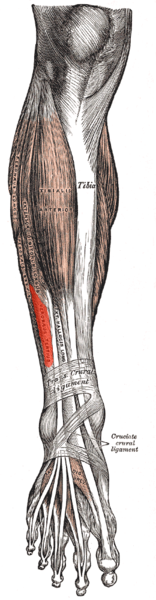
The fibres of this fusiform muscle are relatively parallel to the plane on insertion, ending in a tendon, apparent on the anteriomedial dorsal aspect of the foot close to the ankle.
After passing through the most medial compartments of the jkllj transverse and cruciate crural ligaments, it is inserted into the medial and under surface of the first cuneiform bone, and the base of the first and second metatarsal bone.
Variations
A deep portion of the muscle is rarely inserted into the talus, or a tendinous slip may pass to the head of the first metatarsal bone or the base of the first phalanx of the great toe.
The Tibiofascialis anterior, a small muscle from the lower part of the tibia to the transverse or cruciate crural ligaments or deep fascia.
Additional images
-
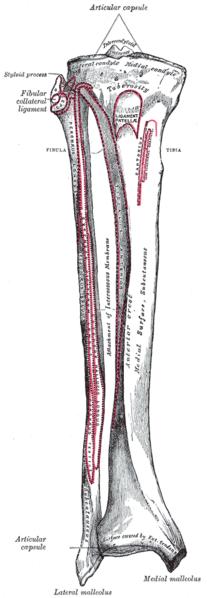 Bones of the right leg. Anterior surface.
 -
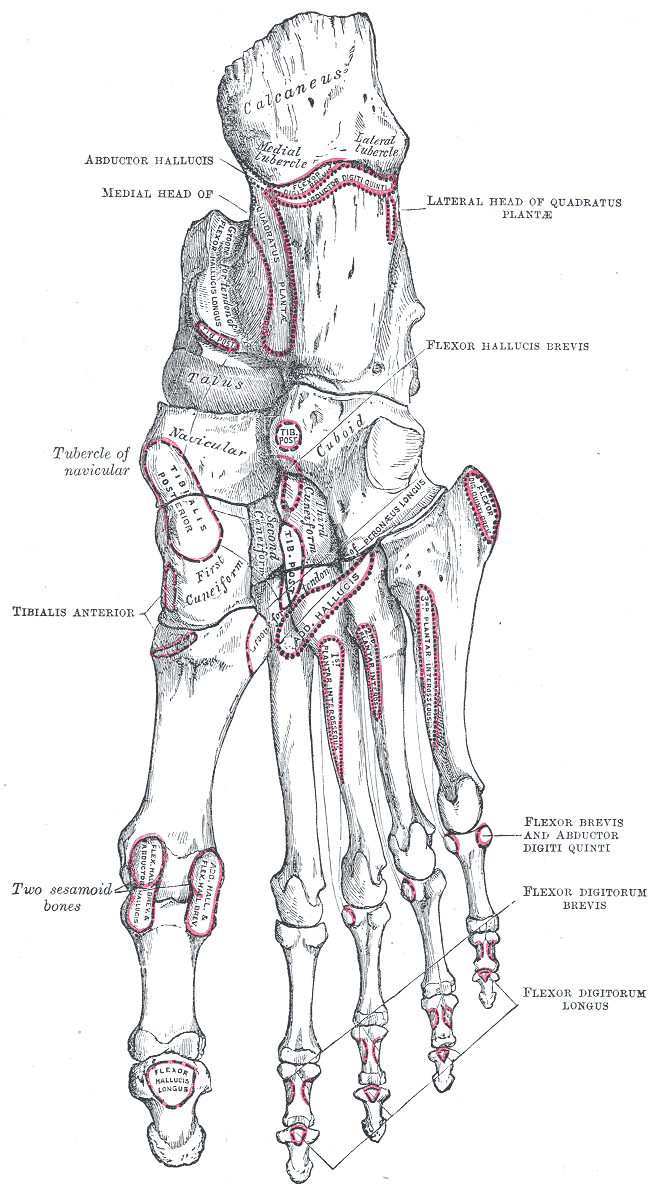 Bones of the right foot. Plantar surface.
 -
 Anatomical terms of motion
 -
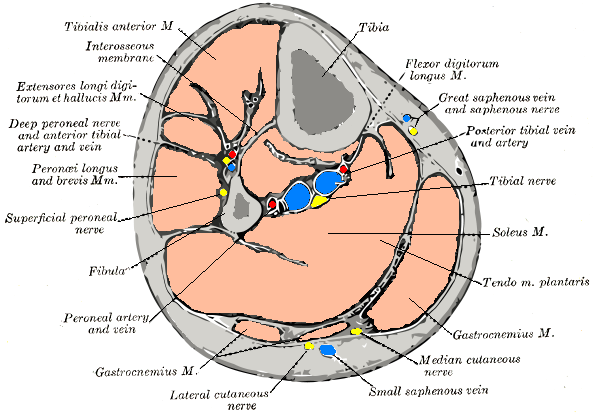 Cross-section through middle of leg.
 -
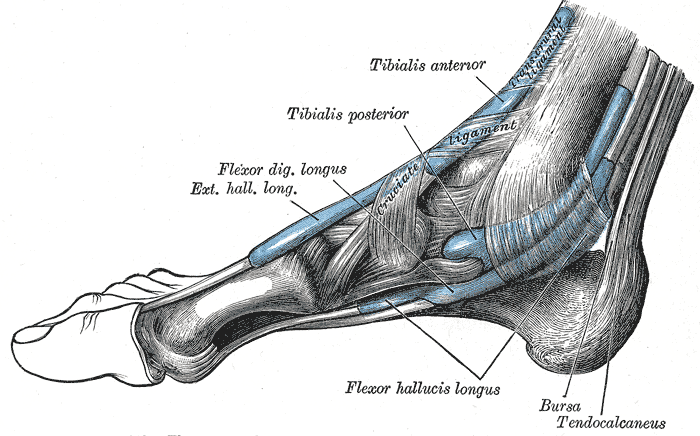 The mucous sheaths of the tendons around the ankle. Medial aspect.
 -
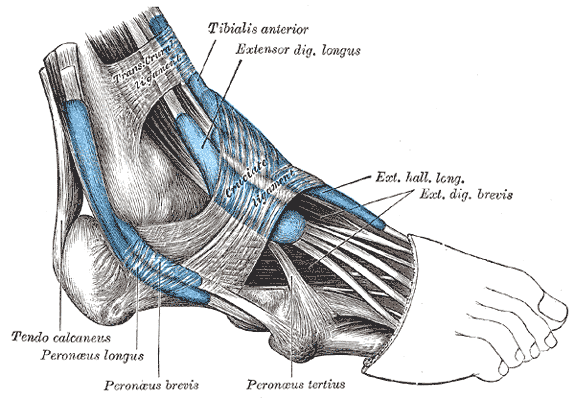 The mucous sheaths of the tendons around the ankle. Lateral aspect.


External links
- http://www.meddean.luc.edu/lumen/MedEd/GrossAnatomy/dissector/mml/tiba.htm
- Template:SUNYAnatomyLabs
- http://www.wheelessonline.com/ortho/tibialis_anterior