Rectus femoris muscle

You don't need to be Editor-In-Chief to add or edit content to WikiDoc. You can begin to add to or edit text on this WikiDoc page by clicking on the edit button at the top of this page. Next enter or edit the information that you would like to appear here. Once you are done editing, scroll down and click the Save page button at the bottom of the page.

Jump to: navigation, search
Rectus femoris muscle
Muscles of the iliac and anterior femoral regions. (Rectus femoris visible near center.)
Gray's subject #128 470
Origin anterior inferior iliac spine and the exterior surface of the bony ridge which forms the iliac portion of the acetabulum
Insertion    inserts into the patellar tendon as on of the four quadriceps muscles
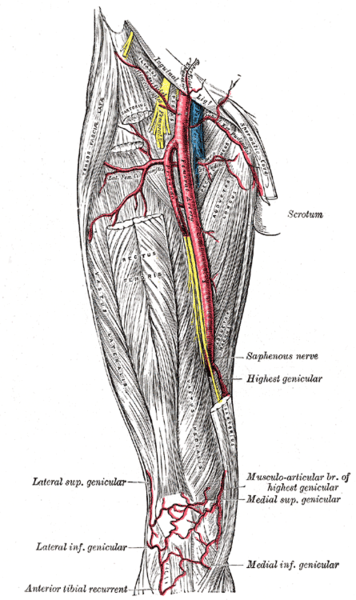
Artery: femoral artery
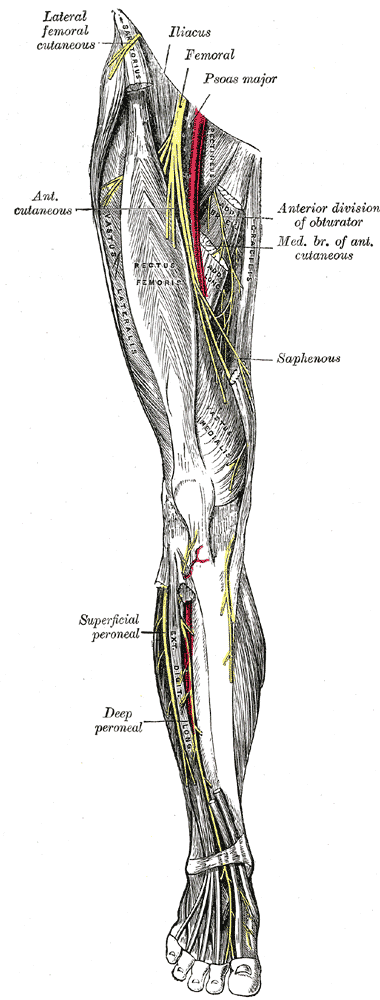
Nerve: femoral nerve
Action: knee extension; hip flexion
Antagonist: Hamstring

WikiDoc Resources for

Rectus femoris muscle

Articles

Most recent articles on Rectus femoris muscle

Most cited articles on Rectus femoris muscle

Review articles on Rectus femoris muscle

Articles on Rectus femoris muscle in N Eng J Med, Lancet, BMJ

Media

Powerpoint slides on Rectus femoris muscle

Images of Rectus femoris muscle

Photos of Rectus femoris muscle

Podcasts & MP3s on Rectus femoris muscle

Videos on Rectus femoris muscle

Evidence Based Medicine

Cochrane Collaboration on Rectus femoris muscle

Bandolier on Rectus femoris muscle

TRIP on Rectus femoris muscle

Clinical Trials

Ongoing Trials on Rectus femoris muscle at Clinical Trials.gov

Trial results on Rectus femoris muscle

Clinical Trials on Rectus femoris muscle at Google

Guidelines / Policies / Govt

US National Guidelines Clearinghouse on Rectus femoris muscle

NICE Guidance on Rectus femoris muscle

NHS PRODIGY Guidance

FDA on Rectus femoris muscle

CDC on Rectus femoris muscle

Books

Books on Rectus femoris muscle

News

Rectus femoris muscle in the news

Be alerted to news on Rectus femoris muscle

News trends on Rectus femoris muscle

Commentary

Blogs on Rectus femoris muscle

Definitions

Definitions of Rectus femoris muscle

Patient Resources / Community

Patient resources on Rectus femoris muscle

Discussion groups on Rectus femoris muscle

Patient Handouts on Rectus femoris muscle

Directions to Hospitals Treating Rectus femoris muscle

Risk calculators and risk factors for Rectus femoris muscle

Healthcare Provider Resources

Symptoms of Rectus femoris muscle

Causes & Risk Factors for Rectus femoris muscle

Diagnostic studies for Rectus femoris muscle

Treatment of Rectus femoris muscle

Continuing Medical Education (CME)

CME Programs on Rectus femoris muscle

International

Rectus femoris muscle en Espanol

Rectus femoris muscle en Francais

Business

Rectus femoris muscle in the Marketplace

Patents on Rectus femoris muscle

Experimental / Informatics

List of terms related to Rectus femoris muscle

Please Take Over This Page and Apply to be Editor-In-Chief for this topic: There can be one or more than one Editor-In-Chief. You may also apply to be an Associate Editor-In-Chief of one of the subtopics below. Please mail us [1] to indicate your interest in serving either as an Editor-In-Chief of the entire topic or as an Associate Editor-In-Chief for a subtopic. Please be sure to attach your CV and or biographical sketch.

Overview

The Rectus femoris muscle is one of the four quadriceps muscles of the human body. (The others are the vastus medialis, the vastus intermedius (deep to the rectus femoris), and the vastus lateralis. All four combine to form the quadriceps tendon, which inserts into the patella and continues as the patellar ligament.)

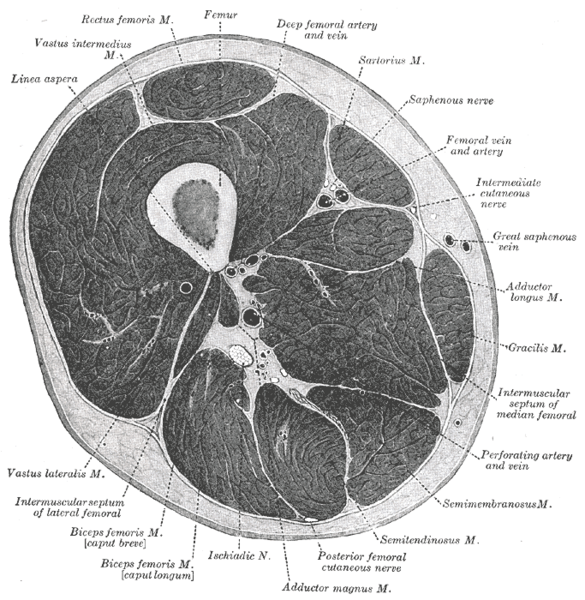
The Rectus femoris is situated in the middle of the front of the thigh; it is fusiform in shape, and its superficial fibers are arranged in a bipenniform manner, the deep fibers running straight down to the deep aponeurosis.

Origin and insertion

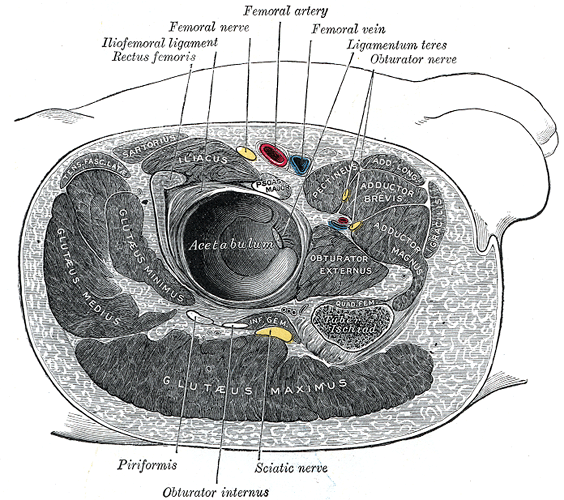
It arises by two tendons: one, the anterior or straight, from the anterior inferior iliac spine; the other, the posterior or reflected, from a groove above the brim of the acetabulum.

The two unite at an acute angle, and spread into an aponeurosis which is prolonged downward on the anterior surface of the muscle, and from this the muscular fibers arise.

The muscle ends in a broad and thick aponeurosis which occupies the lower two-thirds of its posterior surface, and, gradually becoming narrowed into a flattened tendon, is inserted into the base of the patella.

Functions

  • Hip Flexion
  • Knee Extension

The rectus femoris is the only muscle in the quadriceps group that is involved in hip flexion, since it is the only one that originates in the pelvis and not the femur.

The rectus femoris is a weaker hip flexor when the knee is extended because it is already shortened and thus suffers from active insufficiency. In essence: the action of raising a straightened leg will recruit more iliacus, psoas major, tensor fasciae latae, and the remaining hip flexors than it will the rectus femoris.

Similarly, the rectus femoris is not dominant in knee extension when the hip is flexed since it is already shortened and thus suffers from active insufficiency. In essence: the action of extending a leg from a seated position is primarily driven by the vastus lateralis, vastus medialis, and vastus intermedius, and less by the rectus femoris.

The rectus femoris is considered a direct antagonist to the hamstrings. The hamstrings oppkjuose the rectus femoris at the hip joint through extension and at the knee joint through flexion. Simultaneous contraction of the rectus femoris and hamstrings results in simultaneous hip and knee extension due to leverage (Lombard's Paradox.)

Additional images

External links

This article was originally based on an entry from a public domain edition of Gray's Anatomy. As such, some of the information contained herein may be outdated. Please edit the article if this is the case, and feel free to remove this notice when it is no longer relevant.


WikiDoc Help Menu

Quick Start..

Editing basics

Advanced editing

Communicating your edits

Help Videos You Can Watch

Acknowledgement and Attribution Regarding Sources of Content

Some of the initial content on this page may be incorporated in part from copyleft sources in the public domain including wikis such as Wikipedia and AskDrWiki. Drug information for patients came from the The National Library of Medicine. Infectious disease information may have come from the Centers for Disease Control (CDC). Differential Diagnoses are drawn from clinicians as well as an amalgamation of 3 sources: 1.The Disease Database; 2. Kahan, Scott, Smith, Ellen G. In A Page: Signs and Symptoms. Malden, Massachusetts: Blackwell Publishing, 2004:3; 3. Sailer, Christian, Wasner, Susanne. Differential Diagnosis Pocket. Hermosa Beach, CA: Borm Bruckmeir Publishing LLC, 2002:7 .

Personal tools
In other languages