Mesonephros
|
WikiDoc Resources for Mesonephros |
|
Articles |
|---|
|
Most recent articles on Mesonephros Most cited articles on Mesonephros |
|
Media |
|
Powerpoint slides on Mesonephros |
|
Evidence Based Medicine |
|
Clinical Trials |
|
Ongoing Trials on Mesonephros at Clinical Trials.gov Clinical Trials on Mesonephros at Google
|
|
Guidelines / Policies / Govt |
|
US National Guidelines Clearinghouse on Mesonephros
|
|
Books |
|
News |
|
Commentary |
|
Definitions |
|
Patient Resources / Community |
|
Patient resources on Mesonephros Discussion groups on Mesonephros Patient Handouts on Mesonephros Directions to Hospitals Treating Mesonephros Risk calculators and risk factors for Mesonephros
|
|
Healthcare Provider Resources |
|
Causes & Risk Factors for Mesonephros |
|
Continuing Medical Education (CME) |
|
International |
|
|
|
Business |
|
Experimental / Informatics |
Editor-In-Chief: C. Michael Gibson, M.S., M.D. [1]
Overview
The mesonephros (Latin for "middle kidney") is one of three excretory organs that develop in vertebrates. It serves as the main excretory organ of aquatic vertebrates and as a temporary kidney in higher vertebrates. The mesonephros is included in the Wolffian body after Caspar Friedrich Wolff who described it in 1759. (The Wolffian body is composed of : mesonephros + paramesonephrotic blastema)
Structure
The mesonephros is composed of the mesonephric duct (also called the Wolffian duct), mesonephric tubules, and associated capillary tufts. A single tubule and its associated capillary tuft is called a mesonephric excretory unit; these units are similar in structure and function to nephrons of the adult kidney. The mesonephros is derived from intermediate mesoderm in the vertebrate embryo.
Differences between males and females
In human males, the mesonephros gives rise to the efferent ductules of the testis, the epididymis, vas deferens, seminal vesicle, and vestigial structures such as the appendix testis, appendix epididymis, and paradidymis.
The mesonephros largely regresses in human females, though vestigial structures such as Gartner's cysts, the epoophoron, and paroophoron are common.
Differences among species
The mesonephros persists and form the permanent kidneys in fishes and amphibians, but in reptiles, birds, and mammals, it atrophies and for the most part disappears rapidly as the permanent kidney (metanephros) develops begins during the sixth or seventh week, so that by the beginning of the fifth month only the ducts and a few of the tubules of the mesonephros remain.
Additional images
-
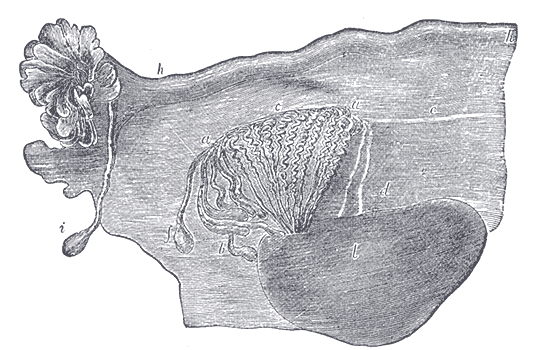
Broad ligament of adult, showing epoöphoron.

See also
- pronephros
- metanephros
- paramesonephric ducts, ducts beside (para-) the mesonephros