Areolar connective tissue

Areolar connective tissue (or loose connective tissue) is the most widely distributed connective tissue type in vertebrates.
Location
It can be found in the skin as well as in places that connect epithelium to other tissues.It is also found in the orbit.
The areolar tissue is found beneath the dermis layer and is also underneath the epithelial tissue of all the body systems that have external openings.
It is also a component of mucus membranes found in the digestive, respiratory, reproductive, and urinary systems.
It also surrounds the blood vessels and nerves.
Composition
It is a pliable, mesh-like tissue with a fluid matrix and functions to cushion and protect body organs.
Cells called fibroblasts are widely dispersed in this tissue; they are irregular branching cells that secrete strong fibrous proteins and proteoglycans as an extracellular matrix.
The cells of this type of tissue are generally separated by quite some distance by a gel-like gelatinous substance primarily made up of collagenous and elastic fibers
Function
Areolar connective tissue holds organs in place and attaches epithelial tissue to other underlying tissues. It also serves as a reservoir of water and salts for surrounding tissues. Almost all cells obtain their nutrients from and release their wastes into areolar connective tissue.
Classification
Loose connective tissue is named based on the "weave" and type of its constituent fibers. There are three main types:
- Collagenous fibers: collagenous fibers are made of collagen and consist of bundles of fibrils that are coils of collagen molecules.
- Elastic fibers: elastic fibers are made of elastin and are "stretchable."
- Reticular fibers: reticular fibers consist of one or more types of very thin collagen fibers. They join connective tissues to other tissues.
Additional images
-
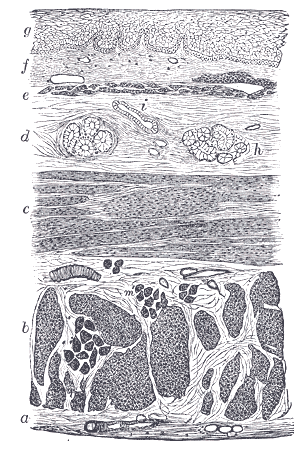
Section of the human esophagus. Moderately magnified.

It has lots of spindles that help the bones get bone marrow