Iris dilator muscle
You don't need to be Editor-In-Chief to add or edit content to WikiDoc. You can begin to add to or edit text on this WikiDoc page by clicking on the edit button at the top of this page. Next enter or edit the information that you would like to appear here. Once you are done editing, scroll down and click the Save page button at the bottom of the page.
| Iris dilator muscle | |
|---|---|
| Iris, front view. (Muscle visible but not labeled.) | |
| The upper half of a sagittal section through the front of the eyeball. ("Radiating fibers" labeled near center.) | |
| Latin | musculus dilatator pupillae |
| Gray's | subject #225 1013 |
| Origin | |
| Insertion | |
| Artery: | |
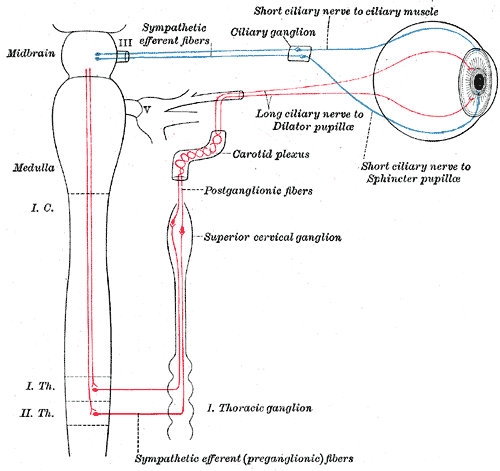
| Nerve: | superior cervical ganglion (sympathetics) |
| Action: | dilates pupil |
| Antagonist: | iris sphincter muscle |
| Dorlands /Elsevier | m_22/12548821 |
Editor-In-Chief: C. Michael Gibson, M.S., M.D. [1] Phone:617-632-7753
Please Take Over This Page and Apply to be Editor-In-Chief for this topic: There can be one or more than one Editor-In-Chief. You may also apply to be an Associate Editor-In-Chief of one of the subtopics below. Please mail us [2] to indicate your interest in serving either as an Editor-In-Chief of the entire topic or as an Associate Editor-In-Chief for a subtopic. Please be sure to attach your CV and or biographical sketch.
The iris dilator muscle (pupil dilator muscle, pupillary dilator, radial muscle of iris, radiating fibers), is a muscle of the eye. It is innervated by the sympathetic system.
Additional images
See also
External links
- Description of function at tedmontgomery.com
- Slide at mscd.edu
- dilator+pupillae+muscle at eMedicine Dictionary
- Histology at Boston University 08010loa
| ||||
Acknowledgement and Attribution Regarding Sources of Content
Some of the initial content on this page may be incorporated in part from copyleft sources in the public domain including wikis such as Wikipedia and AskDrWiki. Drug information for patients came from the The National Library of Medicine. Infectious disease information may have come from the Centers for Disease Control (CDC). Differential Diagnoses are drawn from clinicians as well as an amalgamation of 3 sources: 1.The Disease Database; 2. Kahan, Scott, Smith, Ellen G. In A Page: Signs and Symptoms. Malden, Massachusetts: Blackwell Publishing, 2004:3; 3. Sailer, Christian, Wasner, Susanne. Differential Diagnosis Pocket. Hermosa Beach, CA: Borm Bruckmeir Publishing LLC, 2002:7 .