Fordyce's spot
| Fordyce's spot | |
 | |
|---|---|
| Fordyce's spot |
Template:Search infobox Editor-In-Chief: C. Michael Gibson, M.S., M.D. [1];Associate Editor(s)-in-Chief: Kiran Singh, M.D. [2]
Overview
Fordyce's spots (also known as "Angiokeratoma of the scrotum", "Fordyce's disease," "Fordyce's spot," and "Fordyce granules"[1]) are small, painless, raised, pale or white spots or bumps 1 to 3 mm in diameter that may appear on the shaft of the penis or on the labia, as well as the inner surface and vermilion border of the lips of the face. They are common in men and women of all ages. They are named after an American dermatologist, John Addison Fordyce.[2] On the head of the penis, they are called Tyson glands,[3] not to be confused with Hirsuties papillaris genitalis.[4]
Fordyce's Spots are very common in adult males. The condition can appear either as a single lesion or in a symmetrical group of up to fifty. The spots are typically 1-2mm in diameter.
Causes of Fordyce’s Condition
While there seems to be a genetic link, the cause for this condition is idiopathic. The condition isn’t contagious and it isn’t caused by any viruses. At birth the papules are present but they don’t become prevalent until a child reaches puberty.
Pathogenesis
The spots are a form of ectopic sebaceous gland, and are not known to be associated with any disease or illness and are of cosmetic concern only. They are non-infectious and a natural occurrence on the body. Men sometimes consult with a dermatologist because they are worried they may have a sexually transmitted disease (especially genital warts) or some form of cancer, but this is not the case.[5] They may equally be worried about the appearance of their penis and what their sexual partner might think of it.[6]
-
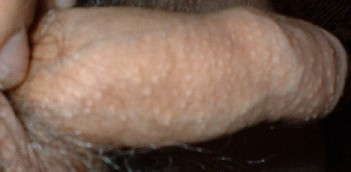 Example of Fordyce's spots on a penis.
 -
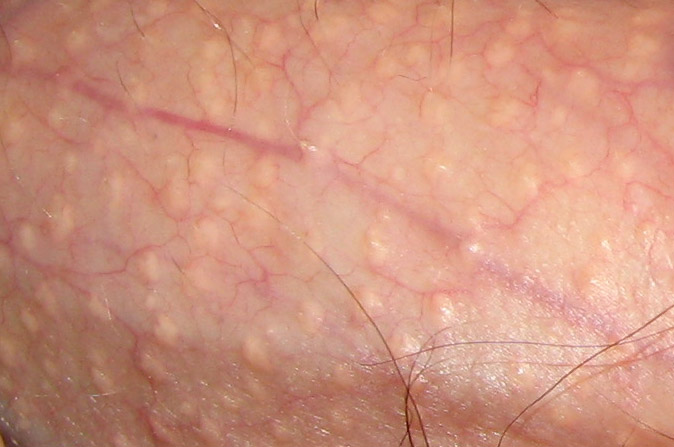 Close-up of Fordyce's spots on a penis.

Diagnosis
Physical examination
skin
Scrotum
-
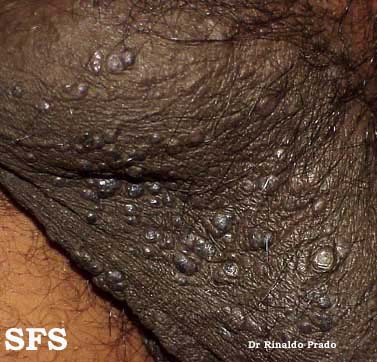 Fordyce,s spot. Adapted from Dermatology Atlas.<ref name="Dermatology Atlas">{{Cite
 -
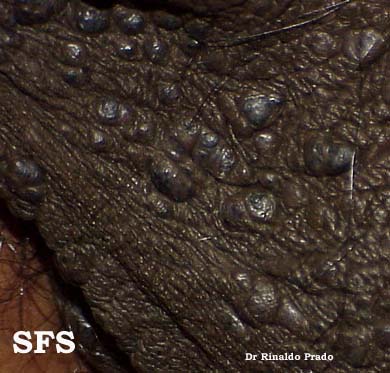 Fordyce,s spot. Adapted from Dermatology Atlas.<ref name="Dermatology Atlas">{{Cite
 -
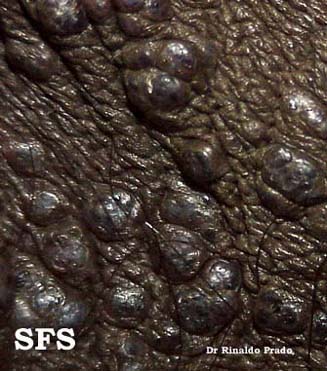 Fordyce,s spot. Adapted from Dermatology Atlas.<ref name="Dermatology Atlas">{{Cite
 -
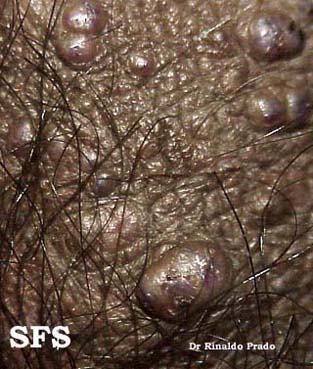 Fordyce,s spot. Adapted from Dermatology Atlas.<ref name="Dermatology Atlas">{{Cite
 -
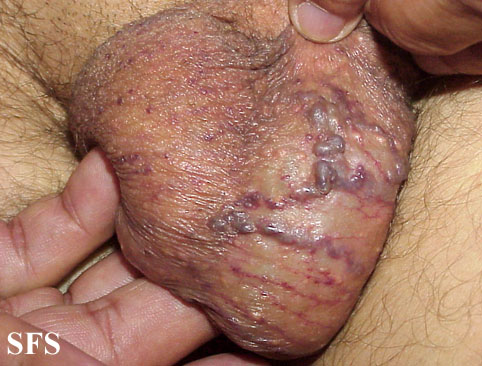 Fordyce,s spot. Adapted from Dermatology Atlas.<ref name="Dermatology Atlas">{{Cite
 -
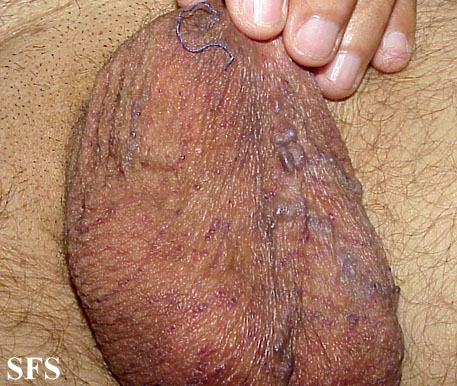 Fordyce,s spot. Adapted from Dermatology Atlas.<ref name="Dermatology Atlas">{{Cite
 -
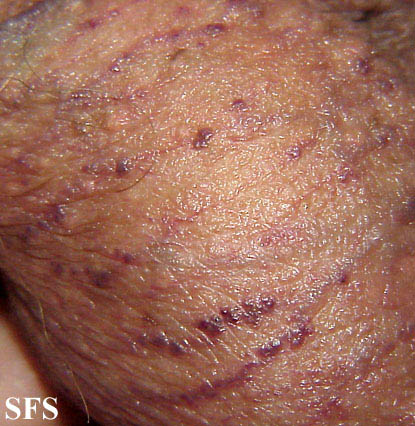 Fordyce,s spot. Adapted from Dermatology Atlas.<ref name="Dermatology Atlas">{{Cite
 -
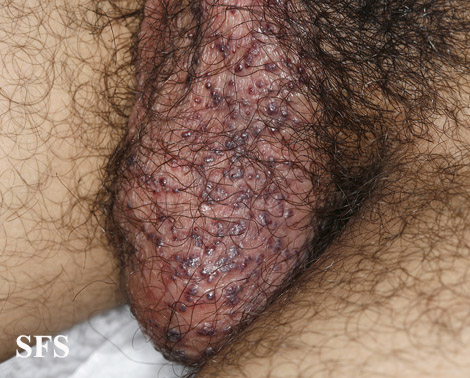 Fordyce,s spot. Adapted from Dermatology Atlas.<ref name="Dermatology Atlas">{{Cite
 -
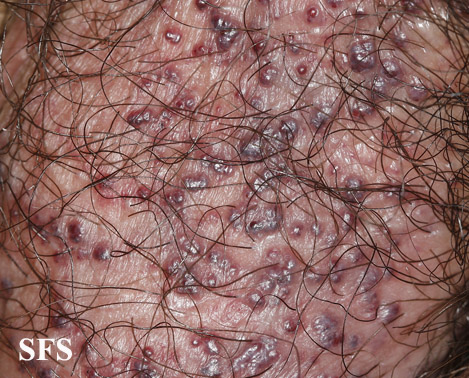 Fordyce,s spot. Adapted from Dermatology Atlas.<ref name="Dermatology Atlas">{{Cite
 -
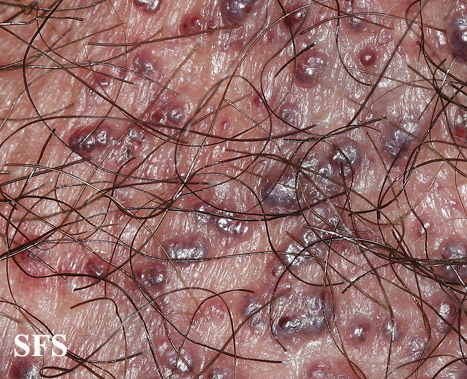 Fordyce,s spot. Adapted from Dermatology Atlas.<ref name="Dermatology Atlas">{{Cite
 -
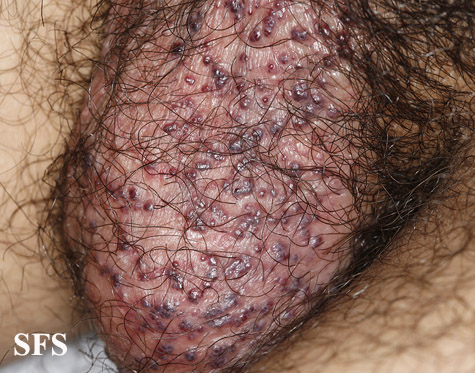 Fordyce,s spot. Adapted from Dermatology Atlas.<ref name="Dermatology Atlas">{{Cite


Treatment
Although no treatment is required, those with the condition can choose to apply Tretinoin gel or cream to the affected areas each day. This can reverse the effects of the condition over time and prevent it from getting any worse. To get the best results from Tretinoin one should use it along with alpha hydroxy acid agents which are normally used to treat acne.
Vaporising laser treatments such as CO2 laser[7] or electro desiccation have been used with some success in diminishing the appearance of this condition if they are of cosmetic concern. However, most doctors consider this a normal physiological phenomenon and advise against treatment.
Sometimes a doctor will prescribe TCA chemical peels, but Fordyce’s Condition will return as soon as treatment is stopped. The condition can also be removed with laser vaporization.
Diathermy or liquid nitrogen freezing can also sometimes be used to remove the condition.
References
- ↑ James, William; Berger, Timothy; Elston, Dirk (2005). Andrews' Diseases of the Skin: Clinical Dermatology. (10th ed.). Saunders. ISBN 0721629210.
- ↑ Template:WhoNamedIt
- ↑ derm/395 at eMedicine
- ↑ Khoo LS, Cheong WK. Common genital dermatoses in male patients attending a public sexually transmitted disease clinic in Singapore. Ann Acad Med Singapore 1995;24:505-9.
- ↑ Palo Alto Medical Foundation Bettina McAdoo , M.D. Retrieved June 24, 2006.
- ↑ Spots on the penis. Dr John Dean. Retrieved June 24, 2006.
- ↑ Ocampo-Candiani J, Villarreal-Rodriguez A, Quinones-Fernandez AG, Herz-Ruelas ME, Ruiz-Esparza J. Treatment of Fordyce spots with CO2 laser. Dermatol Surg 2003; 29: 869-71. PMID 12859392