Sebaceous gland
|
WikiDoc Resources for Sebaceous gland |
|
Articles |
|---|
|
Most recent articles on Sebaceous gland Most cited articles on Sebaceous gland |
|
Media |
|
Powerpoint slides on Sebaceous gland |
|
Evidence Based Medicine |
|
Clinical Trials |
|
Ongoing Trials on Sebaceous gland at Clinical Trials.gov Trial results on Sebaceous gland Clinical Trials on Sebaceous gland at Google
|
|
Guidelines / Policies / Govt |
|
US National Guidelines Clearinghouse on Sebaceous gland NICE Guidance on Sebaceous gland
|
|
Books |
|
News |
|
Commentary |
|
Definitions |
|
Patient Resources / Community |
|
Patient resources on Sebaceous gland Discussion groups on Sebaceous gland Patient Handouts on Sebaceous gland Directions to Hospitals Treating Sebaceous gland Risk calculators and risk factors for Sebaceous gland
|
|
Healthcare Provider Resources |
|
Causes & Risk Factors for Sebaceous gland |
|
Continuing Medical Education (CME) |
|
International |
|
|
|
Business |
|
Experimental / Informatics |
Editor-In-Chief: C. Michael Gibson, M.S., M.D. [1]
The sebaceous glands are glands found in the skin of mammals.
Locations and morphology
A branched type of acinar gland, these glands exist in humans throughout the skin except in the palms of the hands and soles of the feet.
Sebaceous glands can usually be found in hair-covered areas, where they are connected to hair follicles. The glands deposit sebum on the hairs, and bring it to the skin surface along the hair shaft. The structure consisting of hair, hair follicle, arrector pili muscle, and sebaceous gland is known as a pilosebaceous unit.
Sebaceous glands are also found in non-haired areas (glabrous skin) of eyelids, penis, labia minora, and nipples. Here, the sebum traverses ducts which terminate in sweat pores on the surface of the skin.
At the rim of the eyelids, meibomian glands are a specialized form of sebaceous gland. They secrete sebum into the tears coating the eye, to slow evaporation.
Sebum
Sebaceous glands secrete an oily substance called sebum (Latin, meaning fat or tallow) that is made of fat (lipids) and the debris of dead fat-producing cells. In the glands, sebum is produced within specialized cells and is released as these cells burst; sebaceous glands are thus classified as holocrine glands Sebum itself is odorless, but its bacterial breakdown can produce odors. Sebum is one cause of some people experiencing "oily" hair if it is not washed for several days. Earwax is partly composed of sebum.
Sebum acts to protect and waterproof hair and skin, and keep them from becoming dry, brittle, and cracked. It can also inhibit the growth of microorganisms on skin. This is what makes the face oily.
Composition
The composition of sebum varies from species to species; in humans, the lipid content is as follows:[1]
| Percent composition | Substance |
| 25% | wax monoesters |
| 41% | triglycerides |
| 16% | free fatty acids |
| 12% | squalene |
Changes during development
The sebaceous glands of a human fetus in utero secrete a substance called Vernix caseosa, a "waxy" or "cheesy" white substance coating the skin of newborns.
The activity of the sebaceous glands increases during puberty because of heightened levels of androgens. In males, sebaceous glands begin to appear predominantly on the penis during and after puberty. This is however normal, not to be confused with an STD. In females, they appear predominantly in the labia minora.
Pathology
Sebaceous glands are involved in skin problems such as acne and keratosis pilaris. The prescription drug isotretinoin significantly reduces the amount of sebum produced by the sebaceous glands, and is used to treat acne.
The extreme use (up to 10 times doctor prescribed amounts) of anabolic steroids by bodybuilders for muscle gain and repartitioning effects tend to stimulate the sebaceous glands which can cause acne.[2]
A blocked sebaceous gland can result in a sebaceous cyst.
One condition involving enlarged sebaceous glands is known as sebaceous hyperplasia. Another common condition is seborrheic dermatitis.
Sebaceous gland carcinoma is a rare and aggressive form of cancer involving the sebaceous glands; sebaceous adenoma is a more benign neoplasm of the sebaceous glands.
Importance to other animals
Certain species of Demodex mites feed on sebum and are commonly found in the sebaceous glands of mammals, including those of humans.
The preputial glands of mice and rats are large modified sebaceous glands that produce pheromones.
Additional images
-
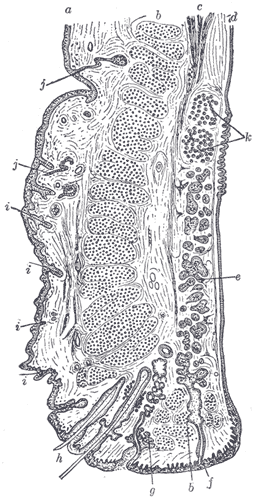
Sagittal section through the upper eyelid.
-
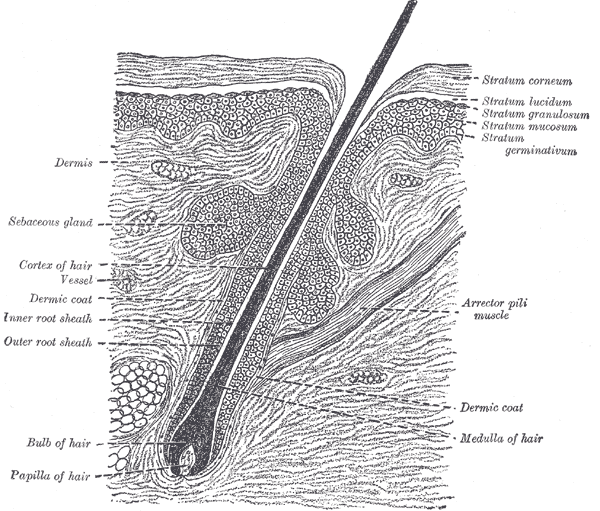
A hair follicle with associated structures.


References
- ↑ Jeffrey B. Cheng and David W. Russell. Mammalian Wax Biosynthesis II: Expression Cloning of Wax Synthase cDNAs Encoding a Member of the Acyltransferase Enzyme Family, J Biol Chem. 2004 Sep 3;279(36):37798-37807. PMID 15220349 Fulltext
- ↑ Abuse Of Anabolic Steroids Causes Acne In Bodybuilders, by Medinda.com
External links
- Histology image: 08801loa – Histology Learning System at Boston University - "Integument: scalp"
da:Talgkirtel de:Talgdrüse it:ghiandola sebacea nl:Talgklier fi:Talirauhanen sv:Talgkörtel sr:Лојнице