Azygos vein
Template:Infobox Vein Editor-In-Chief: C. Michael Gibson, M.S., M.D. [1]
Overview
The azygos vein is a vein running up the right side of the thoracic vertebral column.
Structure
The azygos vein transports deoxygenated blood from the posterior walls of the thorax and abdomen into the superior vena cava vein. The anatomy of this blood vessel can be quite variable. In some rare variations for example, it also drains thoracic veins, bronchial veins and even gonadal veins. The vein is so named because it has no symmetrically equivalent vein on the left side of the body.
It is formed by the union of the ascending lumbar veins with the right subcostal veins at the level of the 12th thoracic vertebra, ascending in the posterior mediastinum, and arching over the root of the right lung to join the superior vena cava. This "arch of the azygos vein" (arcus venae azygou) is an important anatomic landmark.
Its tributaries, apart from its main tributary, the hemiazygos vein, are the bronchial veins, pericardial veins, and posterior right intercostal veins. It communicates with the vertebral venous plexuses.
Azygos venous system
The azygos system of veins is considered to be the azygos vein, along with its left-sided counterparts, the hemiazygos vein and the accessory hemiazygos vein. Together, they form an anastomosis between the superior vena cava to the inferior vena cava.
It can be noted that the azygos system of veins exists because the superior vena cava and the inferior vena cava are not continuous. While the aorta travels downward (continuously) through the mediastinum, supplying blood to the intercostal spaces, the vena cava does not exist at the level of the heart. Thus, the azygos venous system makes up for this deficiency of the venae cavae.
Etymology
The Greek root zyg refers to a pair. 'A-' means not. Thus, azygos means unpaired. The azygos vein is unpaired in that there is only one in the body, mostly on the right side. While there is the hemiazygos vein and its accessory on the left side of the body, they are considered tributaries of the azygos vein rather than its left-side equivalent.
Additional images
-
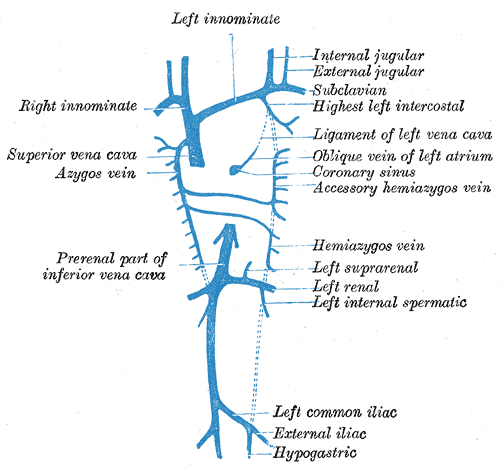 Diagram showing completion of development of the parietal veins.
 -
 Transverse section of thorax, showing relations of pulmonary artery.
 -
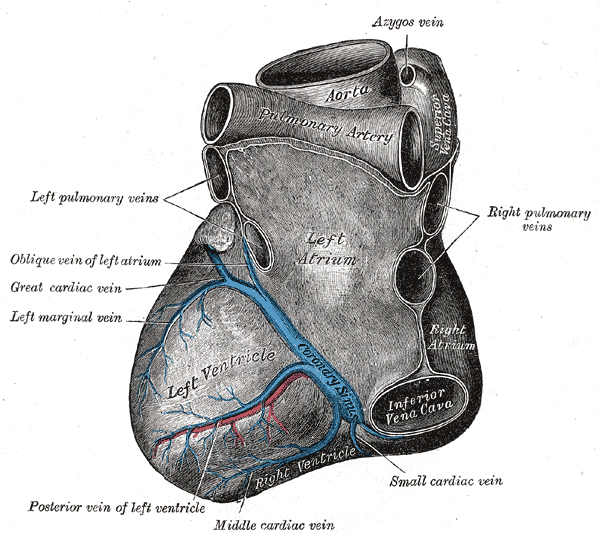 Base and diaphragmatic surface of heart.
 -
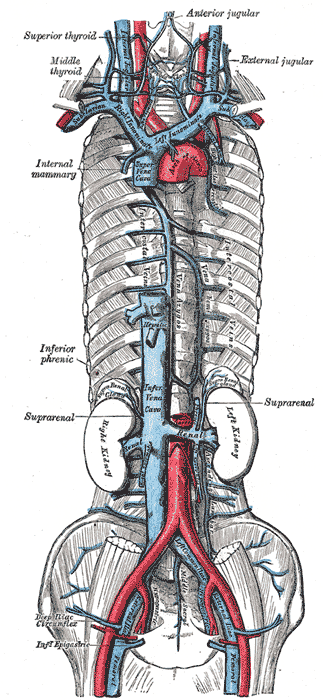 The venæ cavæ and azygos veins, with their tributaries.
 -
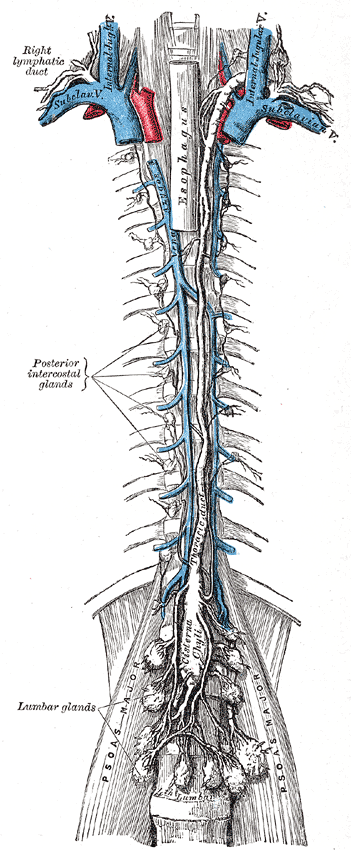 The thoracic and right lymphatic ducts.
 -
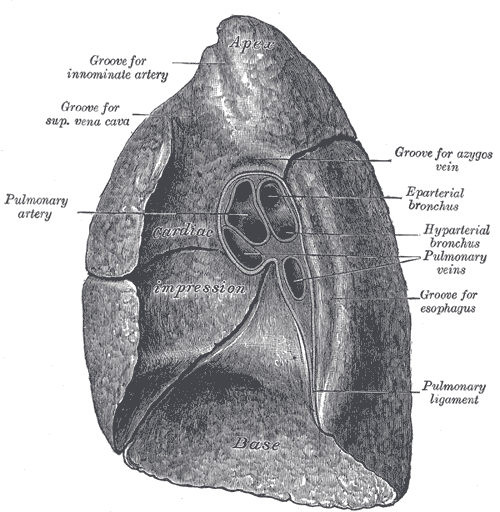 Mediastinal surface of right lung.
 -
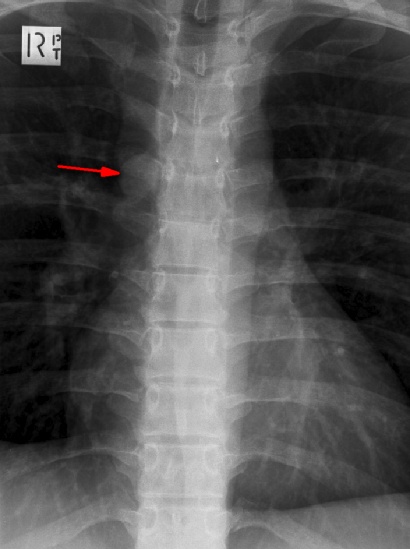 A young patient was involved in a trauma. A supine thoracic spine film demonstrates a rounded opacity in the right mediastinum, just superior to the right main bronchus (arrow). This opacity is a distended azygous vein, and it collapses when the patient is erect (erect chest xray). The azygous vein is a normal structure which may be distended in the supine position, right heart failure, inferior vena cava obstruction, and portosystemic shunting.


See also
External links
- Template:SUNYAnatomyFigs - "Right side of the mediastinum."
- Dissection at lumc.edu
- Radiology at umich.edu