Ascorbic acid (injection)
Editor-In-Chief: C. Michael Gibson, M.S., M.D. [1]; Associate Editor(s)-in-Chief: Ammu Susheela, M.D. [2]
WikiDoc MAKES NO GUARANTEE OF VALIDITY. WikiDoc is not a professional health care provider, nor is it a suitable replacement for a licensed healthcare provider. WikiDoc is intended to be an educational tool, not a tool for any form of healthcare delivery. The educational content on WikiDoc drug pages is based upon the FDA package insert, National Library of Medicine content and practice guidelines / consensus statements. WikiDoc does not promote the administration of any medication or device that is not consistent with its labeling. Please read our full disclaimer here.
Overview
Ascorbic acid (injection) is a vitamin that is FDA approved for the treatment of scurvy. Common adverse reactions include injection site reaction, pain and swelling, diarrhea, iron overload, and nephrolithiasis.
Adult Indications and Dosage
FDA-Labeled Indications and Dosage (Adult)
- Ascorbic acid is recommended for the prevention and treatment of scurvy. Its parenteral administration is desirable for patients with an acute deficiency of ascorbic acid.
- Ascorbic acid is recommended for the prevention and treatment of scurvy. Its parenteral administration is desirable for patients with an acute deficiency or for those whose absorption of orally ingested ascorbic acid is uncertain.
- Symptoms of mild deficiency may include faulty bone and tooth development, gingivitis, bleeding gums, and loosened teeth. Febril states, chronic illness, and infection (pneumonia, whooping cough, tuberculosis, diphtheria, sinusitis, rheumatic fever, etc.) increases the need for ascorbic acid.
- Hemovascular disorders, burns, delayed fracture and wound healing are indications for an increase in the daily intake.
- Ascorbic acid is usually administered orally. When oral administration is not feasible or when malabsorption is suspected, the drug may be administered intramuscularly, intravenously.
- Ascorbic acid is usually administered orally. When oral administration is not feasible or when malabsorption is suspected, the drug may be administered intramuscularly, intravenously or subcutaneously. When given parenterally, utilization of the vitamin reportedly is best after IM administration, which is the preferred parenteral route.
- For intravenous injection, dilution into a large volume parenteral such as Normal Saline or Glucose is recommended to minimize the adverse reactions associated with intravenous injection.
- The average protective dose of ascorbic acid for adults is 70 to 150 mg daily. In the presence of scurvy, doses of 300 mg to 1 gram daily are recommended. However, as much as 6 grams have been administered parenterally to normal adults without evidence of toxicity.
- To enhance wound-healing, doses of 300 to 500 mg daily for a week to ten days, both preoperatively and postoperatively, are generally considered adequate, although considerably larger amounts have been recommended. In the treatment of burns, doses are governed by the extent of tissue injury. For severe burns, daily doses of 1 to 2 grams are recommended. In other conditions in which the need for ascorbic acid is increased, three to five times the daily optimum allowances appear to be adequate.
WARNING
- PRESSURE MAY DEVELOP WITHIN THE VIAL UPON STORAGE.
- Exercise care when withdrawing and/or relieve pressure by first inserting sterile empty syringe into vial thus allowing pressure to equilibrate.
- When using dispensing vials use aseptic technique. Dispense entire contents in aliquots under a laminar flow hood without delay or within 4 hours after entry or discard remaining content after first withdrawal. Prepare stoppers with a suitable antiseptic solution. Do not use unless solution is clear and seal is intact.
- Parenteral drug products should be inspected visually for particulate matter and discoloration prior to administration, whenever the solution and container permit.
Off-Label Use and Dosage (Adult)
Guideline-Supported Use
There is limited information regarding Off-Label Guideline-Supported Use of Ascorbic acid (injection) in adult patients.
Non–Guideline-Supported Use
Pediatric Indications and Dosage
FDA-Labeled Indications and Dosage (Pediatric)
There is limited information regarding FDA-Labeled Use of Ascorbic acid (injection) in pediatric patients.
Off-Label Use and Dosage (Pediatric)
Guideline-Supported Use
There is limited information regarding Off-Label Guideline-Supported Use of Ascorbic acid (injection) in pediatric patients.
Non–Guideline-Supported Use
Contraindications
- There are no contraindications to the administration of ascorbic acid.
Warnings
- Diabetics, patients prone to recurrent renal calculi, those undergoing stool occult blood tests and those on sodium restricted diets or anticoagulant therapy should not take excessive .
- Diabetics, patients prone to recurrent renal calculi, those undergoing stool occult blood tests and those on sodium restricted diets or anticoagulant therapy should not take excessive doses of ascorbic acid over an extended period of time.
Adverse Reactions
Clinical Trials Experience
There is limited information regarding Clinical Trial Experience of Ascorbic acid (injection) in the drug label.
Postmarketing Experience
- Transient mild soreness may occur at the site of [intramuscular]] or subcutaneous injection. Too-rapid intravenous administration of the solution may cause temporary faintness or dizziness.
- Transient mild soreness may occur at the site of intramuscular or subcutaneous injection. Too-rapid intravenous administration of the solution may cause temporary faintness or dizziness.
Drug Interactions
Use in Specific Populations
Pregnancy
- Animal reproduction studies have not been conducted with Ascorbic Acid Injection. It is also not known whether Ascorbic Acid Injection can cause fetal harm when administered to a pregnant woman or can affect reproduction capacity. Ascorbic Acid Injection should be given to a pregnant woman only if clearly needed.
- Australian Drug Evaluation Committee (ADEC) Pregnancy Category
There is no Australian Drug Evaluation Committee (ADEC) guidance on usage of Ascorbic acid (injection) in women who are pregnant.
Labor and Delivery
There is no FDA guidance on use of Ascorbic acid (injection) during labor and delivery.
Nursing Mothers
Caution should be exercised when Ascorbic Acid Injection is administered to a nursing woman.
Pediatric Use
There is no FDA guidance on the use of Ascorbic acid (injection) with respect to pediatric patients.
Geriatic Use
There is no FDA guidance on the use of Ascorbic acid (injection) with respect to geriatric patients.
Gender
There is no FDA guidance on the use of Ascorbic acid (injection) with respect to specific gender populations.
Race
There is no FDA guidance on the use of Ascorbic acid (injection) with respect to specific racial populations.
Renal Impairment
There is no FDA guidance on the use of Ascorbic acid (injection) in patients with renal impairment.
Hepatic Impairment
There is no FDA guidance on the use of Ascorbic acid (injection) in patients with hepatic impairment.
Females of Reproductive Potential and Males
There is no FDA guidance on the use of Ascorbic acid (injection) in women of reproductive potentials and males.
Immunocompromised Patients
There is no FDA guidance one the use of Ascorbic acid (injection) in patients who are immunocompromised.
Administration and Monitoring
Administration
Monitoring
There is limited information regarding Monitoring of Ascorbic acid (injection) in the drug label.
IV Compatibility
There is limited information regarding IV Compatibility of Ascorbic acid (injection) in the drug label.
Overdosage
There is limited information regarding Chronic Overdose of Ascorbic acid (injection) in the drug label.
Pharmacology


Mechanism of Action
There is limited information regarding Ascorbic acid (injection) Mechanism of Action in the drug label.
Structure
- Ascorbic Acid (vitamin C) is a water-soluble vitamin. It occurs as a white or slightly yellow crystal or powder with a light acidic taste. It is an antiscorbutic product.
- Ascorbic Acid (vitamin C) is a water-soluble vitamin. It occurs as a white or slightly yellow crystal or powder with a light acidic taste. It is an antiscorbutic product. On exposure to air and light it gradually darkens. In the dry state it is reasonably stable in air, but in solution it rapidly oxidizes. Ascorbic Acid is freely soluble in water; sparingly soluble in alcohol; insoluble in chloroform, ether, and benzene.
- The chemical name of Ascorbic Acid is L-ascorbic acid. The molecular formula is C6H806 and the molecular weight is 176.13. The structural formula is as follows:
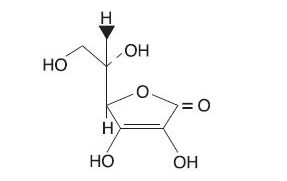
This image is provided by the National Library of Medicine.

- Ascorbic Acid injection is a clear, colorless to slightly yellow sterile solution of Ascorbic Acid in Water for Injection, for intravenous, intramuscular or subcutaneous use. Each ml contains: Ascorbic Acid 500 mg, Disodium Edetate 0.25 mg, Sodium Hydroxide 110 mg, in Water for Injection q.s. pH (range 5.5 to 7.0) adjusted with Sodium Bicarbonate and Sodium Hydroxide. Contains no preservatives.
Pharmacodynamics
- In humans, an exogenous source of ascorbic acid is required for collagen formulation and tissue repair. Ascorbic acid is reversibly oxidized to dehydroascorbic acid in the body. These two ...
- In humans, an exogenous source of ascorbic acid is required for collagen formulation and tissue repair. Ascorbic acid is reversibly oxidized to dehydroascorbic acid in the body. These two forms of the vitamin are believed to be important in oxidation-reduction reactions. The vitamin is involved in tyrosine metabolism, conversion of folic acid to folinic acid, carbohydrate metabolism, synthesis of lipids and proteins, iron metabolism, resistance to infections, and cellular respiration.
- Ascorbic acid deficiency results in scurvy. Collagenous structures are primarily affected, lesions develop in bones and blood vessels. Administration of ascorbic acid completely reverses the symptoms of ascorbic acid deficiency.
Pharmacokinetics
There is limited information regarding Pharmacokinetics of Ascorbic acid (injection) in the drug label.
Nonclinical Toxicology
There is limited information regarding Nonclinical Toxicology of Ascorbic acid (injection) in the drug label.
Clinical Studies
There is limited information regarding Clinical Studies of Ascorbic acid (injection) in the drug label.
How Supplied
- Ascorbic Acid for Injection USP, 500 mg/mL, is available in: Mylan Institutional LLC - NDC 67457-118-50 - carton containing a 50 mL sterile dispensing vial, individually packaged ...
Ascorbic Acid for Injection USP, 500 mg/mL, is available in:Mylan Institutional LLC NDC 67457-118-50 carton containing a 50 mL sterile dispensing vial, individually packaged NOVAPLUS® NDC 67457-303-50 carton containing a 50 mL sterile dispensing vial, individually packaged
Storage
- PROTECT FROM LIGHT. STORE IN CARTON UNTIL TIME OF USE. Store - between 2° to 8°C (36° to 46°F).
- PROTECT FROM LIGHT. STORE IN CARTON UNTIL TIME OF USE.
- Store between 2° to 8°C (36° to 46°F).
Images
Drug Images
{{#ask: Page Name::Ascorbic acid (injection) |?Pill Name |?Drug Name |?Pill Ingred |?Pill Imprint |?Pill Dosage |?Pill Color |?Pill Shape |?Pill Size (mm) |?Pill Scoring |?NDC |?Drug Author |format=template |template=DrugPageImages |mainlabel=- |sort=Pill Name }}
Package and Label Display Panel


{{#ask: Label Page::Ascorbic acid (injection) |?Label Name |format=template |template=DrugLabelImages |mainlabel=- |sort=Label Page }}
Patient Counseling Information
There is limited information regarding Patient Counseling Information of Ascorbic acid (injection) in the drug label.
Precautions with Alcohol
- Alcohol-Ascorbic acid (injection) interaction has not been established. Talk to your doctor about the effects of taking alcohol with this medication.
Brand Names
- ASCORBIC ACID®[3]
Look-Alike Drug Names
There is limited information regarding Ascorbic acid (injection) Look-Alike Drug Names in the drug label.
Price
References
The contents of this FDA label are provided by the National Library of Medicine.
- ↑ Kawai K, Msamanga G, Manji K, Villamor E, Bosch RJ, Hertzmark E; et al. (2010). "Sex differences in the effects of maternal vitamin supplements on mortality and morbidity among children born to HIV-infected women in Tanzania". Br J Nutr. 103 (12): 1784–91. doi:10.1017/S0007114509993862. PMC 3099235. PMID 20211040.
- ↑ 2.0 2.1 Davidsson L, Tanumihardjo S (2011). "New frontiers in science and technology: nuclear techniques in nutrition". Am J Clin Nutr. 94 (2): 691S–5S. doi:10.3945/ajcn.110.005819. PMC 3142739. PMID 21653797.
- ↑ "ASCORBIC ACID- ascorbic acid injection, solution".