Anterior fascial compartment of thigh
You don't need to be Editor-In-Chief to add or edit content to WikiDoc. You can begin to add to or edit text on this WikiDoc page by clicking on the edit button at the top of this page. Next enter or edit the information that you would like to appear here. Once you are done editing, scroll down and click the Save page button at the bottom of the page.
| Anterior fascial compartment of thigh | |
|---|---|
| Cross-section through the middle of the thigh. (Anterior compartment is at upper left.) | |
| Gray's | subject #128 468 |
| Artery | femoral artery |
| Nerve | femoral nerve |
Please Take Over This Page and Apply to be Editor-In-Chief for this topic: There can be one or more than one Editor-In-Chief. You may also apply to be an Associate Editor-In-Chief of one of the subtopics below. Please mail us [1] to indicate your interest in serving either as an Editor-In-Chief of the entire topic or as an Associate Editor-In-Chief for a subtopic. Please be sure to attach your CV and or biographical sketch.
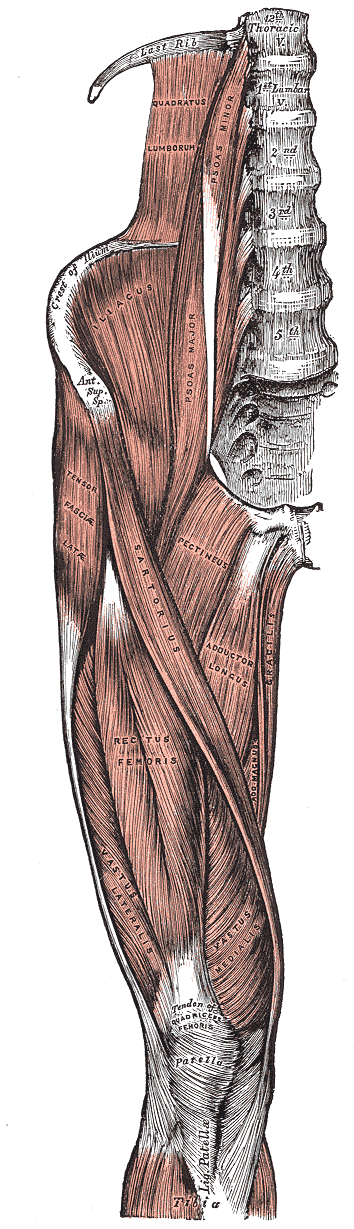
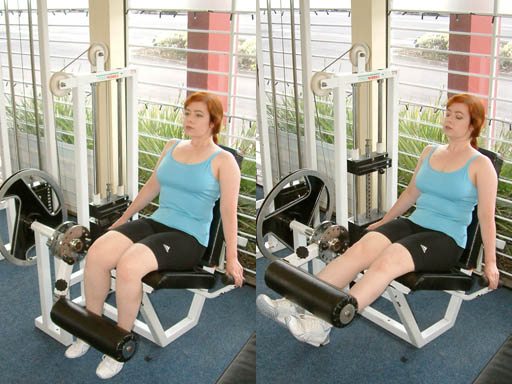
The anterior fascial compartment of thigh contains the knee extensors and hip flexors.
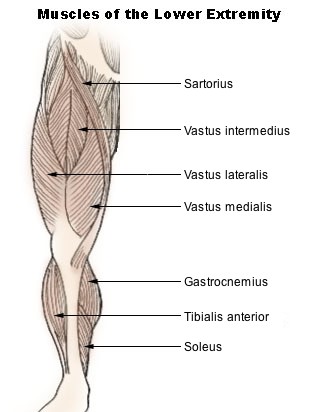
It contains the following five muscles:[1]
- sartorius (the longest muscle in the human body)
- quadriceps (rectus femoris, vastus lateralis, vastus intermedius, vastus medialis)
The articularis genu is sometimes included in this group.[2]
The iliopsoas is sometimes considered a member of this group;[3][2] however, the psoas portions do not share the same innervation.
Additional images
References
- ↑ Sauerland, Eberhardt K.; Patrick W., PhD. Tank; Tank, Patrick W. (2005). Grant's dissector. Hagerstwon, MD: Lippincott Williams & Wilkins, 125. ISBN 0-7817-5484-4.
- ↑ 2.0 2.1 Summary of Lower Limb. Retrieved on 2008-01-27.
- ↑ Ellis, Harold; Susan Standring; Gray, Henry David (2005). Gray's anatomy: the anatomical basis of clinical practice. St. Louis, Mo: Elsevier Churchill Livingstone, 518. ISBN 0-443-07168-3.
External links
Acknowledgement and Attribution Regarding Sources of Content
Some of the initial content on this page may be incorporated in part from copyleft sources in the public domain including wikis such as Wikipedia and AskDrWiki. Drug information for patients came from the The National Library of Medicine. Infectious disease information may have come from the Centers for Disease Control (CDC). Differential Diagnoses are drawn from clinicians as well as an amalgamation of 3 sources: 1.The Disease Database; 2. Kahan, Scott, Smith, Ellen G. In A Page: Signs and Symptoms. Malden, Massachusetts: Blackwell Publishing, 2004:3; 3. Sailer, Christian, Wasner, Susanne. Differential Diagnosis Pocket. Hermosa Beach, CA: Borm Bruckmeir Publishing LLC, 2002:7 .