Pancreatic bud
Overview
|
WikiDoc Resources for Pancreatic bud |
|
Articles |
|---|
|
Most recent articles on Pancreatic bud Most cited articles on Pancreatic bud |
|
Media |
|
Powerpoint slides on Pancreatic bud |
|
Evidence Based Medicine |
|
Clinical Trials |
|
Ongoing Trials on Pancreatic bud at Clinical Trials.gov Trial results on Pancreatic bud Clinical Trials on Pancreatic bud at Google
|
|
Guidelines / Policies / Govt |
|
US National Guidelines Clearinghouse on Pancreatic bud NICE Guidance on Pancreatic bud
|
|
Books |
|
News |
|
Commentary |
|
Definitions |
|
Patient Resources / Community |
|
Patient resources on Pancreatic bud Discussion groups on Pancreatic bud Patient Handouts on Pancreatic bud Directions to Hospitals Treating Pancreatic bud Risk calculators and risk factors for Pancreatic bud
|
|
Healthcare Provider Resources |
|
Causes & Risk Factors for Pancreatic bud |
|
Continuing Medical Education (CME) |
|
International |
|
|
|
Business |
|
Experimental / Informatics |
The ventral and dorsal pancreatic buds (or pancreatic diverticula) are outgrowths of the duodenum during human embryogenesis. They join together to form the adult pancreas.
Additional images
-
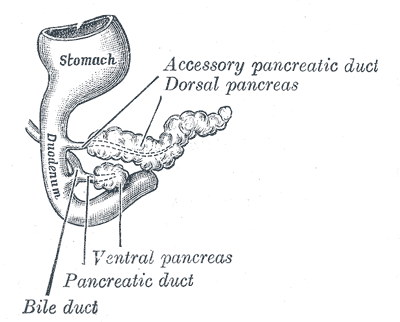 Pancreas of a human embryo of five weeks.
 -
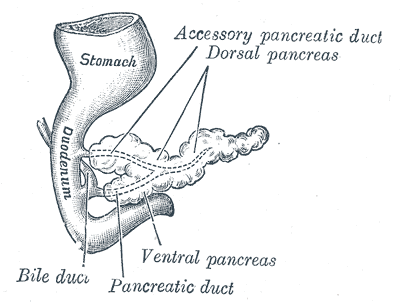 Pancreas of a human embryo at end of sixth week.


External links
- Template:EmbryologyUNC
- Template:EmbryologyUNSW
- Template:EmbryologySwiss
- http://anatomy.med.umich.edu/modules/peritoneal_dev_module/peritoneal_07.html
Template:Development of digestive system Template:WH Template:WikiDoc Sources