Triceps brachii muscle
Editor-In-Chief: C. Michael Gibson, M.S., M.D. [1]
The triceps brachii muscle is often simply called the triceps (both singular and plural). However, the term triceps (Latin for "three-headed") can mean any skeletal muscle having three origins.
Origin and insertion
The three heads have the following names and insertions:
- The "Long head": infraglenoid tubercle of the scapula
- The "Lateral head": posterior shaft of the humerus, lateral and superior to the radial (spiral) groove.
- The "Medial head": posterior shaft of the humerus, medial and inferior to the radial (spiral) groove.
The fibres converge to a single tendon to insert onto the olecranon process of the ulna. The triceps is an extensor muscle, unlike the biceps, which is a flexor muscle. Many mammals have a fourth head, the "Accessory head", which is between the Lateral and Medial heads.
Exercises that build the triceps
The triceps accounts for approximately 70 percent of the upper arm's muscle mass, but people who exercise the arms with weights often neglect this group of muscles in favor of the biceps brachii.
The triceps can be worked through either isolation elbow extension movements, contract statically to keep the arm straightened against resistance, or compound pressing movements.
Isolation movements include cable push-downs, "skull-crushers", and arm extensions behind the back.
Static contraction movements are pullovers, straight-arm pulldowns, and bent-over lateral raises, which are also used to build the rear deltoids and latissimus dorsi.
Examples of pressing movements are press ups, bench presses (level, incline or decline), military presses and dips. Using a closer grip stabilizes the arm allowing more weight to be used, so the triceps can be worked harder without being limited by the strength of the pectorals or shoulders.
Elbow extension is important to many athletic activities. As biceps are often worked more for aesthetic purposes, this is usually a mistake for fitness training. While it is important to maintain a balance between the biceps and triceps for postural & effective movement purposes, what the balance should be and how to measure it is a conflicted area. Pushing and pulling movements on the same plane are often used to measure this ratio.
Additional images
-
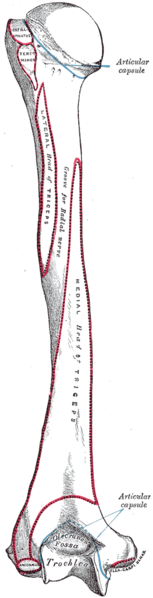 Left humerus. Posterior view.
 -
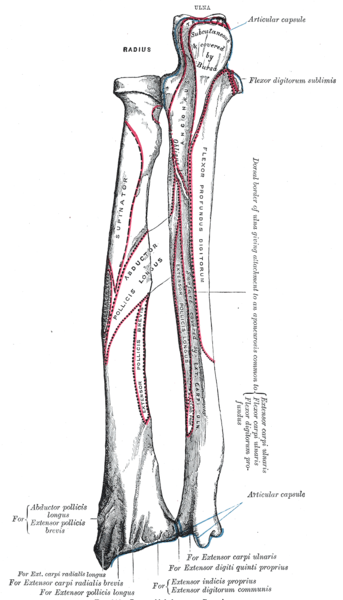 Bones of left forearm. Posterior aspect.
 -
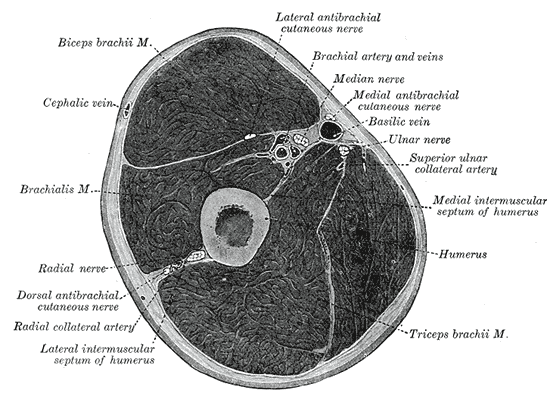 Cross-section through the middle of upper arm.
 -
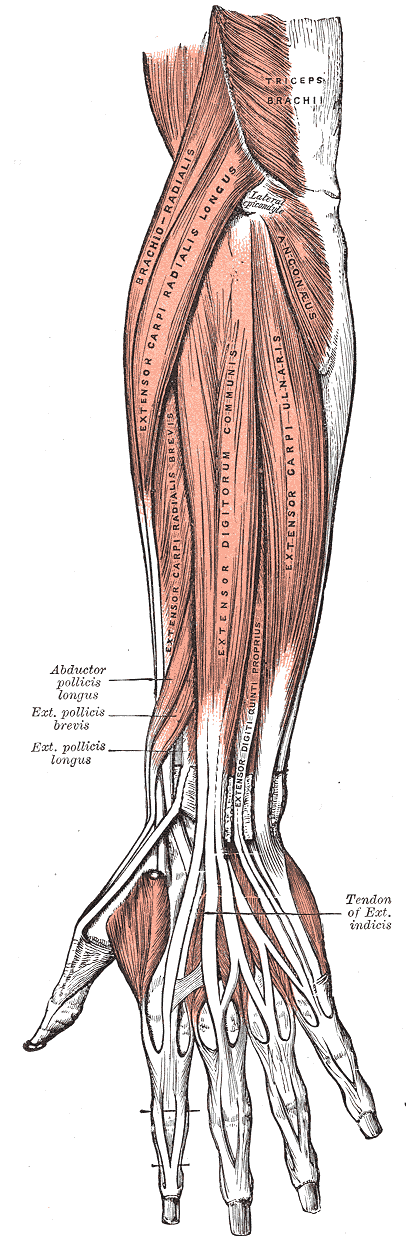 Posterior surface of the forearm. Superficial muscles.
 -
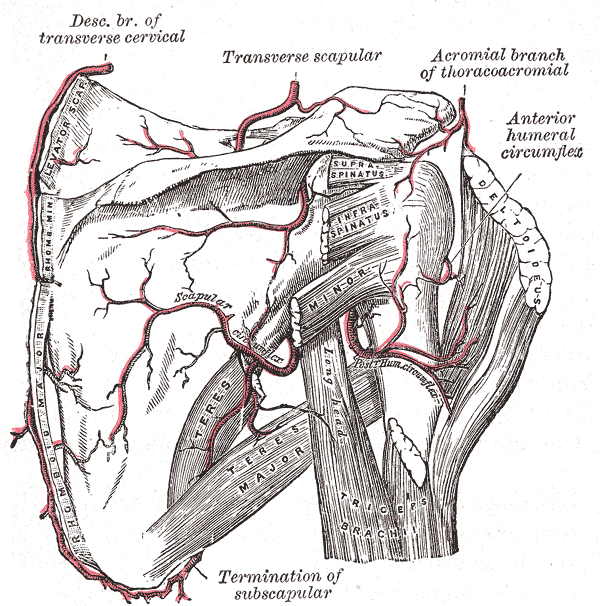 The scapular and circumflex arteries.
 -
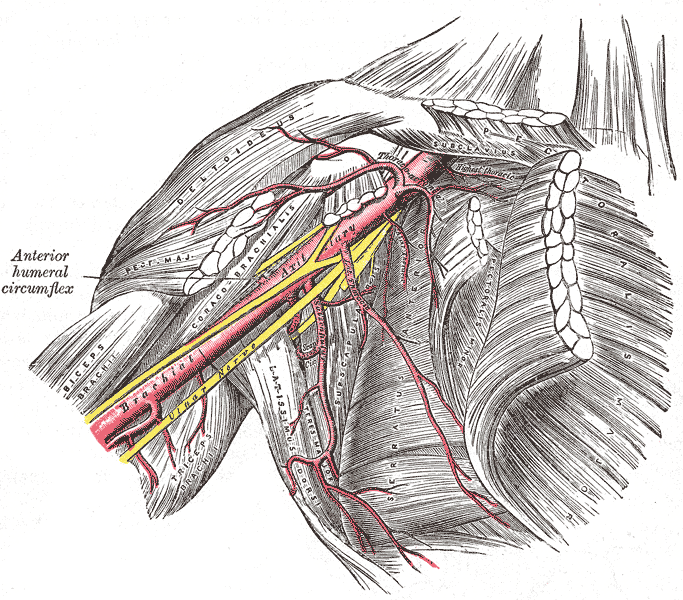 The axillary artery and its branches.
 -
 The brachial artery.
 -
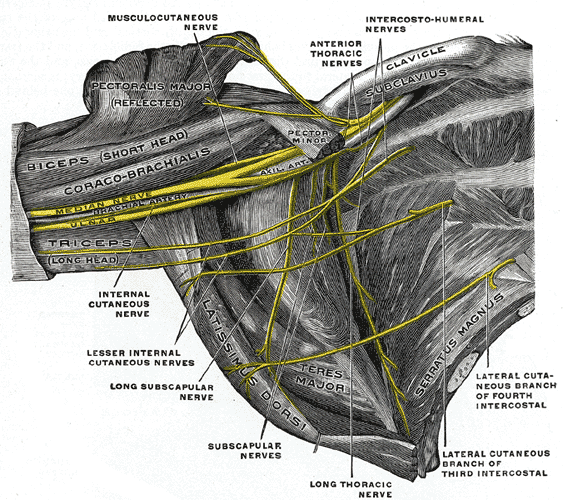 The right brachial plexus (infraclavicular portion) in the axillary fossa; viewed from below and in front.
 -
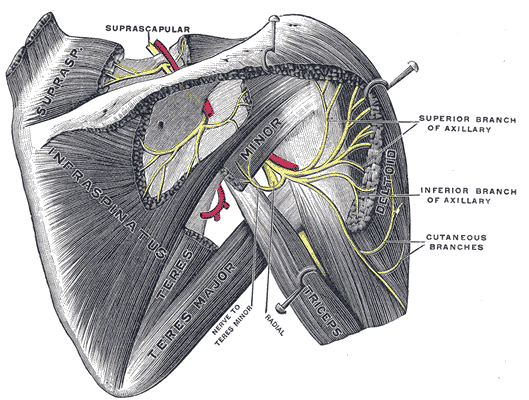 Suprascapular and axillary nerves of right side, seen from behind.
 -
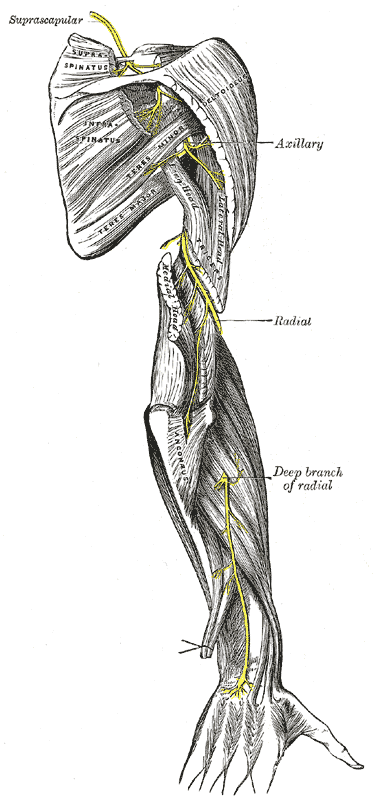 The suprascapular, axillary, and radial nerves.


References
- Madsen M, Marx R, Millett P, Rodeo S, Sperling J, Warren R (2006). "Surgical anatomy of the triceps brachii tendon: anatomical study and clinical correlation". Am J Sports Med. 34 (11): 1839–43. PMID 16735585.
External links
- Template:MuscleLoyola
- Template:MuscleUWash
- Template:GPnotebook
- Template:SUNYAnatomyLabs
- Photo at ithaca.edu
- Triceps exercise
- Template:Exrx
- Triceps workouts

Template:Muscles of upper limb
ca:Tríceps braquial cs:Trojhlavý sval pažní de:Triceps brachii id:Otot triceps brachii it:Tricipite brachiale he:שריר הזרוע התלת ראשי nl:Musculus triceps brachii fi:Ojentaja sv:Triceps brachii