Sassafras
| Sassafras | ||||||||||||
|---|---|---|---|---|---|---|---|---|---|---|---|---|
| Sassafras albidum, Wanaque, New Jersey Sassafras albidum,
Wanaque, New Jersey | ||||||||||||
| Scientific classification | ||||||||||||
| ||||||||||||
| Species | ||||||||||||
|
See text |

Sassafras is a genus of three species of deciduous trees in the family Lauraceae, native to eastern North America and eastern Asia.[1]
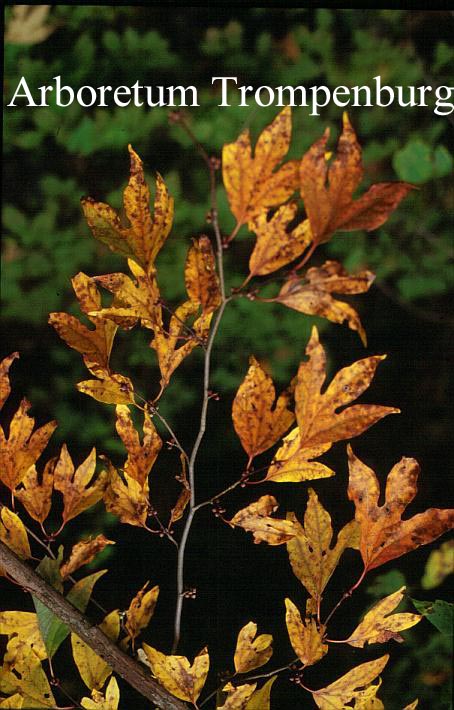
Sassafras trees grow from 15-35 m (50-120 feet) tall and 70-150 cm (2.5-6 feet) in diameter, with many slender branches, and smooth, orange-brown bark. The branching is sympodial. The bark of the mature trunk is thick, red-brown, and deeply furrowed. The wood is light, soft, weak, and brittle. All parts of the plants are very fragrant. The species are unusual in having three distinct leaf patterns on the same plant, unlobed oval, bilobed (mitten-shaped), and trilobed (three pronged; rarely the leaves can be five-lobed[2]). They have smooth margins and grow 7-20 cm long by 5-10 cm broad. The young leaves and twigs are quite mucilaginous, and produce a scent similar to lemons when crushed. The tiny, yellow flowers are five-petaled and bloom in the spring; they are dioecious, with male and female flowers on separate trees. The fruit are blue-black, egg-shaped, 1 cm long, produced on long, red-stalked cups, and mature in late summer.[3]
The name "Sassafras", applied by the botanist Nicolas Monardes in the sixteenth century, is said to be a corruption of the Spanish word for saxifrage.
Species
- Sassafras albidum (Nuttall) Nees - Sassafras, White Sassafras, Red Sassafras or Silky Sassafras. Eastern North America, from southernmost Ontario, Canada through the eastern United States south to central Florida, and west to southern Iowa and eastern Texas.
- Sassafras tzumu (Hemsl.) Hemsl. - Chinese Sassafras or Tzumu. Central and southwestern China. It differs from S. albidum in the leaves being more frequently three-lobed,[4] the lobes having a tapered acuminate apex (not rounded to weakly acute).
- Sassafras randaiense (Hayata) Rehd. - Taiwan Sassafras. Taiwan. Treated by some botanists in a distinct genus as Yushunia randaiensis (Hayata) Kamikoti,[5] though this is not supported by recent genetic evidence which shows the genus to be monophyletic.[1]
Uses
Essential oil distilled from the root-bark or the fruit was used as a fragrance in perfumes and soaps, food (sassafras tea and candy flavoring) and for aromatherapy.
The dried and ground leaves are used to make filé powder, a spice used in the making of some types of gumbo.
References
- ↑ 1.0 1.1 Nie, Z.-L., Wen, J. & Sun, H. (2007). Phylogeny and biogeography of Sassafras (Lauraceae) disjunct between eastern Asia and eastern North America. Plant Systematics and Evolution 267: 191-203 Abstract.
- ↑ Noble Plant Image Gallery Sassafras (includes photo of five-lobed leaf)
- ↑ Flora of North America: Sassafras
- ↑ Arboretum Trompenburg: Sassafras tzumu photo
- ↑ Kamikoti, S. (1933). Ann. Rep. Taihoku Bot. Gard. 3: 78