Raphe nuclei
|
WikiDoc Resources for Raphe nuclei |
|
Articles |
|---|
|
Most recent articles on Raphe nuclei Most cited articles on Raphe nuclei |
|
Media |
|
Powerpoint slides on Raphe nuclei |
|
Evidence Based Medicine |
|
Clinical Trials |
|
Ongoing Trials on Raphe nuclei at Clinical Trials.gov Clinical Trials on Raphe nuclei at Google
|
|
Guidelines / Policies / Govt |
|
US National Guidelines Clearinghouse on Raphe nuclei
|
|
Books |
|
News |
|
Commentary |
|
Definitions |
|
Patient Resources / Community |
|
Patient resources on Raphe nuclei Discussion groups on Raphe nuclei Patient Handouts on Raphe nuclei Directions to Hospitals Treating Raphe nuclei Risk calculators and risk factors for Raphe nuclei
|
|
Healthcare Provider Resources |
|
Causes & Risk Factors for Raphe nuclei |
|
Continuing Medical Education (CME) |
|
International |
|
|
|
Business |
|
Experimental / Informatics |
Overview
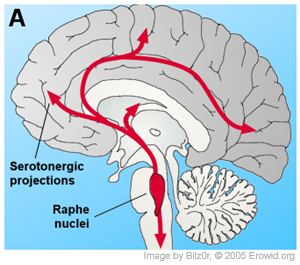
The raphe nuclei (Latin for 'the bit in a fold or seam') is a moderate-size cluster of nuclei found in the brain stem, and releases serotonin to the rest of the brain.[1] Selective serotonin reuptake inhibitor (SSRI) antidepressants are believed to act in these nuclei, as well as at their targets [2].
Anatomy
The raphe nuclei are traditionally considered to be the medial portion of the reticular formation, and they appear as a ridge of cells in the center and most medial portion of the brain stem.
In order from caudal to rostral, the raphe nuclei are known as the nucleus raphe obscurus, the raphe magnus, the raphe pontis, the raphe pallidus, the nucleus centralis superior, nucleus raphe dorsalis, nuclei linearis intermedius and linearis rostralis.[3] Some scientists chose to group the linearis nuclei into one nucleus, shrinking the number of raphe to seven, e.g., NeuroNames makes the following ordering:[4]
- Raphe nuclei of medulla
- Nucleus raphe obscurus (nucleus raphe obscurus)
- Nucleus raphe magnus (raphe magnus)
- Nucleus pallidus (raphe pallidus)
- Raphe nuclei of the pontine reticular formation
- Pontine raphe nucleus (raphe pontis)
- Inferior central nucleus
- Raphe nuclei of the midbrain reticular formation
- Superior central nucleus (nucleus centralis superior)
- Dorsal raphe nucleus (nucleus raphe dorsalis)
Projections
All of these nuclei have fascinating interactions with almost every pertinent portion of the brain, but only a few of them have specifically independent interaction worth exploring in their own right. These select nuclei are discussed as follows.
Overall, the caudal raphe nuclei, including the raphe magnus, pallidus and raphe obscurus, all project towards the spinal cord and brain stem. The more-rostral nuclei, including the raphe pontis, centralis (also called median), dorsal, tend to project towards the brain areas of higher function.[5]
The 8 raphe nuclei receive afferent connections from some of the most fascinating spots in the brain, only to project back to them and alter their processes.
Function
The raphe nuclei have a vast impact upon the central nervous system. The raphe nuclei can be of particular interest to neurologists and psychologists since many of the neurons in the nuclei (but not the majority) are serotonergic, i.e., contain serotonin - a type of monoamine neurotransmitter. Serotonin, also called 5-HT, seems to be the culprit in many of our modern psycho-pharmaceutical problems, such as anorexia, depression, and sleep disorders. It is not the sole culprit in the aforementioned disorders, but it is the area that the pharmacologists know how to affect in the best manner. It is important to note that pharmacology traditionally affects global serotonin levels, while the actions of the raphe nuclei are dependent on the complex interplay between nuclei.
Further reading
- Currie, David (2005). "A Lecture, Higher Brain Function: Activation of the Brain and Levels of Consciousness". East Tennessee State University. Retrieved April 18. Unknown parameter
|accessyear=ignored (|access-date=suggested) (help); Check date values in:|accessdate=(help) - Sari, Youssef (2004). "Serotonin1B receptors: from protein to physiological function and behavior". Neuroscience & Biobehavioral Reviews. 28 (6): 565&ndash, 582. doi:10.1016/j.neubiorev.2004.08.008. Retrieved 2006-04-18. Unknown parameter
|month=ignored (help)
References
- ↑ George J. Siegel, ed. (1999). "Understanding the neuroanatomical organization of serotonergic cells in brain provides insight into the functions of this neurotransmitter". Basic Neurochemistry. Bernard W. Agranoff, Stephen K. Fisher, R. Wayne Albers, Michael D. Uhler (Sixth ed.). Lippincott Williams and Wilkins. ISBN 0-397-51820-X.
In 1964, Dahlstrom and Fuxe (discussed in [2]), using the Falck-Hillarp technique of histofluorescence, observed that the majority of serotonergic soma are found in cell body groups, which previously had been designated as the raphe nuclei.
- ↑ Briley, M (1993). ["Neurobiological mechanisms involved in antidepressant therapies" Check
|url=value (help). Clin Neuropharmacol. 16 (5): 387&ndash, 400. Unknown parameter|month=ignored (help) - ↑ "Fig. 5. The midsagittal section of the brain stem indicating the position of the raphe nuclei" (GIF). 1998. Retrieved 18 April. Unknown parameter
|accessyear=ignored (|access-date=suggested) (help); Check date values in:|accessdate=(help) - ↑ Template:BrainInfo
- ↑ BilZ0r (2005). "Figure 4. Diagram of the human brain showing the divergent serotonergic projections of the raphe nuclei to both cortical and subcortical locations throughout the brain" (PNG). The Neuropharmacology of Hallucinogens: a technical overview. Erowid Pharmacology Vaults. Retrieved April 18. Unknown parameter
|accessyear=ignored (|access-date=suggested) (help); Unknown parameter|coauthors=ignored (help); Check date values in:|accessdate=(help)