Granulocyte
|
WikiDoc Resources for Granulocyte |
|
Articles |
|---|
|
Most recent articles on Granulocyte Most cited articles on Granulocyte |
|
Media |
|
Powerpoint slides on Granulocyte |
|
Evidence Based Medicine |
|
Clinical Trials |
|
Ongoing Trials on Granulocyte at Clinical Trials.gov Clinical Trials on Granulocyte at Google
|
|
Guidelines / Policies / Govt |
|
US National Guidelines Clearinghouse on Granulocyte
|
|
Books |
|
News |
|
Commentary |
|
Definitions |
|
Patient Resources / Community |
|
Patient resources on Granulocyte Discussion groups on Granulocyte Patient Handouts on Granulocyte Directions to Hospitals Treating Granulocyte Risk calculators and risk factors for Granulocyte
|
|
Healthcare Provider Resources |
|
Causes & Risk Factors for Granulocyte |
|
Continuing Medical Education (CME) |
|
International |
|
|
|
Business |
|
Experimental / Informatics |
Editor-In-Chief: C. Michael Gibson, M.S., M.D. [1]
Overview
Granulocytes are a category of white blood cells characterised by the presence of granules in their cytoplasm.[1] They are also called polymorphonuclear leukocytes (PMN or PML) because of the varying shapes of the nucleus, which is usually lobed into three segments. In common parlance, the term polymorphonuclear leukocyte often refers specifically to neutrophil granulocytes,[2] the most abundant of the granulocytes. Granulocytes or PMN are released from the bone marrow by the regulatory complement proteins.
Classification
There are three types of granulocytes, distinguished by their appearance under Wright's stain:
-
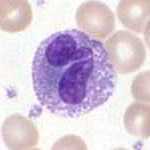
Eosinophil granulocyte
-
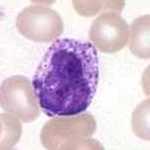
Basophil granulocyte


Their names are derived from their staining characteristics; for example, the most abundant granulocyte is the neutrophil granulocyte, which has neutrally-staining cytoplasmic granules.
Other white blood cells which are not granulocytes ("agranulocytes") are mainly lymphocytes and monocytes.
Toxic materials produced or released
Examples of toxic materials produced or released by degranulation by granulocytes on the ingestion of microorganism includes:
- Low pH vesicles (3.5~4.0)
- Toxic oxygen-derived products (e.g. superoxide, hydrogen peroxide, hydroxy radicals, singlet oxygen, hypohalite)
- Toxic nitrogen oxides (nitric oxide)
- Antimicrobial agents (Defensins and cationic proteins)
- Enzymes (Lysozyme- dissolves cell walls of some gram positive bacteria, acid hydrolases- further digest bacteria).
Pathology
Granulocytopenia is an abnormally low concentration of granulocytes in the blood. This condition reduces the body's resistance to many infections. Closely-related terms include agranulocytosis and neutropenia.
A granuloma is a tumor containing granulocytes, and a "granulomatosis" is a necrotizing granuloma.
There is usually a granulocyte chemotactic defect in individuals who suffer from insulin dependent diabetes mellitus.
Additional images
-
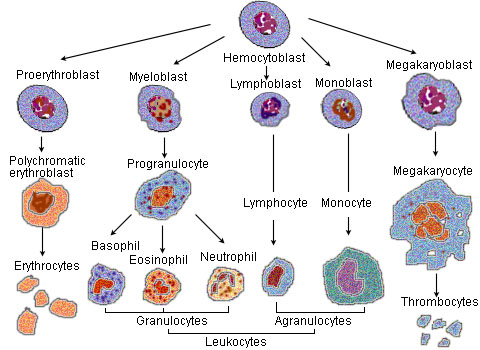
Blood cell lineage
-
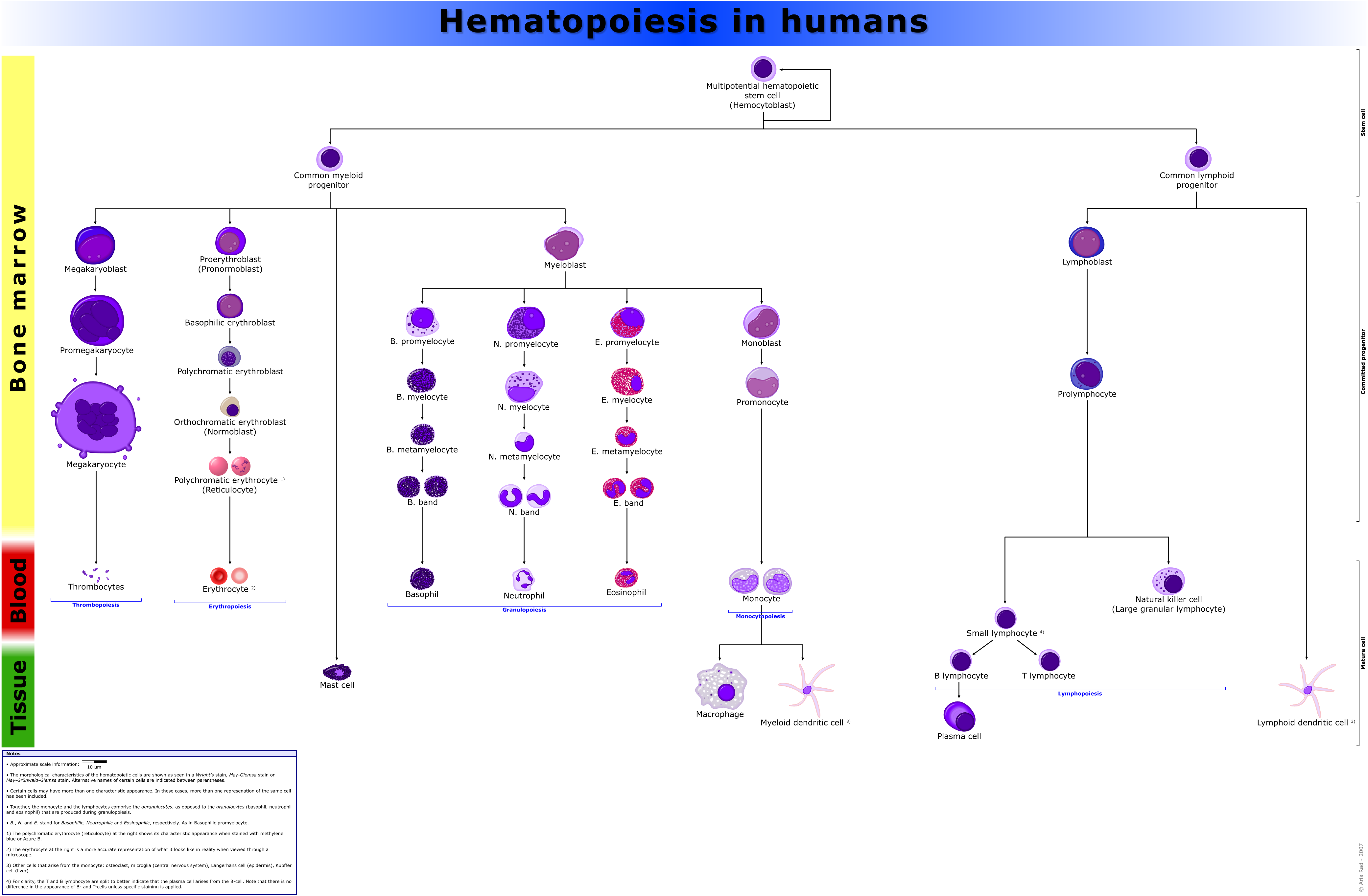
Hematopoiesis

_diagram.png)
See also
External links
- Granulocytes at the US National Library of Medicine Medical Subject Headings (MeSH)