Periaqueductal gray
You don't need to be Editor-In-Chief to add or edit content to WikiDoc. You can begin to add to or edit text on this WikiDoc page by clicking on the edit button at the top of this page. Next enter or edit the information that you would like to appear here. Once you are done editing, scroll down and click the Save page button at the bottom of the page.
| Brain: Periaqueductal gray | ||
|---|---|---|
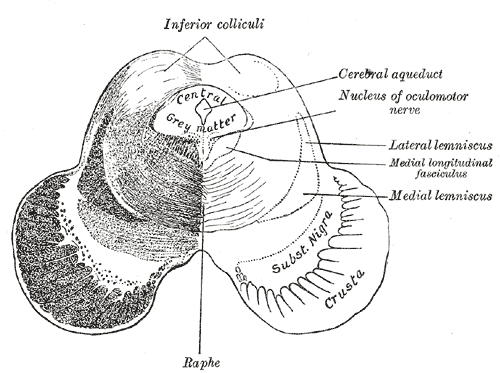
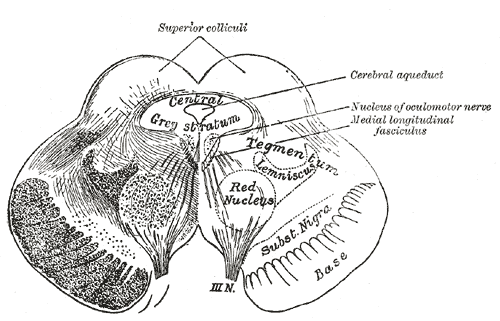
| Section through superior colliculus showing path of oculomotor nerve. Periaqueductal gray is the gray area just peripheral to the cerebral aqueduct.) | ||
| Coronal section through mid-brain. 1. Corpora quadrigemina. 2. Cerebral aqueduct. 3. Central gray stratum. 4. Interpeduncular space. 5. Sulcus lateralis. 6. Substantia nigra. 7. Red nucleus of tegmentum. 8. Oculomotor nerve, with 8’, its nucleus of origin. a. Lemniscus (in blue) with a’ the medial lemniscus and a" the lateral lemniscus. b. Medial longitudinal fasciculus. c. Raphé. d. Temporopontine fibers. e. Portion of medial lemniscus, which runs to the lentiform nucleus and insula. f. Cerebrospinal fibers. g. Frontopontine fibers. | ||
| Latin | s. grisea centralis | |
| Gray's | subject #188 806 | |
| NeuroNames | hier-501 | |
| MeSH | Periaqueductal+Gray | |
| Dorlands/Elsevier | s_27/12766787 | |
Please Take Over This Page and Apply to be Editor-In-Chief for this topic: There can be one or more than one Editor-In-Chief. You may also apply to be an Associate Editor-In-Chief of one of the subtopics below. Please mail us [1] to indicate your interest in serving either as an Editor-In-Chief of the entire topic or as an Associate Editor-In-Chief for a subtopic. Please be sure to attach your CV and or biographical sketch.
Overview
Periaqueductal gray (PAG; also called the "central gray") is the midbrain grey matter that is located around the cerebral aqueduct within the midbrain. It plays a role in the descending modulation of pain and in defensive behaviour. The ascending pain and temperature fibers of the spinothalamic tract also send information to the PAG via the spinomesencephalic tract. The spinomesencephalic tract is so-named because the fibers originate in the spine and terminate in the mesencephalon, another name for the midbrain, which is the part of the brain in which the PAG resides.
Role in Analgesia
Stimulation of the periaqueductal gray matter of the midbrain activates enkephalin releasing neurons that project to the raphe nuclei in the brainstem. 5-HT (serotonin) released from the raphe nuclei descends to the dorsal horn of the spinal cord where it forms excitatory connections with the "inhibitory interneurons" located in Laminae II (aka the substantia gelitanosa). When activated, these interneurons release either enkephalin or dynorphin (endogenous opioid neurotransmitters) which bind to mu opioid receptors* on the axons of incoming C and A-delta fibers carrying pain signals from nociceptors activated in the periphery. The activation of the mu-opioid receptor inhibits the release of substance P from these incoming first order neurons and in turn inhibits the activation of the second order neuron that is responsible for transmitting the pain signal up the spinothalamic tract to the ventroposteriolateral nucleus (VPL) of the thalamus. The nociceptive signal was inhibited before it was able to reach the cortical areas that interpret the signal as "pain" (such as the anterior cingulate). This is sometimes referred to as the Gate control theory of pain and is supported by the fact that electrical stimulation of the PAG results in immediate and profound analgesia.
- Three known kinds of opioid receptors have been identified- mu, kappa, and delta. Synthetic opioid and opioid-derivative drugs activate these receptors (possibly by acting on the PAG directly, where a dense amount of these receptors are expressed) to produce analgesia- including heroin, morphine, vicodin, and similar pain modulating compounds.
Role in defensive behavior
Stimulation of the dorsal and lateral aspects of the PAG [in the rat] can provoke defensive responses characterised by freezing, running, jumping, tachycardia and increases in blood pressure and muscle tonus. Conversely, stimulation of the caudal ventrolateral PAG can result in an immobile, relaxed posture known as quiescence.
Lesions of the caudal ventrolateral PAG can greatly reduce conditioned freezing, while lesions of the dorsal aspect can reduce innate defensive behavior, virtually "taming" the animal.
Role in reproductive behavior
Neurons of the PAG are excited by endorphins and by opiate analgesics. It also plays a role in female copulatory behavior (see Lordosis behavior) via a pathway from the ventromedial nucleus of the hypothalamus.
Additional images
External links
WikiDoc Research Resources for Periaqueductal gray | |
|---|---|
| Articles on Periaqueductal gray | Most recent articles on Periaqueductal gray • Most cited articles on Periaqueductal gray • Review articles on Periaqueductal gray • Articles on Periaqueductal gray in N Eng J Med, Lancet, BMJ |
| Media (Slides, Video, Images, MP3) on Periaqueductal gray | Powerpoint slides on Periaqueductal gray • Images of Periaqueductal gray • Photos of Periaqueductal gray • Podcasts & MP3s on Periaqueductal gray • Videos on Periaqueductal gray |
| Evidence Based Medicine Regarding Periaqueductal gray | Cochrane Collaboration on Periaqueductal gray • Bandolier on Periaqueductal gray • TRIP on Periaqueductal gray |
| Cost Effectiveness of Periaqueductal gray | Cost Effectiveness of Periaqueductal gray |
| Clinical Trials Involving Periaqueductal gray | Ongoing Trials on Periaqueductal gray at Clinical Trials.gov • Trial results on Periaqueductal gray • Clinical Trials on Periaqueductal gray at Google |
| Guidelines / Policies / Government Resources (FDA/CDC) Regarding Periaqueductal gray | US National Guidelines Clearinghouse on Periaqueductal gray • NICE Guidance on Periaqueductal gray • NHS PRODIGY Guidance • FDA on Periaqueductal gray • CDC on Periaqueductal gray |
| Textbook Information on Periaqueductal gray | Books and Textbook Information on Periaqueductal gray |
| Pharmacology Resources on Periaqueductal gray | Dosing of Periaqueductal gray • Drug interactions with Periaqueductal gray • Side effects of Periaqueductal gray • Allergic reactions to Periaqueductal gray • Overdose information on Periaqueductal gray • Carcinogenicity information on Periaqueductal gray • Periaqueductal gray in pregnancy • Pharmacokinetics of Periaqueductal gray • |
| Genetics, Pharmacogenomics, and Proteinomics of Periaqueductal gray | Genetics of Periaqueductal gray • Pharmacogenomics of Periaqueductal gray • Proteomics of Periaqueductal gray |
| Newstories on Periaqueductal gray | Periaqueductal gray in the news • Be alerted to news on Periaqueductal gray • News trends on Periaqueductal gray |
| Commentary on Periaqueductal gray | Blogs on Periaqueductal gray |
| Patient Resources on Periaqueductal gray | Patient resources on Periaqueductal gray • Discussion groups on Periaqueductal gray • Patient Handouts on Periaqueductal gray • Directions to Hospitals Treating Periaqueductal gray • Risk calculators and risk factors for Periaqueductal gray |
| Healthcare Provider Resources on Periaqueductal gray | Symptoms of Periaqueductal gray • Causes & Risk Factors for Periaqueductal gray • Diagnostic studies for Periaqueductal gray • Treatment of Periaqueductal gray |
| Continuing Medical Education (CME) Programs on Periaqueductal gray | CME Programs on Periaqueductal gray |
| International Resources on Periaqueductal gray | Periaqueductal gray en Espanol • Periaqueductal gray en Francais |
| Business Resources on Periaqueductal gray | Periaqueductal gray in the Marketplace • Patents on Periaqueductal gray |
| Informatics Resources on Periaqueductal gray | List of terms related to Periaqueductal gray |
de:Periaquäduktales Graunl:Periaqueductale grijs
| ||||
Acknowledgement and Attribution Regarding Sources of Content
Some of the initial content on this page may be incorporated in part from copyleft sources in the public domain including wikis such as Wikipedia and AskDrWiki. Drug information for patients came from the The National Library of Medicine. Infectious disease information may have come from the Centers for Disease Control (CDC). Differential Diagnoses are drawn from clinicians as well as an amalgamation of 3 sources: 1.The Disease Database; 2. Kahan, Scott, Smith, Ellen G. In A Page: Signs and Symptoms. Malden, Massachusetts: Blackwell Publishing, 2004:3; 3. Sailer, Christian, Wasner, Susanne. Differential Diagnosis Pocket. Hermosa Beach, CA: Borm Bruckmeir Publishing LLC, 2002:7 .