Paronychia
| Paronychia | |
 | |
|---|---|
| Paronychia |
|
WikiDoc Resources for Paronychia |
|
Articles |
|---|
|
Most recent articles on Paronychia |
|
Media |
|
Evidence Based Medicine |
|
Clinical Trials |
|
Ongoing Trials on Paronychia at Clinical Trials.gov Clinical Trials on Paronychia at Google
|
|
Guidelines / Policies / Govt |
|
US National Guidelines Clearinghouse on Paronychia
|
|
Books |
|
News |
|
Commentary |
|
Definitions |
|
Patient Resources / Community |
|
Patient resources on Paronychia Discussion groups on Paronychia Patient Handouts on Paronychia Directions to Hospitals Treating Paronychia Risk calculators and risk factors for Paronychia
|
|
Healthcare Provider Resources |
|
Causes & Risk Factors for Paronychia |
|
Continuing Medical Education (CME) |
|
International |
|
|
|
Business |
|
Experimental / Informatics |
For patient information, click Paronychia
Editor-In-Chief: C. Michael Gibson, M.S., M.D. [1] Associate Editor(s)-in-Chief: Michael Maddaleni, B.S. Luke Rusowicz-Orazem, B.S.
Synonyms and keywords: Felon, Whitlow
Overview
The nail disease paronychia is an often tender bacterial or fungal infection where the nail and skin meet at the side or the base of a finger or toenail. It can start suddenly (acute paronychia) or gradually (chronic paronychia). Despite the small area affected these infections can be extremely painful as the skin becomes inflamed, hot, red, and throbs continually. Pus is usually present, along with gradual thickening and browning discoloration of the nail plate.
Classification
Acute paronychia is usually caused by bacteria. This is often treated with antibiotics, sometimes as a cream, other times orally.
-
![Pyogenic paronychia. Adapted from Dermatology Atlas.[1]](/images/d/df/Pyogenic_paronychia01.jpg)
Pyogenic paronychia. Adapted from Dermatology Atlas.[1]
-
![Pyogenic paronychia. Adapted from Dermatology Atlas.[1]](/images/a/ae/Pyogenic_paronychia02.jpg)
Pyogenic paronychia. Adapted from Dermatology Atlas.[1]
![Pyogenic paronychia. Adapted from Dermatology Atlas.[1]](/index.php/File:Pyogenic_paronychia01.jpg)
![Pyogenic paronychia. Adapted from Dermatology Atlas.[1]](/index.php/File:Pyogenic_paronychia02.jpg)
Chronic paronychia is most often caused by a yeast infection of the soft tissues around the nail but can also be traced to a bacterial infection. If the infection goes on and on then a fungal infection is often the cause and this needs anti-fungal cream or paint to treat it.
Prosector's paronychia is a primary inoculation of tuberculosis of the skin and nails, named after its association with prosectors, who prepare specimens for dissection.
Runaround paronychia is the name sometimes used to refer to paronychia that is around the entire nail.
Pathophysiology
The cuticle acts as a protective seal, but if it is damaged in any way then pathogens are able to enter the skin and cause infection.
Causes
Life Threatening Causes
Common Causes
- Candida albicans
- Excessive immersion of hands in water
- Pseudomonas aeruginosa
- Staphylococcus aureus
- Streptococcus pyogenes
- Trauma
Causes by Organ System
| Cardiovascular | No underlying causes |
| Chemical/Poisoning | No underlying causes |
| Dental | No underlying causes |
| Dermatologic | No underlying causes |
| Drug Side Effect | Afatinib, Indinavir, Isotretinoin, Panitumumab |
| Ear Nose Throat | No underlying causes |
| Endocrine | No underlying causes |
| Environmental | Excessive immersion of hands in water |
| Gastroenterologic | No underlying causes |
| Genetic | No underlying causes |
| Hematologic | No underlying causes |
| Iatrogenic | No underlying causes |
| Infectious Disease | Candida albicans, Eikenella corrodens, Fusobacterium, Herpes simplex, Peptostreptococcus, Porphyromonas spp, Prevotella, Pseudomonas aeruginosa, Staphylococcus aureus, Streptococcus pyogenes, Syphilis |
| Musculoskeletal/Orthopedic | No underlying causes |
| Neurologic | No underlying causes |
| Nutritional/Metabolic | No underlying causes |
| Obstetric/Gynecologic | No underlying causes |
| Oncologic | Acrokeratosis paraneoplastica |
| Ophthalmologic | No underlying causes |
| Overdose/Toxicity | No underlying causes |
| Psychiatric | No underlying causes |
| Pulmonary | No underlying causes |
| Renal/Electrolyte | No underlying causes |
| Rheumatology/Immunology/Allergy | Acrokeratosis paraneoplastica |
| Sexual | Herpes simplex, Syphilis |
| Trauma | Trauma |
| Urologic | No underlying causes |
| Miscellaneous | No underlying causes |
Causes in Alphabetical Order
- Acrokeratosis paraneoplastica
- Afatinib
- Candida albicans
- Eikenella corrodens
- Excessive immersion of hands in water
- Fusobacterium
- Herpes simplex
- Indinavir
- Isotretinoin
- Panitumumab
- Peptostreptococcus
- Porphyromonas spp
- Prevotella
- Pseudomonas aeruginosa
- Staphylococcus aureus
- Streptococcus pyogenes
- Syphilis
- Trauma
Natural History, Complications and Prognosis
Complications are rare, but may include:
- Abscess
- Permanent changes in the shape of the nail
- Spread of infection to tendons, bones, or bloodstream
The prognosis for paronychia is good because it usually responds well to treatment. However, fungal infections may last for several months.
Diagnosis
Symptoms
The main symptom is a painful, red, swollen area around the nail, often at the cuticle or at the site of a hangnail or other injury. There may be pus-filled blisters, especially with a bacterial infection. Bacteria causes the condition to occur suddenly. If all or part of the infection is due to a fungus, it tends to occur more slowly.
Nail changes may occur. For example, the nail may look detached, abnormally shaped, or have an unusual color.
Physical Examination
The images below are good examples of how a patient with paronychia would present.
-
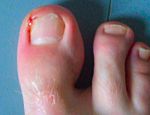
Paronychia of the big toe
-
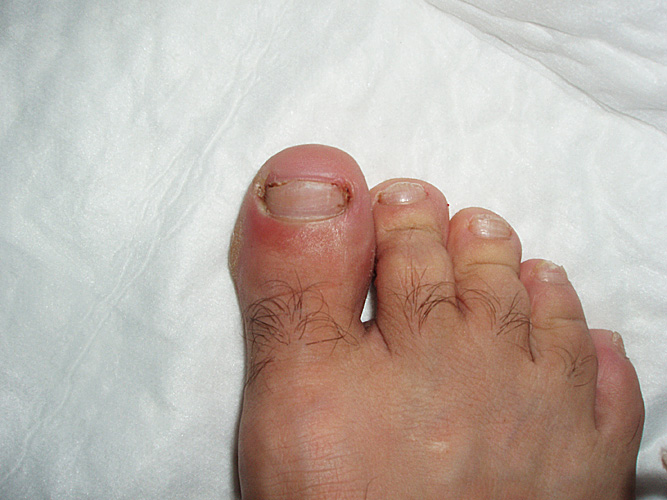
Paronychia: Infection of the skin medial and inferior to nail of great toe.
(Courtesy of Charlie Goldberg, M.D.) -
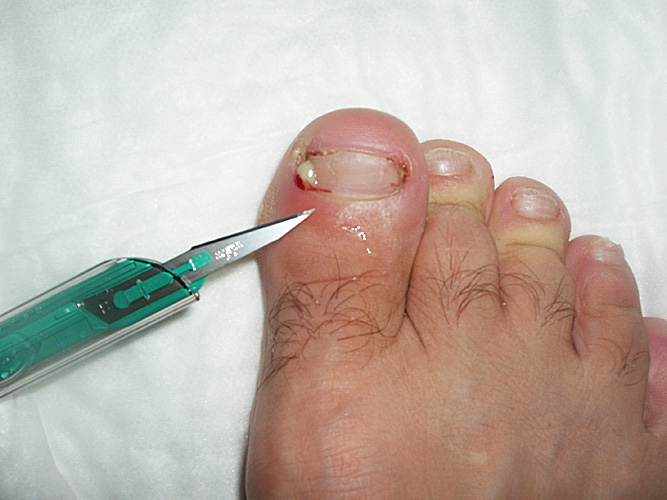
Paronychia: Infection of the skin medial and inferior to nail of great toe. Post I&D.
(Courtesy of Charlie Goldberg, M.D.) -
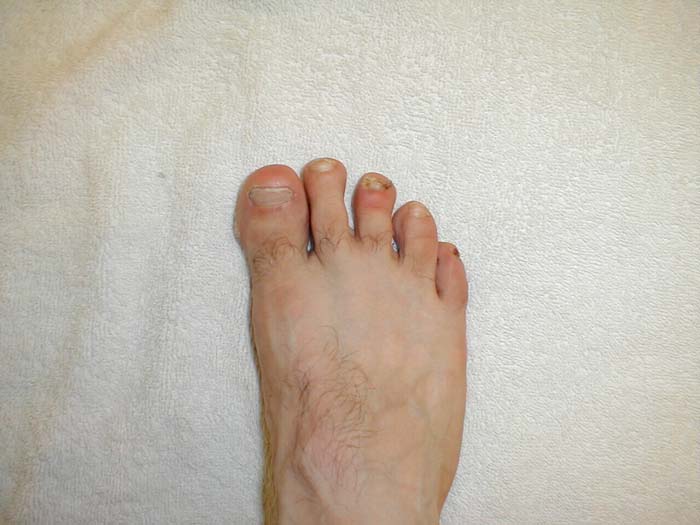
Paronychia: Infection of the skin medial to nail of middle toe.
(Courtesy of Charlie Goldberg, M.D.)


-
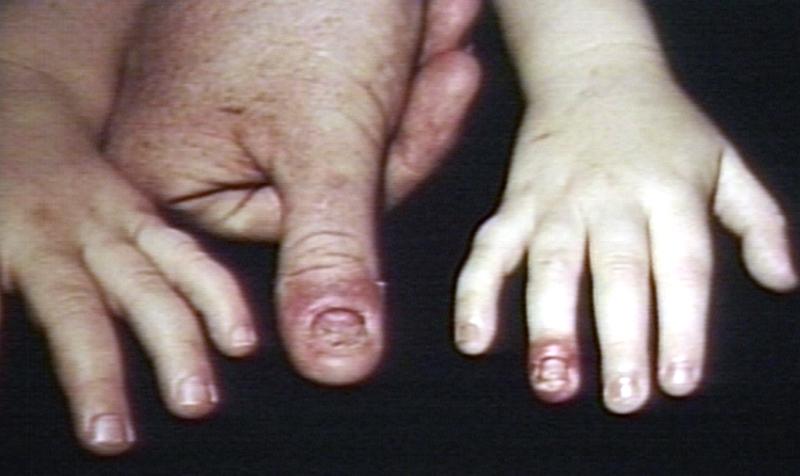
Paronychia due to Candida

Treatment
Pharmacotherapy
Acute Pharmacotherapies
In extreme cases, infections can move under the fingernail and need partial or complete nail removal. Unless there is an extensive cellulitis (inflammation and infection of the soft tissue around the nail), antibiotics are usually not necessary.
Surgery and Device Based Therapy
Indications for Surgery
If a large amount of pus has collected, then it may be necessary to make a small cut in the skin (sometimes under local anaesthetic) to release it.[2]
The doctor will most likely use medicine (such as lidocaine) to numb the entire finger first and then will open the abscess using a surgical knife (scalpel).
Your doctor may or may not take a culture of the drainage to check for a bacterial infection.
Pre-Operative Assessment
Care at home includes warm soaks in a mixture of 50% warm water and 50% liquid antibacterial soap 3-4 times daily for about 15 minutes. This soaking should be done at the first sign of redness around the nail.
Post-Operative Management[3]
After your doctor has drained the paronychia, warm soaks are still recommended. Sometimes packing called a wick is placed in the abscess to allow it to continue to drain when you go home and to keep it from closing up and re-forming the abscess. The packing is usually left in for 24-48 hours. Usually, antibiotics are only prescribed if the infection involves more of the finger than around the nailbed. It is important to follow up with your doctor in 24-48 hours to be sure that the infection is healing properly
Primary Prevention
To prevent paronychia:
- Care for the nails and the skin around the nails properly.
- Avoid damaging the nails or fingertips. Because the nails grow slowly, an injury can last for months.
- Do not bite or pick the nails.
- Protect the nails from exposure to detergents and chemicals by using protective rubber or plastic gloves, preferably with cotton liners.
- Bring your own manicure tools to nail salons.
To minimize the risk of damage to the nails:
- Keep the nails smooth and trim them weekly.
- Trim the toenails about once a month.
- Use sharp manicure scissors or clippers for trimming fingernails and toenails, and an emery board for smoothing the edges.
- Trim nails after bathing, when they are softer.
- Trim fingernails with a slightly rounded edge. Trim toenails straight across and don't cut them too short.
- Do not trim cuticles or use cuticle removers. Cuticle removers may damage the skin around the nail. Trimming the cuticle damages the skin at the base of the nail and allows an entry point for fungi (and bacteria), which can lead to infection.
References
- ↑ 1.0 1.1 "Dermatology Atlas".
- ↑ Jacobs, J.R. (2006 June-July). "Pathophysiology and Management of Paronychia". collegehealth-e. Text " pp. 10–12" ignored (help); Unknown parameter
|Issue=ignored (|issue=suggested) (help); Check date values in:|date=(help) - ↑ Directly from WebMD