Metaphysis
You don't need to be Editor-In-Chief to add or edit content to WikiDoc. You can begin to add to or edit text on this WikiDoc page by clicking on the edit button at the top of this page. Next enter or edit the information that you would like to appear here. Once you are done editing, scroll down and click the Save page button at the bottom of the page.
|
WikiDoc Resources for Metaphysis | |
|
Articles | |
|---|---|
|
Most recent articles on Metaphysis | |
|
Media | |
|
Evidence Based Medicine | |
|
Clinical Trials | |
|
Ongoing Trials on Metaphysis at Clinical Trials.gov Clinical Trials on Metaphysis at Google
| |
|
Guidelines / Policies / Govt | |
|
US National Guidelines Clearinghouse on Metaphysis
| |
|
Books | |
|
News | |
|
Commentary | |
|
Definitions | |
|
Patient Resources / Community | |
|
Patient resources on Metaphysis Discussion groups on Metaphysis Patient Handouts on Metaphysis Directions to Hospitals Treating Metaphysis Risk calculators and risk factors for Metaphysis
| |
|
Healthcare Provider Resources | |
|
Causes & Risk Factors for Metaphysis | |
|
Continuing Medical Education (CME) | |
|
International | |
|
| |
|
Business | |
|
Experimental / Informatics | |
Please Take Over This Page and Apply to be Editor-In-Chief for this topic: There can be one or more than one Editor-In-Chief. You may also apply to be an Associate Editor-In-Chief of one of the subtopics below. Please mail us [1] to indicate your interest in serving either as an Editor-In-Chief of the entire topic or as an Associate Editor-In-Chief for a subtopic. Please be sure to attach your CV and or biographical sketch.
Overview
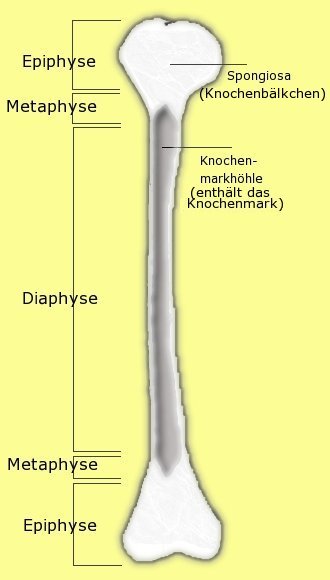
The metaphysis is the portion of a long bone between the epiphyses and the diaphysis. The "growth plate", or "physis", or "epiphyseal plate", although it precedes the development of the ossified metaphysis, may also be referred to as the metaphysis. It is this part of the bone that grows during childhood; as it grows, it ossifies near the diaphysis and the epiphyses. At roughly 18 to 25 years of age, the metaphysis stops growing altogether and completely ossifies into solid bone.
Epiphyseal plates ("growth plates") are located in the metaphysis and are responsible for growth in the length of the bone. Because of their rich blood supply, metaphysis of long bones are prone to hematogenous spread of Osteomyelitis in children.
Additional images
External links
- Organology at UC Davis Musculoskeletal/bone/structure0/structure2 - "Bone, structure (Gross, Low)"
Musculoskeletal system, connective tissue: bone and cartilage | |
|---|---|
| Cartilage | perichondrium, fibrocartilage callus, metaphysis
cells (chondroblast, chondrocyte) types (hyaline, elastic, fibrous) |
| Bone | ossification (intramembranous, endochondral, epiphyseal plate)
cycle (osteoblast, osteoid, osteocyte, osteoclast) types (cancellous, cortical) regions (epiphysis, metaphysis, diaphysis) structure (osteon/Haversian system, Haversian canals, Volkmann's canals, endosteum, periosteum, Sharpey's fibres, enthesis, lacunae, canaliculi, trabeculae, medullary cavity, bone marrow) shapes (long, short, flat, irregular, sesamoid) |
Acknowledgement and Attribution Regarding Sources of Content
Some of the initial content on this page may be incorporated in part from copyleft sources in the public domain including wikis such as Wikipedia and AskDrWiki. Drug information for patients came from the The National Library of Medicine. Infectious disease information may have come from the Centers for Disease Control (CDC). Differential Diagnoses are drawn from clinicians as well as an amalgamation of 3 sources: 1.The Disease Database; 2. Kahan, Scott, Smith, Ellen G. In A Page: Signs and Symptoms. Malden, Massachusetts: Blackwell Publishing, 2004:3; 3. Sailer, Christian, Wasner, Susanne. Differential Diagnosis Pocket. Hermosa Beach, CA: Borm Bruckmeir Publishing LLC, 2002:7 .