Intraventricular hemorrhages
| Intraventricular hemorrhages | |
 | |
|---|---|
| Brain: Intraventricular Hemorrhage In Newborn: Gross natural color external view of base of brain with blood in fourth ventricle and subarachnoid space. Image courtesy of Professor Peter Anderson DVM PhD and published with permission © PEIR, University of Alabama at Birmingham, Department of Pathology | |
| ICD-10 | I61.5 |
| ICD-9 | 431 |
| DiseasesDB | 6906 |
| eMedicine | ped/2595 |
Template:Search infobox Editor-In-Chief: C. Michael Gibson, M.S., M.D. [1]
Intraventricular hemorrhage (or "IVH") is a bleeding of the ventricles, where the cerebrospinal fluid is produced and circulates through towards the subarachnoid space.
In infants
This type of hemorrhage is particularly common in infants, especially premature infants or those of very low birth weight.[1] The cause of IVH in premature infants, unlike that in older infants, children or adults, is rarely due to trauma. Instead it is thought to result from changes in perfusion of the delicate cellular structures that are present in the growing brain. The lack of blood flow results in cell death and subsequent breakdown of the blood vessel walls, leading to bleeding. While this bleeding can result in further injury, it is itself a marker for injury that has already occurred. Most intraventricular hemorrhages occur in the first 72 hours after birth.[1]
-
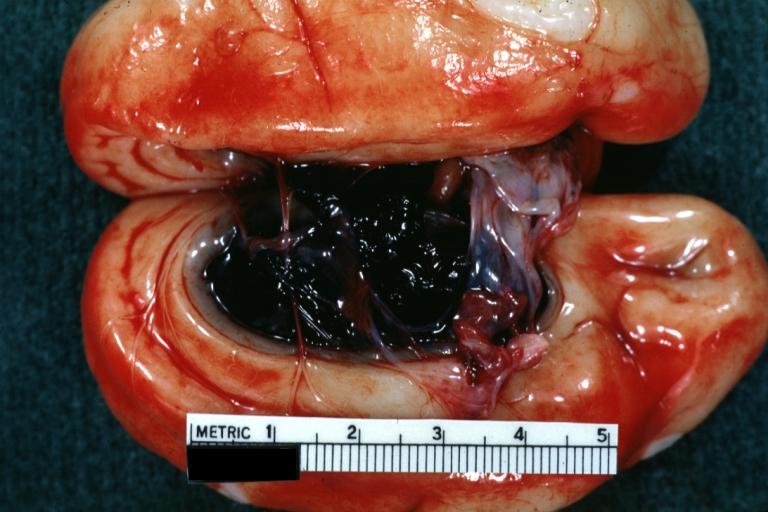 Brain: Intraventricular Hemorrhage In Newborn: Gross natural color separated cerebral hemispheres with removed septum pellucidum showing ventricle filled with blood
 -
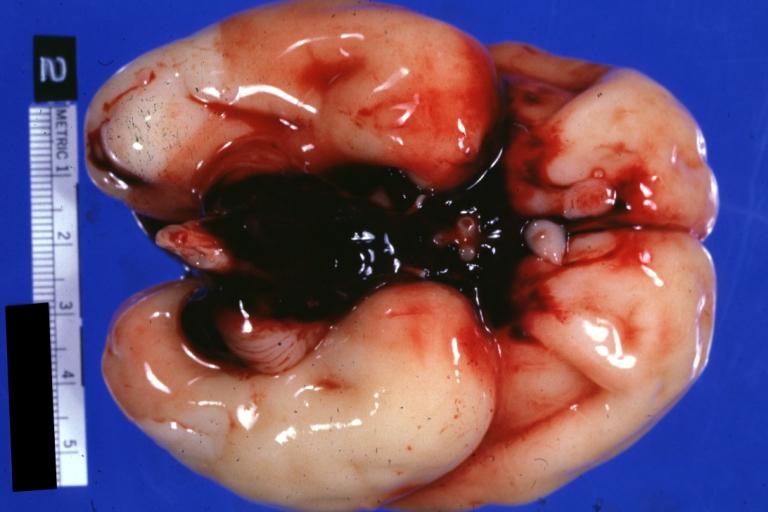 Brain: Intraventricular Hemorrhage: Gross natural color blood filled basilar leptomeninges characteristic of external brain appearance with intraventricular hemorrhage


In adults
Intraventricular hemorrhage is rare in adults[2] and requires a great deal of force to cause. Thus the hemorrhage usually does not occur without an extensive associated damage, and so the outcome is rarely good.[3][4]
Associated conditions
Brain contusions and subarachnoid hemorrhages are commonly associated with IVH.[5] The bleeding can involve the middle communicating artery or the posterior communicating artery.
In both adults and infants, IVH can cause dangerous increases in intracranial pressure, damage to the brain tissue, and hydrocephalus.[1][2]
References
- ↑ 1.0 1.1 1.2 Annibale DJ and Hill J. 2006. Periventricular Hemorrhage-Intraventricular Hemorrhage. Emedicine.com. Retrieved on June 19, 2007.
- ↑ 2.0 2.1 Mayfrank L, Kissler J, Raoofi R, Delsing P, Weis J, Kuker W, and Gilsbach JM. 1997. Ventricular Dilatation in Experimental Intraventricular Hemorrhage in Pigs: Characterization of Cerebrospinal Fluid Dynamics and the Effects of Fibrinolytic Treatment. Stroke, 28:141–148. Retrieved on June 19, 2007.
- ↑ Dawodu S. 2007. "Traumatic Brain Injury: Definition, Epidemiology, Pathophysiology" Emedicine.com. Retrieved on June 19, 2007.
- ↑ Vinas FC and Pilitsis J. 2006. "Penetrating Head Trauma." Emedicine.com.
- ↑ LeRoux PD, Haglund MM, Newell DW, Grady MS, and Winn HR. 1992. "Intraventricular hemorrhage in blunt head trauma: an analysis of 43 cases." Neurosurgery. Volume 4, pp. 678-84. PMID 1407453. Retrieved on June 19, 2007.