Human nose
|
WikiDoc Resources for Human nose |
|
Articles |
|---|
|
Most recent articles on Human nose |
|
Media |
|
Evidence Based Medicine |
|
Clinical Trials |
|
Ongoing Trials on Human nose at Clinical Trials.gov Clinical Trials on Human nose at Google
|
|
Guidelines / Policies / Govt |
|
US National Guidelines Clearinghouse on Human nose
|
|
Books |
|
News |
|
Commentary |
|
Definitions |
|
Patient Resources / Community |
|
Patient resources on Human nose Discussion groups on Human nose Patient Handouts on Human nose Directions to Hospitals Treating Human nose Risk calculators and risk factors for Human nose
|
|
Healthcare Provider Resources |
|
Causes & Risk Factors for Human nose |
|
Continuing Medical Education (CME) |
|
International |
|
|
|
Business |
|
Experimental / Informatics |
Editor-In-Chief: C. Michael Gibson, M.S., M.D. [1]
The visible part of the human nose is the protruding part of the face that bears the nostrils. The shape of the nose is determined by the ethmoid bone and the nasal septum, which consists mostly of cartilage and which separates the nostrils.
Associated health risks
Because of the special nature of the blood supply to the human nose and surrounding area, it is possible for retrograde infections from the nasal area to spread to the brain. For this reason, the area from the corners of the mouth to the bridge of the nose, including the nose and maxilla, is known to doctors as the danger triangle of the face.
Shapes of the human nose
Human noses can take many different shapes. Several attempts have been made towards a classification of noses. The following examples are from Nasology by Eden Warwick (pseudonym of George Jabet). This 19th century tract associated nose shapes with character traits in a way akin to phrenology, in a somewhat ironic way, as the booklet was intended to mock the popular but highly controversial subject of phrenology.
- Class I: The Roman, or Aquiline nose, which is rather convex, but undulating as its name aquiline imports. (See: Hooknose)
- Class II: The Greek or Straight nose, which is perfectly straight
- Class III: The Nubian, or Wide-nostrilled nose, wide at the end, thick and broad, gradually widening from below the bridge. The other noses are seen in profile, but this one in full face.
- Class IV: The Hawk nose, which is very convex, and preserves its convexity like a bow. It is thin and sharp
- Class V: The Snub nose
- Class VI: The Turn-up or Celestial nose, with a continuous concavity from the eyes to the tip
-

Class I
-
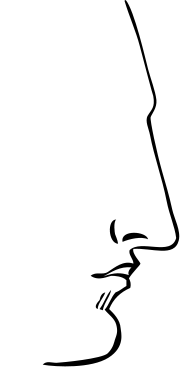
Class II
-
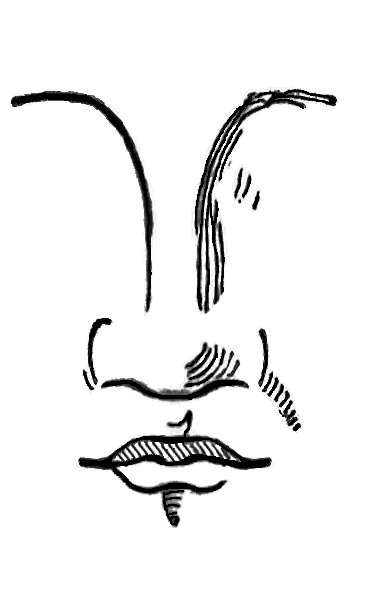
Class III
-

Class IV
-
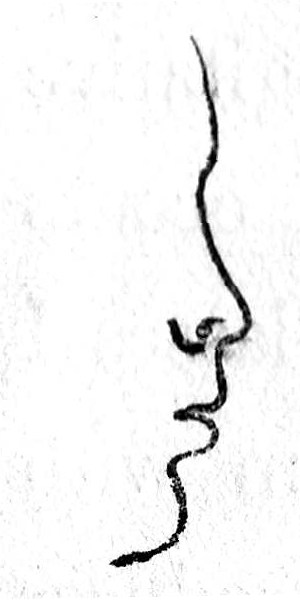
Class V
-
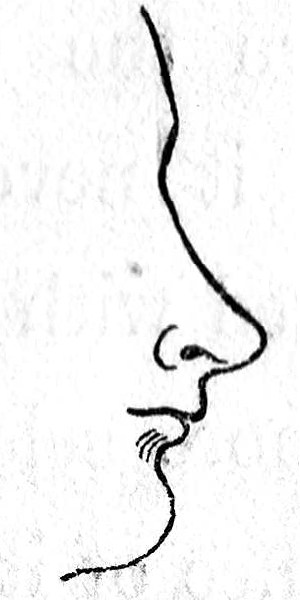
Class VI


Culture
In the Western world, some people choose to get rhinoplasty to change the aesthetic appearance of their nose. Nose piercings are also common, such as nostril, septum or bridge.
In New Zealand, nose pressing ("hongi") is a traditional greeting amongst Maori people, however is now generally confined to certain traditional celebrations.
People famous for their noses
- Barbara Streisand
- John Barrymore known as "The Great Profile"
- Cyrano de Bergerac
- Adrien Brody
- Tom Cruise was offered rhinoplasty in his earlier career, but passed.
- Jimmy Durante Cartoonist Al Hirschfeld questioned the size of Durante's schnozz. In The World of Hirschfeld (1966) he illustrated the point by taking a picture of Durante and adding white hair, a cigar, and a few other features, and leaving the nose untouched--and he came up with an uncanny likeness of former governor of New York, Alfred E. Smith.
- Nanette Fabray (for her small nose)
- Jamie Farr, who played Klinger on M*A*S*H. Many gags about Klinger's nose were written into the episodes.
- Jennifer Grey
- W.C. Fields
- Pinocchio, whose nose grew whenever he told a lie.
- Bob Hope ("ski-nose")
- Michael Jackson known for having multiple plastic surgery on his nose [1].
- Major Kovalyov in Nikolai Gogol's novel The Nose.
- Barry Manilow known for his large nose, often parodied [2], [3]
- Al Molinaro (Al from Happy Days)
- Jack Nicholson in the film Chinatown (1974) by Roman Polanski
- Richard Nixon
- Danny Thomas
- Duke of Wellington - The first Duke of Wellington was so renowned for his large hooked nose that his troops gave him the nickname of 'Nosey'.
- Owen Wilson
- Tycho Brahe lost his nose in a duel and wore a prosthetic nose made of gold and silver
- Severus Snape in J.K. Rowling's Harry Potter series
- Gonzo in The Muppets
- Hector Sepúlveda In Colegio De San José
References
- ↑ Surgeon: Michael Jackson A 'Nasal Cripple', ABC News, February 8, 2003
- ↑ "Legendary singer Barry Manilow has broken his famous nose", June 5, 2003, WENN
- ↑ "The star - who is almost as famous for the size of his nose as his hit songs - injured himself as he got up in the middle of the night while at his Californian home." Manilow breaks his nose, BBC News, June 4, 2003
Further readings
- Eden Warwick (pseudonym of George Jabet), Nasology, or hints towards a classification of Noses, London, Richard Bentley, 1848
- Encyclopedia Britannica Micropedia, 1982
See also
- Electronic Nose
- Empty nose syndrome
- Hooknose
- Jala neti
- Little's area
- Mucus
- Nasal congestion
- Nose-picking
- Nosebleed
- Nose grease
- Olfactory system
- Photic sneeze reflex
- Rhinoplasty
- Sneeze
- Sròn
External links
- From the Nose to the Eustachian Tube: Information, videos, tips for diving
- Your Nose: The Guardian Of Your Lungs
Template:Respiratory system Template:Human anatomical features Template:Head and neck general