Glottis
|
WikiDoc Resources for Glottis |
|
Articles |
|---|
|
Most recent articles on Glottis |
|
Media |
|
Evidence Based Medicine |
|
Clinical Trials |
|
Ongoing Trials on Glottis at Clinical Trials.gov Clinical Trials on Glottis at Google
|
|
Guidelines / Policies / Govt |
|
US National Guidelines Clearinghouse on Glottis
|
|
Books |
|
News |
|
Commentary |
|
Definitions |
|
Patient Resources / Community |
|
Directions to Hospitals Treating Glottis Risk calculators and risk factors for Glottis
|
|
Healthcare Provider Resources |
|
Causes & Risk Factors for Glottis |
|
Continuing Medical Education (CME) |
|
International |
|
|
|
Business |
|
Experimental / Informatics |
The space between the vocal cords is called the glottis.
Function
As the vocal cords vibrate, the resulting vibration produces a "buzzing" quality to the speech, called voice or voicing.
Sound production involving only the glottis is called glottal. English has a voiceless glottal fricative spelled "h". In many accents of English the glottal stop (made by pressing the folds together) is used as a variant allophone of the phoneme Template:IPA (and in some dialects, occasionally of Template:IPA and Template:IPA); in some languages, this sound is a phoneme of its own.
Skilled players of the Australian didgeridoo restrict their glottal opening in order to produce the full range of timbres available on the instrument. [1]
The vibration produced is an essential component of voiced consonants as well as vowels. If the vocal folds are drawn apart, air flows between them causing no vibration, as in the production of voiceless consonants.
- Voiced consonants include Template:IPA
- Voiceless consonants include Template:IPA
Additional images
-
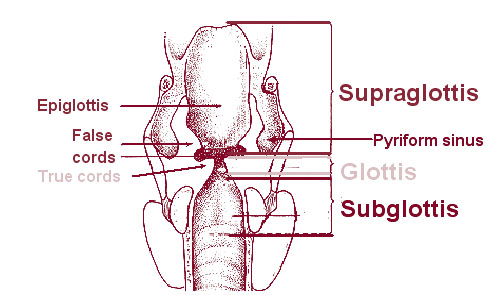 Larynx
 -
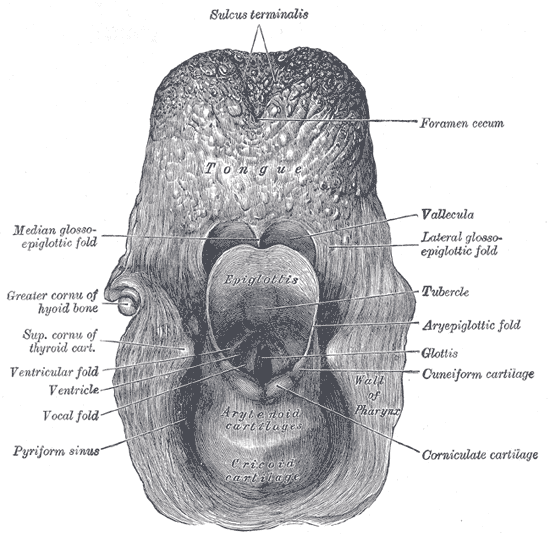 The entrance to the larynx, viewed from behind.
 -
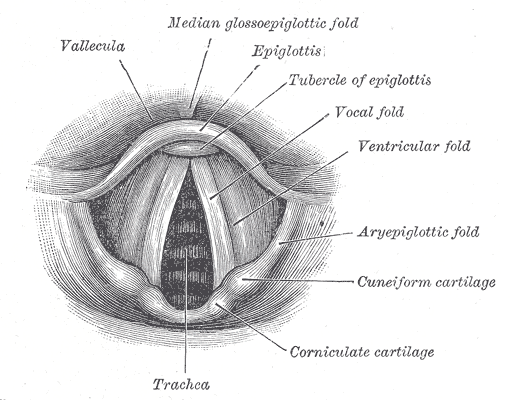 The entrance to the larynx.


See also
External links
Notes
References of Glottis Simulator
de Menezes Lyra R. Glottis simulator. Anesth Analg. 1999 Jun;88(6):1422-3.[1]
Smith, N Ty. Simulation in anesthesia: the merits of large simulators versus small simulators. Current Opinion in Anaesthesiology. 13(6):659-665, December 2000.
ca:Glotis de:Glottis eo:Gloto gl:Glote it:Glottide ko:성문 (몸) nl:Glottis fi:Äänirako sv:Röstspringa