Glottis

You don't need to be Editor-In-Chief to add or edit content to WikiDoc. You can begin to add to or edit text on this WikiDoc page by clicking on the edit button at the top of this page. Next enter or edit the information that you would like to appear here. Once you are done editing, scroll down and click the Save page button at the bottom of the page.

(Redirected from Glottic)
Jump to: navigation, search
Glottis
Arytenoid cartilage
Glottis positions
MeSH Glottis
Dorlands/Elsevier g_08/12395255

WikiDoc Resources for

Glottis

Articles

Most recent articles on Glottis

Most cited articles on Glottis

Review articles on Glottis

Articles on Glottis in N Eng J Med, Lancet, BMJ

Media

Powerpoint slides on Glottis

Images of Glottis

Photos of Glottis

Podcasts & MP3s on Glottis

Videos on Glottis

Evidence Based Medicine

Cochrane Collaboration on Glottis

Bandolier on Glottis

TRIP on Glottis

Clinical Trials

Ongoing Trials on Glottis at Clinical Trials.gov

Trial results on Glottis

Clinical Trials on Glottis at Google

Guidelines / Policies / Govt

US National Guidelines Clearinghouse on Glottis

NICE Guidance on Glottis

NHS PRODIGY Guidance

FDA on Glottis

CDC on Glottis

Books

Books on Glottis

News

Glottis in the news

Be alerted to news on Glottis

News trends on Glottis

Commentary

Blogs on Glottis

Definitions

Definitions of Glottis

Patient Resources / Community

Patient resources on Glottis

Discussion groups on Glottis

Patient Handouts on Glottis

Directions to Hospitals Treating Glottis

Risk calculators and risk factors for Glottis

Healthcare Provider Resources

Symptoms of Glottis

Causes & Risk Factors for Glottis

Diagnostic studies for Glottis

Treatment of Glottis

Continuing Medical Education (CME)

CME Programs on Glottis

International

Glottis en Espanol

Glottis en Francais

Businness

Glottis in the Marketplace

Patents on Glottis

Experimental / Informatics

List of terms related to Glottis

Please Take Over This Page and Apply to be Editor-In-Chief for this topic: There can be one or more than one Editor-In-Chief. You may also apply to be an Associate Editor-In-Chief of one of the subtopics below. Please mail us [1] to indicate your interest in serving either as an Editor-In-Chief of the entire topic or as an Associate Editor-In-Chief for a subtopic. Please be sure to attach your CV and or biographical sketch.

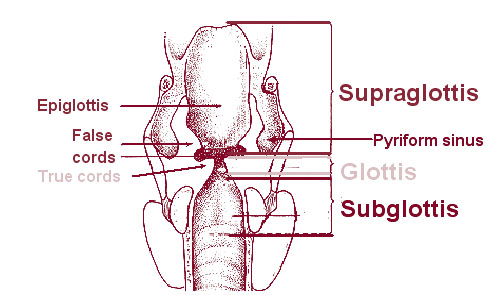
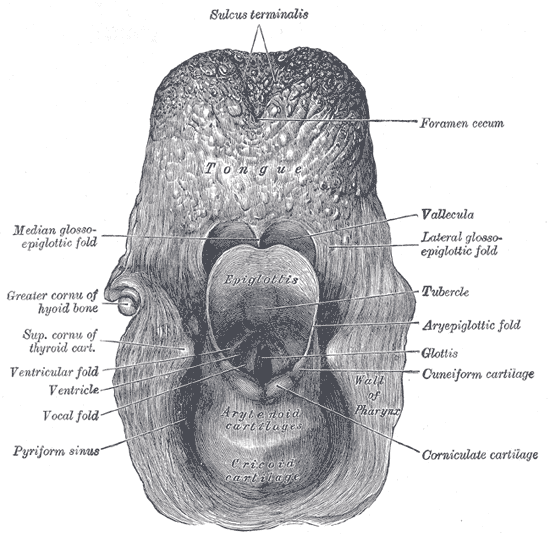
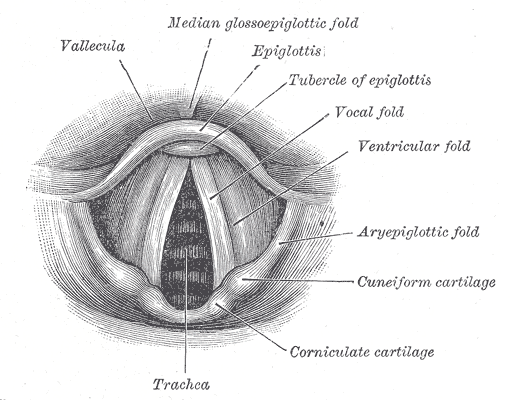
The space between the vocal cords is called the glottis.

Function

As the vocal cords vibrate, the resulting vibration produces a "buzzing" quality to the speech, called voice or voicing.

Sound production involving only the glottis is called glottal. English has a voiceless glottal fricative spelled "h". In many accents of English the glottal stop (made by pressing the folds together) is used as a variant allophone of the phoneme /t/ (and in some dialects, occasionally of /k/ and /p/); in some languages, this sound is a phoneme of its own.

Skilled players of the Australian didgeridoo restrict their glottal opening in order to produce the full range of timbres available on the instrument. [1]

The vibration produced is an essential component of voiced consonants as well as vowels. If the vocal folds are drawn apart, air flows between them causing no vibration, as in the production of voiceless consonants.

  • Voiced consonants include /w/, /v/, /z/, /ʒ/, /ʤ/, /ð/, /b/, /d/, and /g/.
  • Voiceless consonants include /h/, /ʍ/, /f/, /s/, /ʃ/, /ʧ/, /θ/, /p/, /t/, and /k/.

Additional images

See also

External links

Notes


References of Glottis Simulator

de Menezes Lyra R. Glottis simulator. Anesth Analg. 1999 Jun;88(6):1422-3.[2]

Smith, N Ty. Simulation in anesthesia: the merits of large simulators versus small simulators. Current Opinion in Anaesthesiology. 13(6):659-665, December 2000.

ca:Glotis de:Glottiseo:Gloto fr:Glotte gl:Glote it:Glottide ko:성문 (몸) nl:Glottisfi:Äänirako sv:Röstspringa


WikiDoc Help Menu

Quick Start..

Editing basics

Advanced editing

Communicating your edits

Help Videos You Can Watch


Acknowledgement and Attribution Regarding Sources of Content

Some of the initial content on this page may be incorporated in part from copyleft sources in the public domain including wikis such as Wikipedia and AskDrWiki. Drug information for patients came from the The National Library of Medicine. Infectious disease information may have come from the Centers for Disease Control (CDC). Differential Diagnoses are drawn from clinicians as well as an amalgamation of 3 sources: 1.The Disease Database; 2. Kahan, Scott, Smith, Ellen G. In A Page: Signs and Symptoms. Malden, Massachusetts: Blackwell Publishing, 2004:3; 3. Sailer, Christian, Wasner, Susanne. Differential Diagnosis Pocket. Hermosa Beach, CA: Borm Bruckmeir Publishing LLC, 2002:7 .

Personal tools
In other languages