Cuneate nucleus

You don't need to be Editor-In-Chief to add or edit content to WikiDoc. You can begin to add to or edit text on this WikiDoc page by clicking on the edit button at the top of this page. Next enter or edit the information that you would like to appear here. Once you are done editing, scroll down and click the Save page button at the bottom of the page.

Jump to: navigation, search
Brain: Cuneate nucleus
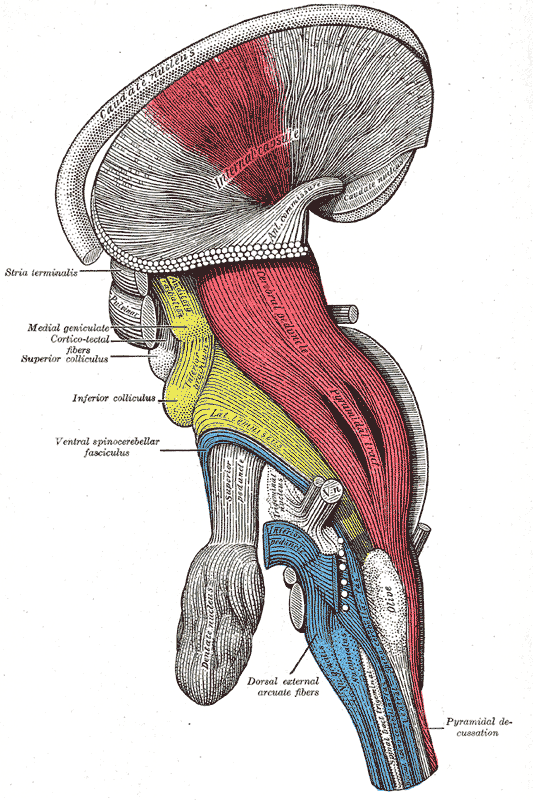
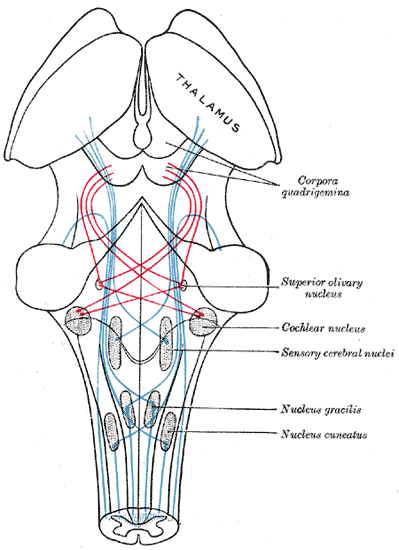
Dissection of brain-stem. Dorsal view. (Label for "nucleus cuneatus" is on left, third from the bottom.)
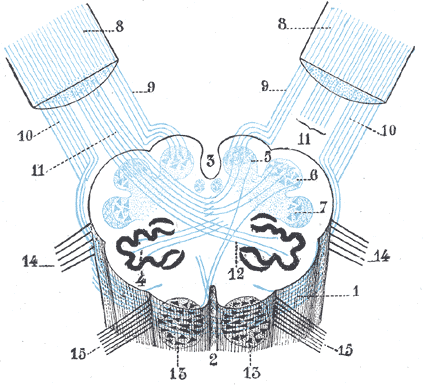
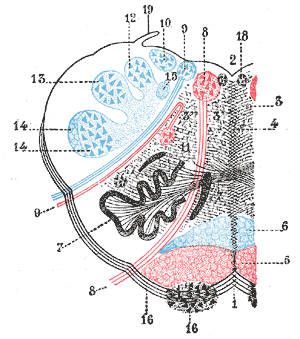
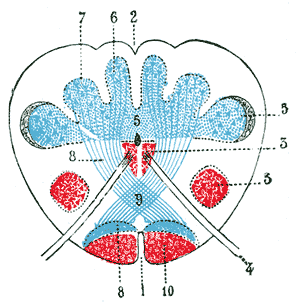
Section of the medulla oblongata at about the middle of the olive.
Latin nucleus cuneatus
Gray's subject #187 774
NeuroNames hier-764
Dorlands/Elsevier n_11/12580900

Please Take Over This Page and Apply to be Editor-In-Chief for this topic: There can be one or more than one Editor-In-Chief. You may also apply to be an Associate Editor-In-Chief of one of the subtopics below. Please mail us [1] to indicate your interest in serving either as an Editor-In-Chief of the entire topic or as an Associate Editor-In-Chief for a subtopic. Please be sure to attach your CV and or biographical sketch.

Overview

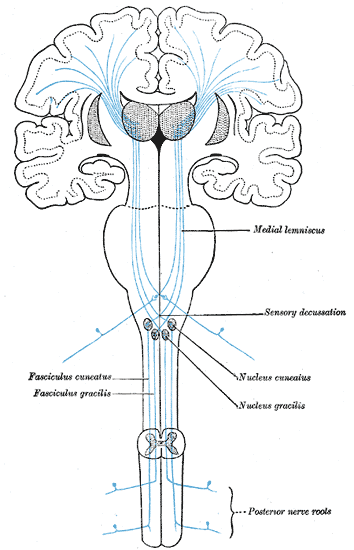
One of the dorsal column nuclei, the cuneate nucleus is a wedge-shaped nucleus in the closed part of the medulla oblongata. It contains cells that give rise to the cuneate tubercle, visible on the posterior aspect of the medulla. It lies laterally to the gracile nucleus and medial to the spinal trigeminal nucleus in the medulla.

Function

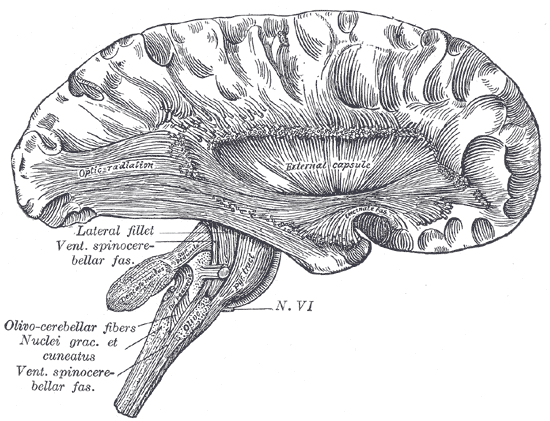
The cuneate nucleus is part of dorsal column-medial lemniscus system, carrying fine touch and proprioceptive information to the thalamus and cerebellum.

Pathology

It may be affected by vitamin E deficiency exhibiting neuroaxonal swelling.

See also

Additional images

External links

WikiDoc Help Menu

Quick Start..

Editing basics

Advanced editing

Communicating your edits

Help Videos You Can Watch


Acknowledgement and Attribution Regarding Sources of Content

Some of the initial content on this page may be incorporated in part from copyleft sources in the public domain including wikis such as Wikipedia and AskDrWiki. Drug information for patients came from the The National Library of Medicine. Infectious disease information may have come from the Centers for Disease Control (CDC). Differential Diagnoses are drawn from clinicians as well as an amalgamation of 3 sources: 1.The Disease Database; 2. Kahan, Scott, Smith, Ellen G. In A Page: Signs and Symptoms. Malden, Massachusetts: Blackwell Publishing, 2004:3; 3. Sailer, Christian, Wasner, Susanne. Differential Diagnosis Pocket. Hermosa Beach, CA: Borm Bruckmeir Publishing LLC, 2002:7 .

Personal tools
related articles
viewed previously [ + ]

often viewed next [ + ]