Cricoid
|
WikiDoc Resources for Cricoid |
|
Articles |
|---|
|
Most recent articles on Cricoid |
|
Media |
|
Evidence Based Medicine |
|
Clinical Trials |
|
Ongoing Trials on Cricoid at Clinical Trials.gov Clinical Trials on Cricoid at Google
|
|
Guidelines / Policies / Govt |
|
US National Guidelines Clearinghouse on Cricoid
|
|
Books |
|
News |
|
Commentary |
|
Definitions |
|
Patient Resources / Community |
|
Directions to Hospitals Treating Cricoid Risk calculators and risk factors for Cricoid
|
|
Healthcare Provider Resources |
|
Causes & Risk Factors for Cricoid |
|
Continuing Medical Education (CME) |
|
International |
|
|
|
Business |
|
Experimental / Informatics |
The cricoid cartilage, or simply cricoid (from the Greek krikoeides meaning "ring-shaped"), is the only complete ring of cartilage around the trachea.
Location
It sits just inferior to the thyroid cartilage in the neck, and is joined to it medially by the median cricothyroid ligament and postero-laterally by the cricothyroid joints. Inferior to it are the rings of cartilage around the trachea (which are not continuous - rather they are C-shaped with a gap posteriorly). The cricoid is joined to the first tracheal ring by the cricotracheal ligament, and this can be felt as a more yielding area between the firm thyroid cartilage and firmer cricoid.
It is also anatomically related to the thyroid gland; although the thyroid isthmus is inferior to it, the two lobes of the thyroid extend superiorly on each side of the cricoid as far as the thyroid cartilage above it.
The posterior part of the cricoid is slightly broader than the anterior and lateral parts, and is called the lamina, while the anterior part is the band; this may be the reason for the common comparison made between the cricoid and a signet ring.
Function
The function of the cricoid is to provide attachments for the various muscles, cartilages, and ligaments involved in opening and closing the airway and in speech production.
Composition
It is made of hyaline cartilage, and so can become calcified or even ossified, particularly in old age.
Clinical significance
When intubating a patient under general anesthesia prior to surgery, the anesthesiologist will press on the cricoid cartilage to compress the esophagus behind it so as to prevent gastric reflux from occurring.
Gastric reflux could cause aspiration if this is not done considering the general anesthesia can cause relaxation of the gastro-esophageal sphincter allowing stomach contents to ascend through the esophagus into the trachea.
Additional images
-
 Larynx
 -
Tracheotomy neck profile
-
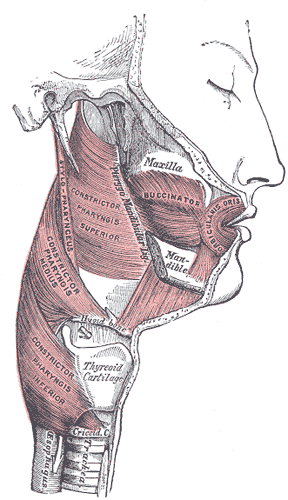 Muscles of the pharynx and cheek.
 -
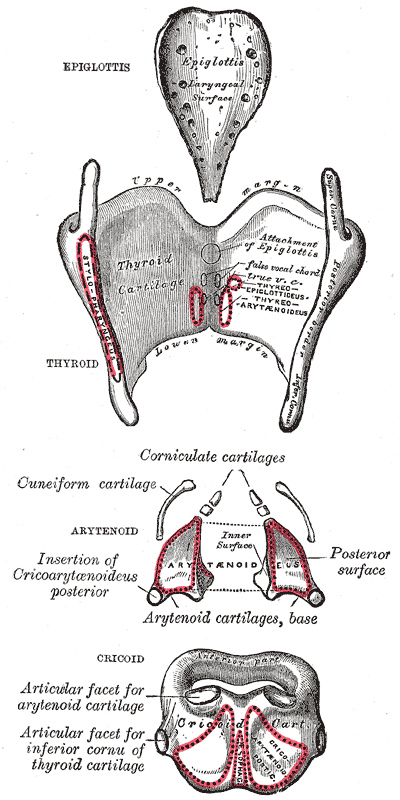 The cartilages of the larynx. Posterior view.
 -
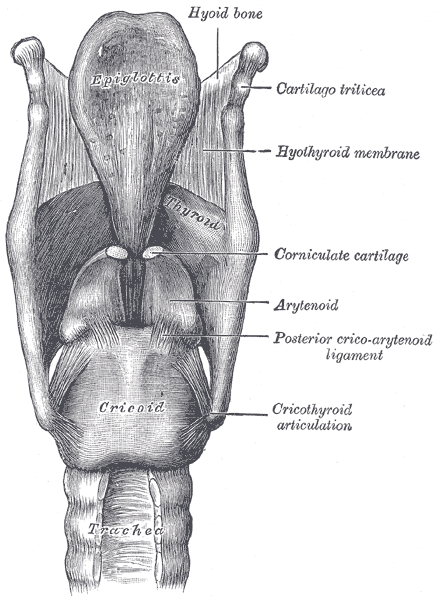 Ligaments of the larynx. Posterior view.
 -
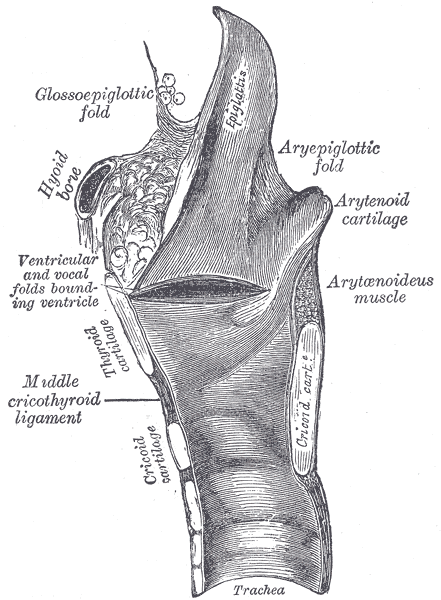 Sagittal section of the larynx and upper part of the trachea.
 -
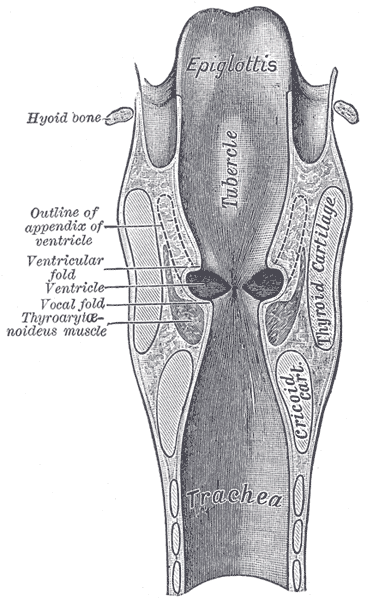 Coronal section of larynx and upper part of trachea.
 -
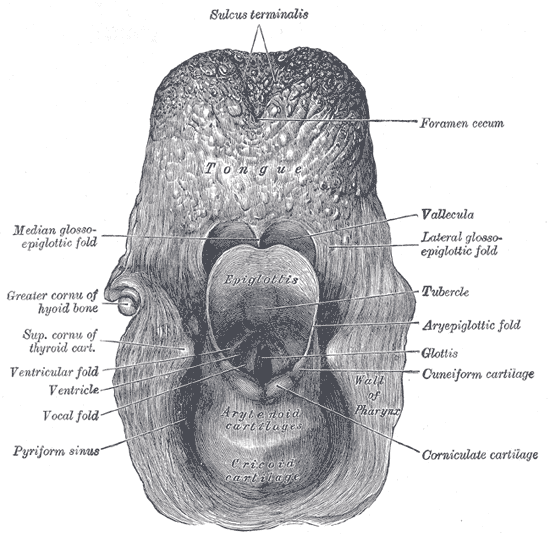 The entrance to the larynx, viewed from behind.
 -
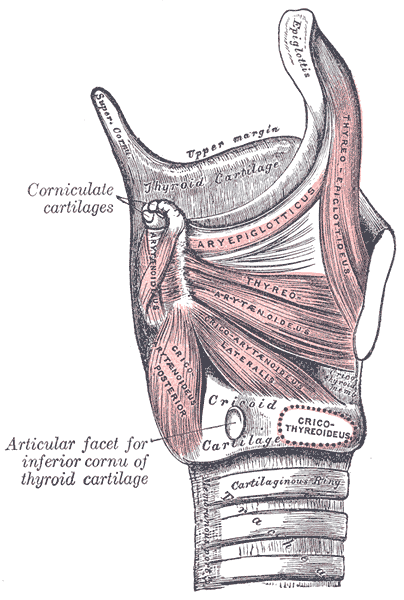 Muscles of larynx. Side view. Right lamina of thyroid cartilage removed.
 -
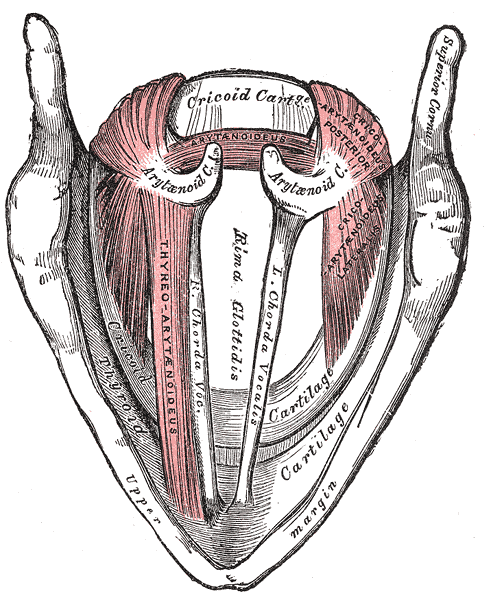 Muscles of the larynx, seen from above.
 -
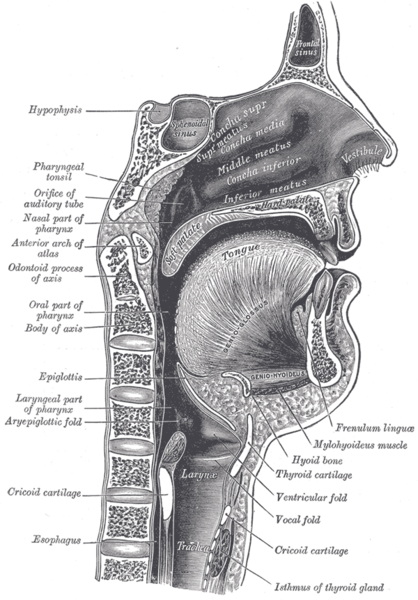 Sagittal section of nose mouth, pharynx, and larynx.
 -
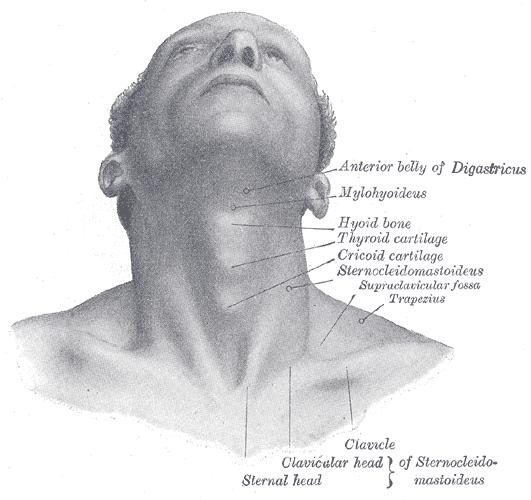 Front view of neck.


See also
External links
- Illustration at nda.ox.ac.uk
- Template:SUNYAnatomyFigs - "Skeleton of the larynx."
- Template:NormanAnatomy (Template:NormanAnatomyFig)