Cetylpyridinium chloride
Editor-In-Chief: C. Michael Gibson, M.S., M.D. [1]; Associate Editor(s)-in-Chief: Rabin Bista, M.B.B.S. [2]
WikiDoc MAKES NO GUARANTEE OF VALIDITY. WikiDoc is not a professional health care provider, nor is it a suitable replacement for a licensed healthcare provider. WikiDoc is intended to be an educational tool, not a tool for any form of healthcare delivery. The educational content on WikiDoc drug pages is based upon the FDA package insert, National Library of Medicine content and practice guidelines / consensus statements. WikiDoc does not promote the administration of any medication or device that is not consistent with its labeling. Please read our full disclaimer here.
NOTE: Most over the counter (OTC) are not reviewed and approved by the FDA. However, they may be marketed if they comply with applicable regulations and policies. FDA has not evaluated whether this product complies.
Overview
Cetylpyridinium chloride is a antiseptic that is FDA approved for the treatment of gingivitis. Common adverse reactions include staining of the teeth and tongue.
Adult Indications and Dosage
FDA-Labeled Indications and Dosage (Adult)
Indications
- helps control plaque that leads to gingivitis
Dosage

Off-Label Use and Dosage (Adult)
Guideline-Supported Use
There is limited information regarding Off-Label Guideline-Supported Use of Cetylpyridinium chloride in adult patients.
Non–Guideline-Supported Use
There is limited information regarding Off-Label Non–Guideline-Supported Use of Cetylpyridinium chloride in adult patients.
Pediatric Indications and Dosage
FDA-Labeled Indications and Dosage (Pediatric)
Indications
- helps control plaque that leads to gingivitis
Dosage
Off-Label Use and Dosage (Pediatric)
Guideline-Supported Use
There is limited information regarding Off-Label Guideline-Supported Use of Cetylpyridinium chloride in pediatric patients.
Non–Guideline-Supported Use
There is limited information regarding Off-Label Non–Guideline-Supported Use of Cetylpyridinium chloride in pediatric patients.
Contraindications
There is limited information regarding Cetylpyridinium chloride Contraindications in the drug label.
Warnings
- Keep out of reach of children under 6 years of age.
- If more than used for rinsing is accidentally swallowed, get medical help or contact a Poison Control Center right away.
- Stop use and ask a dentist if
- gingivitis, bleeding, or redness persists for more than 2 weeks
- you have painful or swollen gums, pus from the gum line, loose teeth, or increasing spacing between the teeth
- These may be signs or symptoms of periodontitis, a serious form of gum disease.
Adverse Reactions
Clinical Trials Experience
There is limited information regarding Clinical Trial Experience of Cetylpyridinium chloride in the drug label.
Postmarketing Experience
staining of the teeth and tongue
Drug Interactions
There is limited information regarding Cetylpyridinium chloride Drug Interactions in the drug label.
Use in Specific Populations
Pregnancy
- Pregnancy Category
- Australian Drug Evaluation Committee (ADEC) Pregnancy Category
There is no Australian Drug Evaluation Committee (ADEC) guidance on usage of Cetylpyridinium chloride in women who are pregnant.
Labor and Delivery
There is no FDA guidance on use of Cetylpyridinium chloride during labor and delivery.
Nursing Mothers
There is no FDA guidance on the use of Cetylpyridinium chloride with respect to nursing mothers.
Pediatric Use
There is no FDA guidance on the use of Cetylpyridinium chloride with respect to pediatric patients.
Geriatic Use
There is no FDA guidance on the use of Cetylpyridinium chloride with respect to geriatric patients.
Gender
There is no FDA guidance on the use of Cetylpyridinium chloride with respect to specific gender populations.
Race
There is no FDA guidance on the use of Cetylpyridinium chloride with respect to specific racial populations.
Renal Impairment
There is no FDA guidance on the use of Cetylpyridinium chloride in patients with renal impairment.
Hepatic Impairment
There is no FDA guidance on the use of Cetylpyridinium chloride in patients with hepatic impairment.
Females of Reproductive Potential and Males
There is no FDA guidance on the use of Cetylpyridinium chloride in women of reproductive potentials and males.
Immunocompromised Patients
There is no FDA guidance one the use of Cetylpyridinium chloride in patients who are immunocompromised.
Administration and Monitoring
Administration
Monitoring
There is limited information regarding Monitoring of Cetylpyridinium chloride in the drug label.
IV Compatibility
There is limited information regarding IV Compatibility of Cetylpyridinium chloride in the drug label.
Overdosage
There is limited information regarding Overdose of Cetylpyridinium chloride in the drug label.
Pharmacology
| Template:Chembox header2 | Cetylpyridinium chloride | |
|---|---|
| Identifiers | |
3D model (JSmol)
|
|
| ChEBI | |
| ChEMBL | |
| ChemSpider | |
| ECHA InfoCard | Lua error in Module:Wikidata at line 879: attempt to index field 'wikibase' (a nil value). Lua error in Module:Wikidata at line 879: attempt to index field 'wikibase' (a nil value). |
PubChem CID
|
|
| UNII | |
| |
| |
| Template:Chembox header2 | Except where noted otherwise, data are given for materials in their standard state (at 25 °C, 100 kPa) Infobox disclaimer and references | |

Mechanism of Action
There is limited information regarding Cetylpyridinium chloride Mechanism of Action in the drug label.
Structure
- ACTIVE INGREDIENT (IN EACH 20 ML)
- cetylpyridinium chloride (0.05% w/w)
- INACTIVE INGREDIENTS
- water, glycerin, propylene glycol, sorbitol, polysorbate 20, sodium benzoate, flavor, phosphoric acid, menthol, sodium saccharin, FD&C blue no. 1
Pharmacodynamics
There is limited information regarding Pharmacodynamics of Cetylpyridinium chloride in the drug label.
Pharmacokinetics
There is limited information regarding Pharmacokinetics of Cetylpyridinium chloride in the drug label.
Nonclinical Toxicology
There is limited information regarding Nonclinical Toxicology of Cetylpyridinium chloride in the drug label.
Clinical Studies
There is limited information regarding Clinical Studies of Cetylpyridinium chloride in the drug label.
How Supplied
There is limited information regarding Cetylpyridinium chloride How Supplied in the drug label.
Storage
- store at controlled room temperature 20-25° C (68-77° F)
- this rinse is not intended to replace brushing or flossing
Images
Drug Images
{{#ask: Page Name::Cetylpyridinium chloride |?Pill Name |?Drug Name |?Pill Ingred |?Pill Imprint |?Pill Dosage |?Pill Color |?Pill Shape |?Pill Size (mm) |?Pill Scoring |?NDC |?Drug Author |format=template |template=DrugPageImages |mainlabel=- |sort=Pill Name }}
Package and Label Display Panel
PRINCIPAL DISPLAY PANEL - 30 ML BOTTLE LABEL
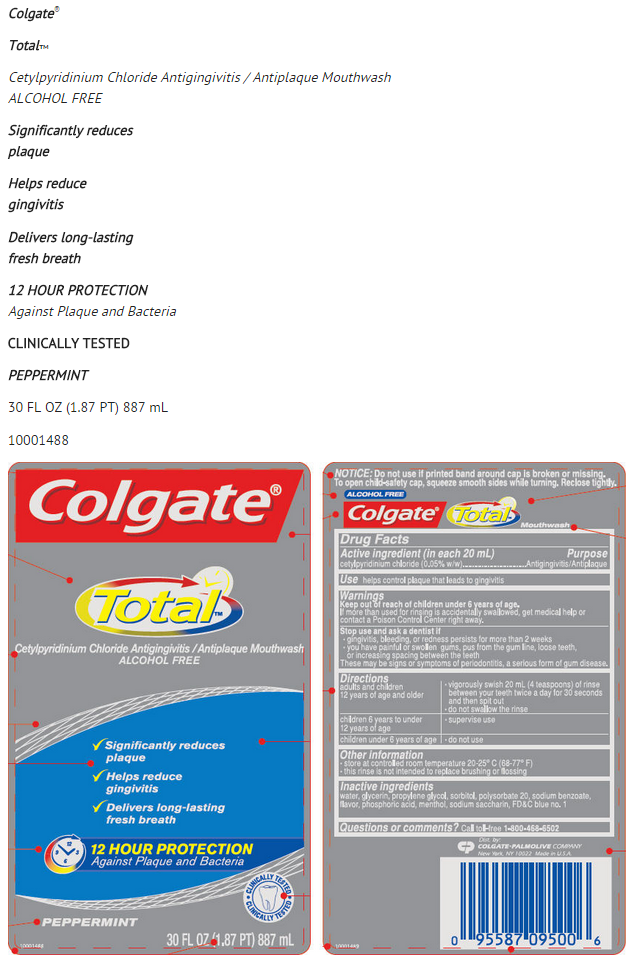
This image is provided by the National Library of Medicine.

Ingredients and Appearance
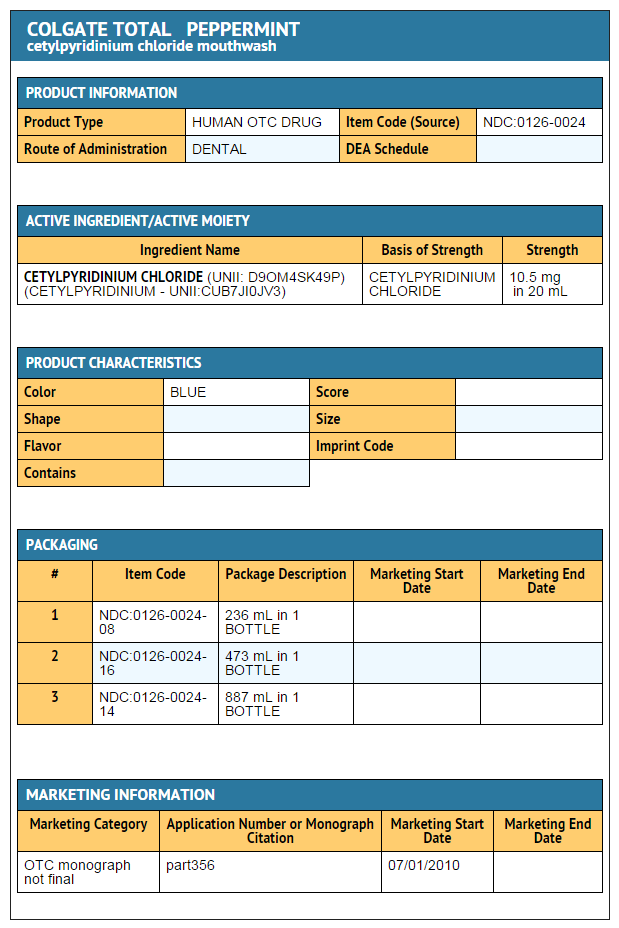
This image is provided by the National Library of Medicine.

{{#ask: Label Page::Cetylpyridinium chloride |?Label Name |format=template |template=DrugLabelImages |mainlabel=- |sort=Label Page }}
Patient Counseling Information
- QUESTIONS OR COMMENTS?
- Call toll-free 1-800-468-6502
Precautions with Alcohol
- Alcohol-Cetylpyridinium chloride interaction has not been established. Talk to your doctor about the effects of taking alcohol with this medication.
Brand Names
- COLGATE TOTAL PEPPERMINT®[1]
Look-Alike Drug Names
There is limited information regarding the look alike drug names
Price
References
The contents of this FDA label are provided by the National Library of Medicine.