Bile duct
|
WikiDoc Resources for Bile duct |
|
Articles |
|---|
|
Most recent articles on Bile duct |
|
Media |
|
Evidence Based Medicine |
|
Clinical Trials |
|
Ongoing Trials on Bile duct at Clinical Trials.gov Clinical Trials on Bile duct at Google
|
|
Guidelines / Policies / Govt |
|
US National Guidelines Clearinghouse on Bile duct
|
|
Books |
|
News |
|
Commentary |
|
Definitions |
|
Patient Resources / Community |
|
Patient resources on Bile duct Discussion groups on Bile duct Directions to Hospitals Treating Bile duct Risk calculators and risk factors for Bile duct
|
|
Healthcare Provider Resources |
|
Causes & Risk Factors for Bile duct |
|
Continuing Medical Education (CME) |
|
International |
|
|
|
Business |
|
Experimental / Informatics |
Editor-In-Chief: C. Michael Gibson, M.S., M.D. [1]
Overview
A bile duct is any of a number of long tube-like structures that carry bile.
Bile, required for the digestion of food, is excreted by the liver into passages that carry bile toward the hepatic duct, which joins with the cystic duct (carrying bile to and from the gallbladder) to form the common bile duct, which opens into the intestine.
The biliary tree (see below) is the whole network of various sized ducts branching through the liver.
The path is as follows: Bile canaliculi → Canals of Hering → interlobular bile ducts → intrahepatic bile ducts → left and right hepatic ducts merge to form → common hepatic duct exits liver and joins → cystic duct (from gall bladder) forming → common bile duct → joins with pancreatic duct → forming ampulla of Vater → enters duodenum
Common bile duct
The top half of the common bile duct is associated with the liver, while the bottom half of the common bile duct is associated with the pancreas, through which it passes on its way to the intestine. It opens in the part of the intestine called the duodenum into a structure called the ampulla of Vater.
Pathology
Blockage of the bile duct by a cancer, gallstones, or scarring from injury prevents the bile from being transported to the intestine and the active ingredient in the bile (bilirubin) instead accumulates in the blood. This condition is called jaundice and the skin and eyes become yellow from the bilirubin in the blood. This condition also causes severe itchiness from the bilirubin deposited in the tissues. In certain types of jaundice, the urine will be noticeably darker, and the stools will be much paler than usual. This is caused by the bilirubin all going to the bloodstream and being filtered into the urine by the kidneys, instead of some being lost in the stools through the ampulla of Vater.
Jaundice is commonly caused by conditions such as pancreatic cancer, which causes blockage of the bile duct passing through the cancerous portion of the pancreas; cholangiocarcinoma, cancer of the bile ducts; blockage by a stone in patients with gallstones; and from scarring after injury to the bile duct during gallbladder removal.
Additional images
-
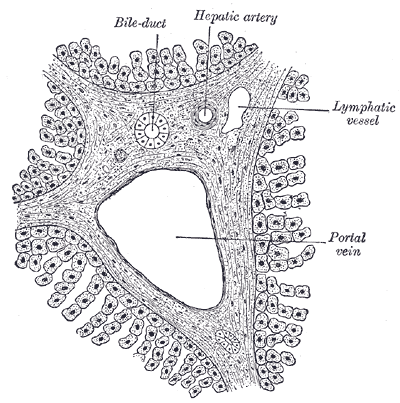 Section across portal canal of pig. X 250.

External links
- The Cholangiocarcinoma Foundation
- The Johns Hopkins Gall Bladder & Bile Duct Cancer Web page
- Template:EMedicineDictionary
- Bile+Ducts at the US National Library of Medicine Medical Subject Headings (MeSH)
cs:Žlučovod id:Saluran empedu is:Gallrás it:Dotti biliari pag:Apgo fi:Sappitiehyt