Xiphoid process

You don't need to be Editor-In-Chief to add or edit content to WikiDoc. You can begin to add to or edit text on this WikiDoc page by clicking on the edit button at the top of this page. Next enter or edit the information that you would like to appear here. Once you are done editing, scroll down and click the Save page button at the bottom of the page.

Jump to: navigation, search
Bone: Xiphoid process
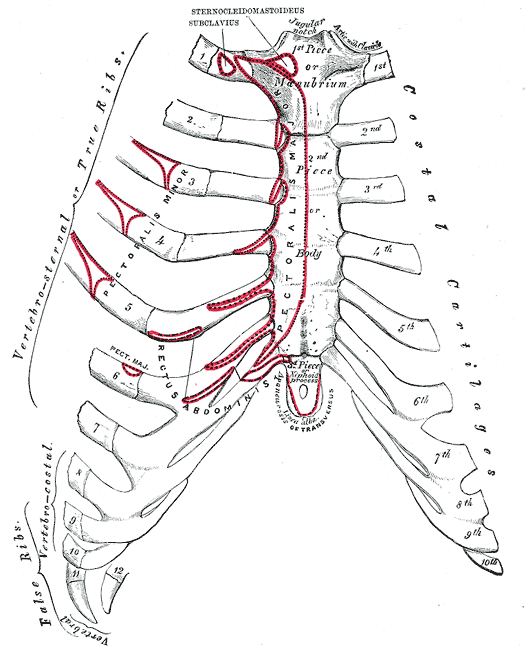
Lateral border of sternum. (Xiphoid process labeled at bottom.)
Posterior surface of sternum.
Latin processus xiphoideus
Gray's subject #27 121
MeSH Xiphoid+Bone

Editor-In-Chief: C. Michael Gibson, M.S., M.D. [1] Phone:617-525-6884

Please Take Over This Page and Apply to be Editor-In-Chief for this topic: There can be one or more than one Editor-In-Chief. You may also apply to be an Associate Editor-In-Chief of one of the subtopics below. Please mail us [2] to indicate your interest in serving either as an Editor-In-Chief of the entire topic or as an Associate Editor-In-Chief for a subtopic. Please be sure to attach your CV and or biographical sketch.

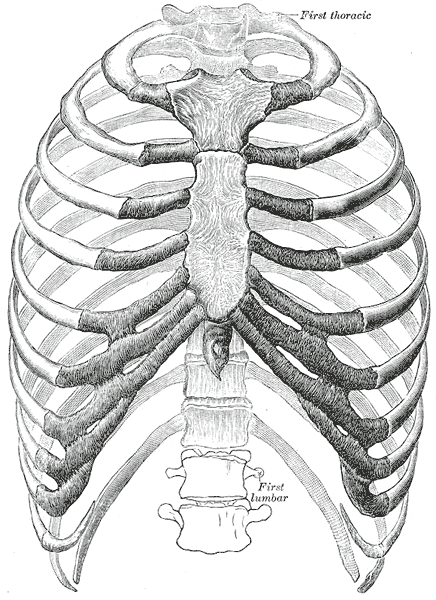
The xiphoid process, also known as the xiphisternum is a small cartilaginous extension to the lower part of the sternum which is usually ossified in the adult human. By age 15 to 29, the xiphoid usually fuses to the body of the sternum with a fibrous joint. Unlike the synovial articulation of major joints, this is non movable. Much the way the first seven ribs articulate with the sternum, the cartilage in the solar plexus joins on the xiphoid process, reinforcing it, and indirectly attaches the costal cartilage to the sternum.

Bifurcation

The xiphoid process can be bifurcated, and sometimes perforated, naturally. These variances in morphology are inheritable, which can help group family members together when dealing with burial remains. These morphological differences pose no health risk, and are simply a difference in form.

Clinical significance

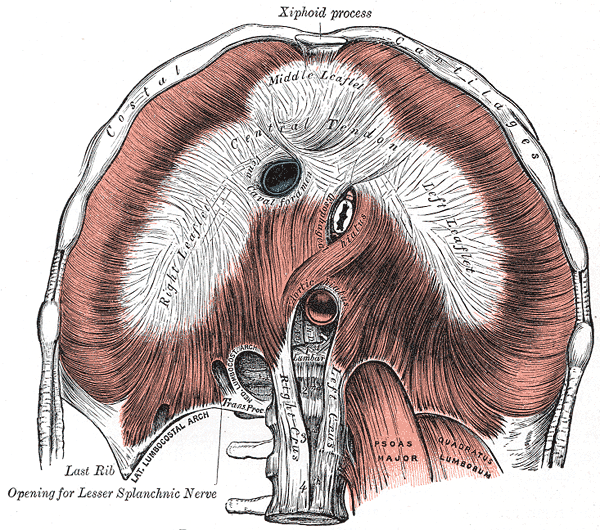
Pressure on the xiphoid process should be avoided when administering chest compressions in CPR, as this can cause the xiphoid process to break off and be driven into the heart lining and muscle, resulting in punctures or lacerations of the diaphragm.

Xiphoid process in birds

In birds, the xiphoid process is a long structure, often following the direction of the carina.

Etymology

The word derives from the Greek word xiphos for straight sword, the tip of which the process somewhat resembles.

Additional images

de:Processus xiphoideus
WikiDoc Help Menu

Quick Start..

Editing basics

Advanced editing

Communicating your edits

Help Videos You Can Watch


Acknowledgement and Attribution Regarding Sources of Content

Some of the initial content on this page may be incorporated in part from copyleft sources in the public domain including wikis such as Wikipedia and AskDrWiki. Drug information for patients came from the The National Library of Medicine. Infectious disease information may have come from the Centers for Disease Control (CDC). Differential Diagnoses are drawn from clinicians as well as an amalgamation of 3 sources: 1.The Disease Database; 2. Kahan, Scott, Smith, Ellen G. In A Page: Signs and Symptoms. Malden, Massachusetts: Blackwell Publishing, 2004:3; 3. Sailer, Christian, Wasner, Susanne. Differential Diagnosis Pocket. Hermosa Beach, CA: Borm Bruckmeir Publishing LLC, 2002:7 .

Personal tools
In other languages