Virchow's node
| Lymph: Virchow's node | ||
|---|---|---|
| Regional lymph tissue. (Supraclavicular near top, in green.)⋅ | ||
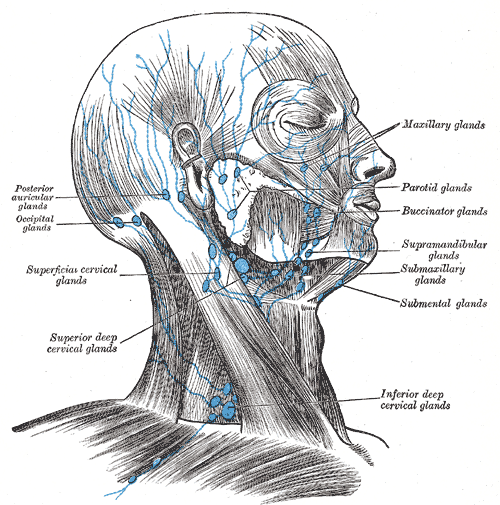
| Deep Lymph Nodes 1. Submental 2. Submandibular (Submaxillary) Anterior Cervical Lymph Nodes (Deep) 3. Prelaryngeal 4. Thyroid 5. Pretracheal 6. Paratracheal Deep Cervical Lymph Nodes 7. Lateral jugular 8. Anterior jugular 9. Jugulodigastric Inferior Deep Cervical Lymph Nodes 10. Juguloomohyoid 11. Supraclavicular (scalene) | ||
| Gray's | subject #177 697 | |
| Dorlands/Elsevier | n_09/12575322 | |
|
WikiDoc Resources for Virchow's node | |
|
Articles | |
|---|---|
|
Most recent articles on Virchow's node Most cited articles on Virchow's node | |
|
Media | |
|
Powerpoint slides on Virchow's node | |
|
Evidence Based Medicine | |
|
Clinical Trials | |
|
Ongoing Trials on Virchow's node at Clinical Trials.gov Trial results on Virchow's node Clinical Trials on Virchow's node at Google
| |
|
Guidelines / Policies / Govt | |
|
US National Guidelines Clearinghouse on Virchow's node NICE Guidance on Virchow's node
| |
|
Books | |
|
News | |
|
Commentary | |
|
Definitions | |
|
Patient Resources / Community | |
|
Patient resources on Virchow's node Discussion groups on Virchow's node Patient Handouts on Virchow's node Directions to Hospitals Treating Virchow's node Risk calculators and risk factors for Virchow's node
| |
|
Healthcare Provider Resources | |
|
Causes & Risk Factors for Virchow's node | |
|
Continuing Medical Education (CME) | |
|
International | |
|
| |
|
Business | |
|
Experimental / Informatics | |
Editor-In-Chief: C. Michael Gibson, M.S., M.D. [1]
Overview
Virchow's node (or signal node) is an enlarged, hard, left supraclavicular lymph node which can contain metastasis of visceral (abdominal) malignancy.
Clinical significance
Malignancies of the internal organs can reach an advanced stage before giving symptoms. Stomach cancer, for example, can remain symptomless while metastatizing. One of the first visible spots where these tumors metastatise is the left supraclavicular lymph node. The left supraclavicular node is the classical Virchow's node because it is on the left side of the neck where the lymphatic drainage of most of the body (from the thoracic duct) enters the venous circulation via the left subclavian vein.
Differential diagnosis of an enlarged Virchow's node includes lymphoma, various intra-abdominal malignancies, breast cancer, lung cancer, and infection (e.g. of the arm).
Eponym
It is named after Rudolf Virchow (1821-1902), the German pathologist who first described the association. The presence of an enlarged Virchow's node is also referred to as Troisier's sign, named after Charles Emile Troisier, who also described this.
Because an enlarged Virchow's node is often a harbinger of malignant disease, it is sometimes called the sentinel node. This needs to be contrasted with the technique of sentinel lymph node biopsy. It should also not be confused with the 'sentinel gland' of the greater omentum.[1]
Additional images
References
- ↑ sentinel+gland at eMedicine Dictionary
External links
- synd/1222 at Who Named It
- 1973026851 at GPnotebook
- HEM39 at FPnotebook
- Mizutani M, Nawata S, Hirai I, Murakami G, Kimura W (2005). "Anatomy and histology of Virchow's node.". Anat Sci Int 80 (4): 193-8. PMID 16333915.
Acknowledgements
The content on this page was first contributed by: C. Michael Gibson M.S., M.D.
Symptoms and signs: circulatory (R00–R03, 785) | |||||||
|---|---|---|---|---|---|---|---|
| Cardiovascular |
| ||||||
| Myeloid/blood |
| ||||||
Symptoms and signs: respiratory system (R04–R07, 786) | |
|---|---|
| Hemorrhage | * Epistaxis |
| Abnormalities of breathing | ; Respiratory sounds: |
| Other | * Asphyxia |
| Chest, general | * Chest pain |
Symptoms and signs: digestive system and abdomen (R10–R19, 787,789) | |||||
|---|---|---|---|---|---|
| GI tract |
| ||||
| Accessory | Hepatosplenomegaly/Hepatomegaly Jaundice | ||||
| Abdominopelvic | Ascites | ||||
| Abdominal – general | |||||
Symptoms and signs: skin and subcutaneous tissue (R20-R23, 782) | |
|---|---|
| Disturbances of skin sensation | Hypoesthesia - Paresthesia - Hyperesthesia |
| Other | Rash - Cyanosis - Pallor - Flushing - Petechia - Desquamation - Induration - Diaphoresis |
Symptoms and signs: nervous and musculoskeletal systems (R25-R29, 781) | |
|---|---|
| Abnormal involuntary movements (see also movement disorders) | Tremor - Spasm - Fasciculation - Athetosis |
| Gait abnormality | Scissor gait - Antalgic gait - Cerebellar ataxia - Festinating gait - Pigeon gait - Propulsive gait - Steppage gait - Stomping gait - Spastic gait - Myopathic gait - Magnetic gait - Trendelenburg gait |
| Lack of coordination | Ataxia (Cerebellar ataxia, Sensory ataxia) - Dysmetria - Dysdiadochokinesia - Hypotonia |
| Other | Tetany - Meningism - Hyperreflexia - Opisthotonus - Abnormal posturing - Hemispatial neglect |
Symptoms and signs: urinary system (R30-R39, 788) | |
|---|---|
| General | Renal colic - Dysuria - Vesical tenesmus - Urinary incontinence - Urinary retention - Oliguria - Polyuria - Nocturia - Extravasation of urine - Extrarenal uremia |
Symptoms and signs: cognition, perception, emotional state and behaviour (R40-R46, 780-781) | |
|---|---|
| General | Anxiety - Somnolence - Coma - Amnesia (Anterograde amnesia, Retrograde amnesia) - Dizziness/Vertigo |
| Olfaction | Anosmia - Parosmia |
| Taste | Ageusia - Parageusia |
Symptoms and signs: Speech and voice (R47-R49, 784) | |
|---|---|
| Aphasia/Dysphasia | Expressive aphasia - Receptive aphasia - Conduction aphasia |
| Other speech disturbances | Dysarthria - Schizophasia |
| Symbolic dysfunctions | Dyslexia - Alexia - Agnosia (Prosopagnosia) - Apraxia - Acalculia - Agraphia |
| Voice disturbances | Dysphonia - Aphonia |
Symptoms and signs: general (R50-R69, 780-789) | |
|---|---|
| General | Fever (Hyperpyrexia) - Headache - Chronic pain - Malaise/Fatigue (Asthenia, Debility) - Fainting (Vasovagal syncope) - Febrile seizure - Shock (Cardiogenic shock) - Lymphadenopathy - Edema (Peripheral edema, Anasarca) - Hyperhidrosis (Sleep hyperhidrosis) - Delayed milestone - Failure to thrive - Short stature (Idiopathic) - food and fluid intake (Anorexia, Polydipsia, Polyphagia) - Cachexia - Xerostomia - Clubbing - Tenderness |
Symptoms and signs: Symptoms concerning nutrition, metabolism and development (R62–R64, 783) | |
|---|---|
| Ingestion/Weight | |
| Growth | Delayed milestone • Failure to thrive • Short stature (e.g., Idiopathic) |
Table of Contents In Alphabetical Order | By Individual Diseases | Signs and Symptoms | Physical Examination | Lab Tests | Drugs
Editor Tools Become an Editor | Editors Help Menu | Create a Page | Edit a Page | Upload a Picture or File | Printable version | Permanent link | Maintain Pages | What Pages Link HereThere is no pharmaceutical or device industry support for this site and we need your viewer supported Donations | Editorial Board | Governance | Licensing | Disclaimers | Avoid Plagiarism | Policies