Dinoprostone
Editor-In-Chief: C. Michael Gibson, M.S., M.D. [1]; Associate Editor(s)-in-Chief: Ammu Susheela, M.D. [2]
WikiDoc MAKES NO GUARANTEE OF VALIDITY. WikiDoc is not a professional health care provider, nor is it a suitable replacement for a licensed healthcare provider. WikiDoc is intended to be an educational tool, not a tool for any form of healthcare delivery. The educational content on WikiDoc drug pages is based upon the FDA package insert, National Library of Medicine content and practice guidelines / consensus statements. WikiDoc does not promote the administration of any medication or device that is not consistent with its labeling. Please read our full disclaimer here.
Overview
Dinoprostone is a genitourinary agent that is FDA approved for the treatment of for cervical ripening in patients at or near term in whom there is a medical or obstetrical indication for the induction of labor. Common adverse reactions include diarrhea, nausea, backache, headache, fever.
Adult Indications and Dosage
FDA-Labeled Indications and Dosage (Adult)
- Dinoprostone is indicated for the initiation and/or continuation of cervical ripening in patients at or near term in whom there is a medical or obstetrical indication for the induction of labor.
- The dosage of dinoprostone in the vaginal insert is 10 mg designed to be released at approximately 0.3 mg/hour over a 12 hour period. Cervidil should be removed upon onset of active labor or 12 hours after insertion.
- Dinoprostone is supplied in an individually wrapped aluminium/polyethylene package with a "tear mark" on one side of the package. The package should only be opened by tearing the aluminium package along the tear mark. The package should never be opened with scissors or other sharp objects which may compromise or cut the knitted polyester pouch that serves as the retrieval system for the polymeric slab.
- Dinoprostone must be kept frozen until use, and is administered by placing one unit transversely in the posterior fornix of the vagina immediately after removal from its foil package. The insertion of the vaginal insert does not require sterile conditions. The vaginal insert must not be used without its retrieval system. There is no need for previous warming of the product. A minimal amount of water-miscible lubricant may be used to assist insertion of dinoprostone. Care should be taken not to permit excess contact or coating with the lubricant which could prevent optimal swelling and release of dinoprostone from the vaginal insert. Patients should remain in the recumbent position for 2 hours following insertion, but thereafter may be ambulatory. If the patient is ambulatory, care should be taken to ensure the vaginal insert remains in place. If uterine hyperstimulation is encountered or if labor commences, the vaginal insert should be removed. Dinoprostone should also be removed prior to amniotomy.
- Upon removal of dinoprostone, it is essential to ensure that the slab has been removed, as it will continue delivering the active ingredient. This is accomplished by visualizing the knitted polyester retrieval system and confirming that it contains the slab. In the rare instance that the slab is not contained within the polyester retrieval system, a vaginal exam should be performed to remove the slab.
Off-Label Use and Dosage (Adult)
Guideline-Supported Use
There is limited information regarding Off-Label Guideline-Supported Use of Dinoprostone in adult patients.
Non–Guideline-Supported Use
- Induction of labor.
Pediatric Indications and Dosage
FDA-Labeled Indications and Dosage (Pediatric)
There is limited information regarding FDA-Labeled Use of Dinoprostone in pediatric patients.
Off-Label Use and Dosage (Pediatric)
Guideline-Supported Use
There is limited information regarding Off-Label Guideline-Supported Use of Dinoprostone in pediatric patients.
Non–Guideline-Supported Use
There is limited information regarding Off-Label Non–Guideline-Supported Use of Dinoprostone in pediatric patients.
Contraindications
- Dinoprostone is contraindicated in:
- Patients with known hypersensitivity to prostaglandins.
- Patients in whom there is clinical suspicion or definite evidence of fetal distress where delivery is not imminent.
- Patients with unexplained vaginal bleeding during this pregnancy.
- Patients in whom there is evidence or strong suspicion of marked cephalopelvic disproportion.
- Patients in whom oxytocic drugs are contraindicated or when prolonged contraction of the uterus may be detrimental to fetal safety or uterine integrity, such as previous cesarean section or major uterine surgery.
- Patients already receiving intravenous oxytocic drugs.
- Multipara with 6 or more previous term pregnancies.
Warnings
- For hospital use only
- Dinoprostone should be administered only by trained obstetrical personnel in a hospital setting with appropriate obstetrical care facilities.
- Women aged 30 years or older, those with complications during pregnancy and those with a gestational age over 40 weeks have been shown to have an increased risk of postpartum disseminated intravascular coagulation. In addition, these factors may further increase the risk associated with labor induction.
- Therefore, in these women, use of dinoprostone should be undertaken with caution. Measures should be applied to detect as soon as possible an evolving fibrinolysisin the immediate post-partum period.
- The Clinician should be alert that use of dinoprostone may result in inadvertent disruption and subsequent embolization of antigenic tissue causing in rare circumstances the development of Anaphylactoid Syndrome of Pregnancy (Amniotic Fluid Embolism).
Adverse Reactions
Clinical Trials Experience
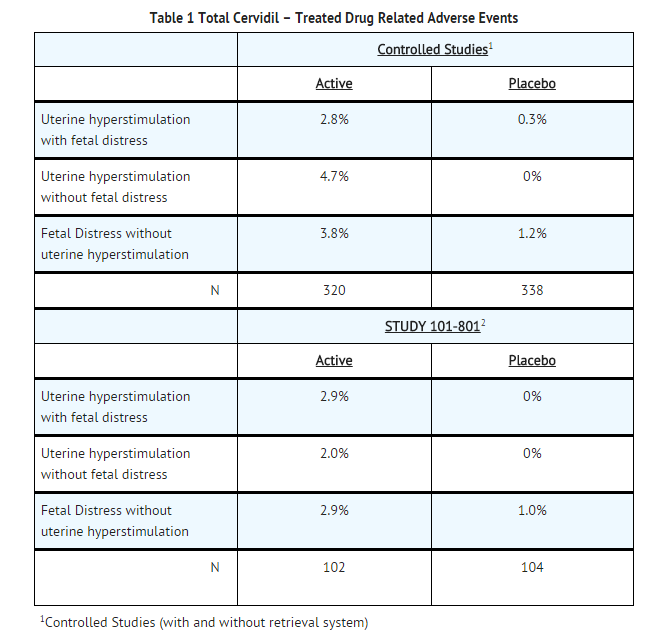
- Dinoprostone is well tolerated. In placebo-controlled trials in which 658 women were entered and 320 received active therapy (218 without retrieval system, 102 with retrieval system), the following events were reported.
This image is provided by the National Library of Medicine.

- Drug related fever, nausea, vomiting, diarrhea, and abdominal pain were noted in less than 1% of patients who received dinoprostone.
- In study 101-801 (with the retrieval system) cases of hyperstimulation reversed within 2 to 13 minutes of removal of the product. Tocolytics were required in one of the five cases.
- In cases of fetal distress, when product removal was thought advisable there was a return to normal rhythm and no neonatal sequelae.
- Five minute Apgar scores were 7 or above in 98.2% (646/658) of studied neonates whose mothers received dinoprostone. In a report of a 3 year pediatric follow-up study in 121 infants, 51 of whose mothers received dinoprostone, there were no deleterious effects on physical examination or psychomotor evaluation.
Post-marketing surveillance
- Immune System Disorders
- Blood and lymphatic system disorders.
- Reports of uterine rupture have been reported in association with use of dinoprostone some required a hysterectomy and some resulted in subsequent fetal or neonatal death.
- Vascular Disorders
Postmarketing Experience
There iimited information regarding Postmarketing Experience of Dinoprostone in the drug label.
Drug Interactions
There is limited information regarding Dinoprostone Drug Interactions in the drug label.
Use in Specific Populations
Pregnancy
- Prostaglandin E2 has produced an increase in skeletal anomalies in rats and rabbits. No effect would be expected clinically, when used as indicated, since dinoprostone (dinoprostone) Vaginal Insert is administered after the period of organogenesis.
- Prostaglandin E2 has been shown to be embryotoxic in rats and rabbits, and any dose that produces sustained increased uterine tone could put the embryo or fetus at risk.
- Australian Drug Evaluation Committee (ADEC) Pregnancy Category
There is no Australian Drug Evaluation Committee (ADEC) guidance on usage of Dinoprostone in women who are pregnant.
Labor and Delivery
There is no FDA guidance on use of Dinoprostone during labor and delivery.
Nursing Mothers
There is no FDA guidance on the use of Dinoprostone with respect to nursing mothers.
Pediatric Use
- The safety and efficacy of dinoprostone has been established in women of a reproductive age and women who are pregnant. Although safety and efficacy has not been established in pediatric patients, safety and efficacy are expected to be the same for adolescents.
Geriatic Use
There is no FDA guidance on the use of Dinoprostone with respect to geriatric patients.
Gender
There is no FDA guidance on the use of Dinoprostone with respect to specific gender populations.
Race
There is no FDA guidance on the use of Dinoprostone with respect to specific racial populations.
Renal Impairment
There is no FDA guidance on the use of Dinoprostone in patients with renal impairment.
Hepatic Impairment
There is no FDA guidance on the use of Dinoprostone in patients with hepatic impairment.
Females of Reproductive Potential and Males
There is no FDA guidance on the use of Dinoprostone in women of reproductive potentials and males.
Immunocompromised Patients
There is no FDA guidance one the use of Dinoprostone in patients who are immunocompromised.
Administration and Monitoring
Administration
Monitoring
There is limited information regarding Monitoring of Dinoprostone in the drug label.
- Description
IV Compatibility
There is limited information regarding IV Compatibility of Dinoprostone in the drug label.
Overdosage
- dinoprostone is used as a single dosage in a single application. Overdosage is usually manifested by uterine hyperstimulation which may be accompanied by fetal distress, and is usually responsive to removal of the insert. Other treatment must be symptomatic since, to date, clinical experience with prostaglandin antagonists is insufficient.
- The use of beta-adrenergic agents should be considered in the event of undesirable increased uterine activity.
Pharmacology
There is limited information regarding Dinoprostone Pharmacology in the drug label.
Mechanism of Action
Structure
- Dinoprostone vaginal insert is a thin, flat, polymeric slab which is rectangular in shape with rounded corners contained within the pouch of an off-white knitted polyester retrieval system. Each slab is buff colored, semitransparent and contains 10 mg of dinoprostone in a hydrogel insert. An integral part of the knitted polyester retrieval system is a long tape designed to aid retrieval at the end of the dosing interval or earlier if clinically indicated. The finished product is a controlled release formulation which has been found to release dinoprostone in vivo at a rate of approximately 0.3 mg/hr.
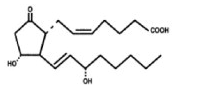
- The chemical name for dinoprostone (commonly known as prostaglandin E2 or PGE2) is 11α, 15S-dihydroxy-9-oxo-prosta-5Z,13E-dien-1-oic acid and the structural formula is represented below:
This image is provided by the National Library of Medicine.

- The molecular formula is C20H32O5 and its molecular weight is 352.5. Dinoprostone occurs as a white to off-white crystalline powder. It has a melting point within the range of 65° to 69°C. Dinoprostone is soluble in ethanol and in 25% ethanol in water. * Each insert contains 10 mg of dinoprostone in 241 mg of a cross-linked polyethylene oxide/urethane polymer which is a semi-opaque, beige colored, flat rectangular slab measuring 29 mm by 9.5 mm and 0.8 mm in thickness. The insert and its retrieval system, made of polyester yarn, are non-toxic and when placed in a moist environment, absorb water, swell, and release dinoprostone.
Pharmacodynamics
There is limited information regarding Pharmacodynamics of Dinoprostone in the drug label.
Pharmacokinetics
- Dinoprostone (PGE2) is a naturally-occurring biomolecule. It is found in low concentrations in most tissues of the body and functions as a local hormone (1-3). As with any local hormone, it is very rapidly metabolized in the tissues of synthesis (the half-life estimated to be 2.5-5 minutes). The rate limiting step for inactivation is regulated by the enzyme 15-hydroxyprostaglandin dehydrogenase (PGDH) (1,4). Any PGE2 that escapes local inactivation is rapidly cleared to the extent of 95% on the first pass through the pulmonary circulation (1,2).
- In pregnancy, PGE2 is secreted continuously by the fetal membranes and placenta and plays an important role in the final events leading to the initiation of labor (1,2). It is known that PGE2 stimulates the production of PGF2α which in turn sensitizes the myometrium to endogenous or exogenously administered oxytocin. Although PGE2 is capable of initiating uterine contractions and may interact with oxytocin to increase uterine contractility, the available evidence indicates that, in the concentrations found during the early part of labor, PGE2 plays an important role in cervical ripening without affecting uterine contractions (5-7). This distinction serves as the basis for considering cervical ripening and induction of labor, usually by the use of oxytocin (8-10), as two separate processes.
- PGE2 plays an important role in the complex set of biochemical and structural alterations involved in cervical ripening. Cervical ripening involves a marked relaxation of the cervical smooth muscle fibers of the uterine cervix which must be transformed from a rigid structure to a softened, yielding and dilated configuration to allow passage of the fetus through the birth canal (11-13). This process involves activation of the enzyme collagenase which is responsible for digestion of some of the structural collagen network of the cervix (1, 14). This is associated with a concomitant increase in the amount of hydrophilic glycosaminoglycan, hyaluronic acid and a decrease in dermatan sulfate (1). Failure of the cervix to undergo these natural physiologic changes, usually assessed by the method described by Bishop (15,16), prior to the onset of effective uterine contractions, results in an unfavourable outcome for successful vaginal delivery and may result in fetal compromise. It is estimated that in approximately 5% of pregnancies the cervix does not ripen normally (17). In an additional 10-11% of pregnancies, labor must be induced for medical or obstetric reasons prior to the time of cervical ripening (17).
- The delivery rate of PGE2in vivo is about 0.3 mg/hour over a period of 12 hours. The controlled release of PGE2 from the hydrogel insert is an attempt to provide sufficient quantities of PGE2 to the local receptors to satisfy hormonal requirements. In the majority of patients, these local effects are manifested by changes in the consistency, dilatation and effacement of the cervix as measured by the Bishop score. Although some patients experience uterine hyperstimulation as a result of direct PGE2- or PGF2α-, mediated sensitization of the myometrium to oxytocin, systemic effects of PGE2 are rarely encountered. The insert is fitted with a biocompatible retrieval system which facilitates removal at the conclusion of therapy or in the event of an adverse reaction.
- No correlation could be established between PGE2 release and plasma concentrations of PGEm. The relative contributions of endogenously and exogenously released PGE2 to the plasma levels of the metabolite PGEm could not be determined. Moreover, it is uncertain as to whether the measured concentrations of PGEm reflect the natural progression of PGEm concentrations in blood as birth approaches or to what extent the measured concentrations following PGE2 administration represent an increase over basal levels that might be measured in control patients.
Nonclinical Toxicology
There is limited information regarding Nonclinical Toxicology of Dinoprostone in the drug label.
Clinical Studies
This image is provided by the National Library of Medicine.

How Supplied
- Cervidil (NDC 0456-4123-63) contains 10 mg dinoprostone. The product is wound and enclosed in an aluminium/polyethylene pack.
Storage
- Store in a freezer: between -20°C and -10°C (-4°F and 14°F). Cervidil is packed in foil and is stable when stored in a freezer for a period of three years. Vaginal inserts exposed to high humidity will absorb moisture from the air and thereby alter the release characteristics of dinoprostone. Once used, the vaginal insert should be discarded.
Images
Drug Images
{{#ask: Page Name::Dinoprostone |?Pill Name |?Drug Name |?Pill Ingred |?Pill Imprint |?Pill Dosage |?Pill Color |?Pill Shape |?Pill Size (mm) |?Pill Scoring |?NDC |?Drug Author |format=template |template=DrugPageImages |mainlabel=- |sort=Pill Name }}
Package and Label Display Panel
{{#ask: Label Page::Dinoprostone |?Label Name |format=template |template=DrugLabelImages |mainlabel=- |sort=Label Page }}
Patient Counseling Information
There is limited information regarding Patient Counseling Information of Dinoprostone in the drug label.
Precautions with Alcohol
- Alcohol-Dinoprostone interaction has not been established. Talk to your doctor about the effects of taking alcohol with this medication.
Brand Names
- CERVIDIL®[1]
Look-Alike Drug Names
There is limited information regarding Dinoprostone Look-Alike Drug Names in the drug label.
Price
References
The contents of this FDA label are provided by the National Library of Medicine.
{{#subobject:
 |Label Page=Dinoprostone
 |Label Name=Dinoprostone 05.jpg
}}
{{#subobject:
 |Label Page=Dinoprostone
 |Label Name=Dinoprostone 06.jpg
}}
{{#subobject:
 |Label Page=Dinoprostone
 |Label Name=Dinoprostone 04.jpg
}}
{{#subobject:
 |Label Page=Dinoprostone
 |Label Name=DailyMed - CERVIDIL- dinoprostone insert, extended release .png
}}