Princeps pollicis artery

You don't need to be Editor-In-Chief to add or edit content to WikiDoc. You can begin to add to or edit text on this WikiDoc page by clicking on the edit button at the top of this page. Next enter or edit the information that you would like to appear here. Once you are done editing, scroll down and click the Save page button at the bottom of the page.

(Redirected from Princeps pollicis)
Jump to: navigation, search
Artery: Princeps pollicis artery
Palm of left hand, showing position of skin creases and bones, and surface markings for the volar arches.
Latin arteria princeps pollicis
Gray's subject #151 595
Supplies thumb
Source radial artery   
Dorlands
/ Elsevier
    
a_61/12155558
Cardiology Network

Discuss Princeps pollicis artery further in the WikiDoc Cardiology Network
Adult Congenital
Biomarkers
Cardiac Rehabilitation
Congestive Heart Failure
CT Angiography
Echocardiography
Electrophysiology
Cardiology General
Genetics
Health Economics
Hypertension
Interventional Cardiology
MRI
Nuclear Cardiology
Peripheral Arterial Disease
Prevention
Public Policy
Pulmonary Embolism
Stable Angina
Valvular Heart Disease
Vascular Medicine

Editor-In-Chief: C. Michael Gibson, M.S., M.D. [1] Phone:617-525-6884

Please Take Over This Page and Apply to be Editor-In-Chief for this topic: There can be one or more than one Editor-In-Chief. You may also apply to be an Associate Editor-In-Chief of one of the subtopics below. Please mail us [2] to indicate your interest in serving either as an Editor-In-Chief of the entire topic or as an Associate Editor-In-Chief for a subtopic. Please be sure to attach your CV and or biographical sketch.


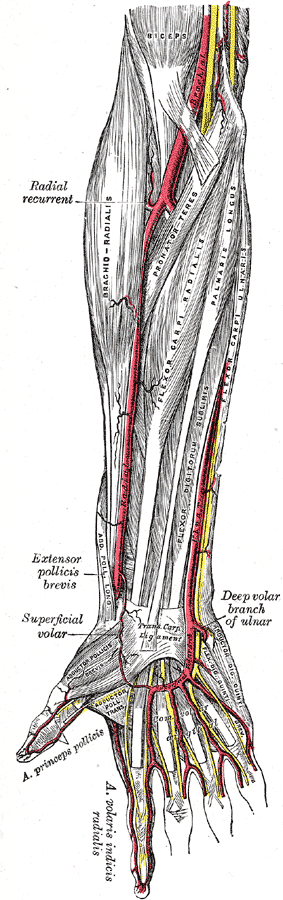
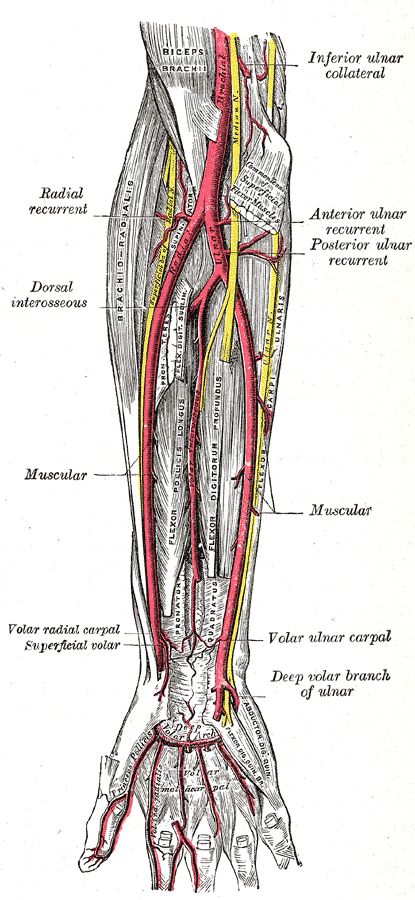
The princeps pollicis (principal artery of the thumb) arises from the radial artery just as it turns medially towards the deep part of the hand; it descends between the first dorsal interosseous muscle and the oblique head of the adductor pollicis, along the medial side of the first metacarpal bone to the base of the proximal phalanx, where it lies beneath the tendon of the flexor pollicis longus muscle and divides into two branches.

These make their appearance between the medial and lateral insertions of the adductor pollicis, and run along the sides of the thumb, forming an arch on the palmar surface of the distal phalanx, from which branches are distributed to the integument and subcutaneous tissue of the thumb.

Additional images

External links

This article was originally based on an entry from a public domain edition of Gray's Anatomy. As such, some of the information contained herein may be outdated. Please edit the article if this is the case, and feel free to remove this notice when it is no longer relevant.

WikiDoc Help Menu

Quick Start..

Editing basics

Advanced editing

Communicating your edits

Help Videos You Can Watch


Acknowledgement and Attribution Regarding Sources of Content

Some of the initial content on this page may be incorporated in part from copyleft sources in the public domain including wikis such as Wikipedia and AskDrWiki. Drug information for patients came from the The National Library of Medicine. Infectious disease information may have come from the Centers for Disease Control (CDC). Differential Diagnoses are drawn from clinicians as well as an amalgamation of 3 sources: 1.The Disease Database; 2. Kahan, Scott, Smith, Ellen G. In A Page: Signs and Symptoms. Malden, Massachusetts: Blackwell Publishing, 2004:3; 3. Sailer, Christian, Wasner, Susanne. Differential Diagnosis Pocket. Hermosa Beach, CA: Borm Bruckmeir Publishing LLC, 2002:7 .

Personal tools