Macula
You don't need to be Editor-In-Chief to add or edit content to WikiDoc. You can begin to add to or edit text on this WikiDoc page by clicking on the edit button at the top of this page. Next enter or edit the information that you would like to appear here. Once you are done editing, scroll down and click the Save page button at the bottom of the page.
| Macula | |
|---|---|
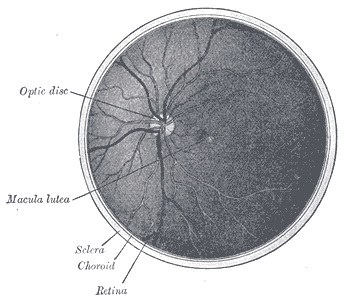
| Human eye cross-sectional view. | |
| Latin | macula lutea |
| Gray's | subject #225 1015 |
| MeSH | Macula+Lutea |
| Dorlands/Elsevier | m_01/12509252 |
Editor-In-Chief: C. Michael Gibson, M.S., M.D. [1] Phone:617-525-6884
Please Join in Editing This Page and Apply to be an Editor-In-Chief for this topic: There can be one or more than one Editor-In-Chief. You may also apply to be an Associate Editor-In-Chief of one of the subtopics below. Please mail us [2] to indicate your interest in serving either as an Editor-In-Chief of the entire topic or as an Associate Editor-In-Chief for a subtopic. Please be sure to attach your CV and or biographical sketch.
The macula or macula lutea (from Latin macula, "spot" + lutea, "yellow") is an oval yellow spot near the center of the retina of the human eye. It has a diameter of about 1.5 mm and is often histologically defined as having two or more layers of ganglion cells. Near its center is the fovea, a small pit that contains the largest concentration of cone cells in the eye and is responsible for central vision.
It is specialized for high acuity vision. Within the macula are the fovea and foveola which contain a high density of cones (photoreceptors with high acuity).
Clinical significance
Whereas loss of peripheral vision may go unnoticed for some time, damage to the macula will result in loss of central vision, which is usually immediately obvious. The progressive destruction of the macula is a disease known as macular degeneration and leads to the creation of a macular hole. Macular holes can rarely be caused by trauma, if a severe blow is delivered perfectly it can burst the blood vessels going to the macula, destroying it.
Visual input to the macula occupies a substantial portion of the brain's visual capacity. As a result, some forms of visual field loss can occur without involving the macula; this is termed macular sparing. (For example, visual field testing might demonstrate homonymous hemianopsia with macular sparing.) This finding can be very informative for the ophthalmologist.
See also
Additional images
Sensory system - Visual system - Eye | |
|---|---|
| Fibrous tunic (outer) | Conjunctiva • Sclera • Schlemm's canal • Trabecular meshwork • Limbus Cornea (Epithelium, Bowman's, Stroma, Descemet's, Endothelium) |
| Uvea (middle) | Choroid (Ciliary processes, Choriocapillaris, Bruch's membrane) • Iris (Stroma) • Pupil • Ciliary body |
| Retina (inner) | Macula • Fovea • Optic disc |
| Anterior segment | Anterior chamber • Aqueous humour • Posterior chamber • Lens |
| Posterior segment | Vitreous humour • Zonule of Zinn |
| Intraocular muscles | parasympathetic (Ciliary muscle, Iris sphincter muscle) • sympathetic (Iris dilator muscle) |
Sensory system - Visual system |
|---|
| Eye • Optic nerve • Optic chiasm • Optic tract • Lateral geniculate nucleus • Optic radiation • Visual cortex • Blobs |
de:Gelber Fleck (Auge)
el:Ωχρή κηλίδαfr:Macula
lt:Geltonoji dėmė
nl:Gele vlek
no:Macula luteasimple:Yellow spot
sv:Gula fläcken
Acknowledgement and Attribution Regarding Sources of Content
Some of the initial content on this page may be incorporated in part from copyleft sources in the public domain including wikis such as Wikipedia and AskDrWiki. Drug information for patients came from the The National Library of Medicine. Infectious disease information may have come from the Centers for Disease Control (CDC). Differential Diagnoses are drawn from clinicians as well as an amalgamation of 3 sources: 1.The Disease Database; 2. Kahan, Scott, Smith, Ellen G. In A Page: Signs and Symptoms. Malden, Massachusetts: Blackwell Publishing, 2004:3; 3. Sailer, Christian, Wasner, Susanne. Differential Diagnosis Pocket. Hermosa Beach, CA: Borm Bruckmeir Publishing LLC, 2002:7 .