Hypertrichosis
Template:DiseaseDisorder infobox
|
WikiDoc Resources for Hypertrichosis |
|
Articles |
|---|
|
Most recent articles on Hypertrichosis Most cited articles on Hypertrichosis |
|
Media |
|
Powerpoint slides on Hypertrichosis |
|
Evidence Based Medicine |
|
Clinical Trials |
|
Ongoing Trials on Hypertrichosis at Clinical Trials.gov Trial results on Hypertrichosis Clinical Trials on Hypertrichosis at Google
|
|
Guidelines / Policies / Govt |
|
US National Guidelines Clearinghouse on Hypertrichosis NICE Guidance on Hypertrichosis
|
|
Books |
|
News |
|
Commentary |
|
Definitions |
|
Patient Resources / Community |
|
Patient resources on Hypertrichosis Discussion groups on Hypertrichosis Patient Handouts on Hypertrichosis Directions to Hospitals Treating Hypertrichosis Risk calculators and risk factors for Hypertrichosis
|
|
Healthcare Provider Resources |
|
Causes & Risk Factors for Hypertrichosis |
|
Continuing Medical Education (CME) |
|
International |
|
|
|
Business |
|
Experimental / Informatics |
Editor-In-Chief: C. Michael Gibson, M.S., M.D. [1]
Hypertrichosis, congenital generalized Hypertrichosis or werewolf syndrome is a medical term referring to a condition of excessive body hair. It can be generalized, symmetrically affecting most of the torso and limbs, or localized, affecting an area of skin. It may be mild or severe. In most cases, the term is used to refer to an above-average amount of normal body hair that is unwanted and is an aspect of human variability.
In medical practice, once generalized hypertrichosis has been distinguished from hirsutism, it is most often considered a variation of normal, primarily resulting from genetic factors.
Most of the people recently featured in the media with hypertrichosis are from the Aceves clan of Loreto, Zacatecas, Mexico, some of whom have emigrated to the United States. Many of them have worked for circuses. The brothers Victor Ramon "Danny" Ramos and Gabriel "Larry" Ramos have worked as acrobats. Their cousins, Jesus "Chuy" Aceves, and his sister, Lili, have worked in sideshows.
Although the statistic has been cited that this only occurs for 1 out of 10 billion people[2], 19 people alive today have hypertrichosis, out of ~6.5 billion people in the world, makes for an average of 1 in 340 million.
Body hair
Template:Human hair Nearly all the skin of the human body except palms of hands and soles of feet is covered with hairs. The density of the hairs (in hair follicles per square centimeter) thickness of the hairs, color of the hairs, speed of hair growth, and qualities such as kinkiness, vary from one part of the body to another, and from one person to another. All of these features have strong genetic determinants, as demonstrated by the heritability of these qualities.
Doctors generally distinguish scalp hair, vellus hair, and androgenic (terminal) hair. Scalp hair is the hair on the head. Its absence is termed "baldness." Vellus hair is the hair on the rest of the body which has not been stimulated and transformed by sex hormones. Androgenic hair is the hair that greatly increases in heaviness and rate of growth with puberty.
Vellus hair
Even children are covered with fine vellus hair, varying in density, length, and heaviness, but usually white due to a lack of pigment.
It is evident that a slight genetic variation, or variation in hormone signalling, could turn this vellus hair into full thickness hair. Pigmented thick hairs may grow from a scar, presumably because in the process of growing a scar, the vellus hair follice is triggered into to growing as a thicker pigmented hair follicle.
Also, thick, pigmented hair is noted to grow on the skin near the site of a spinal injury. It is the ordinarily vellus hair follicle responding to a signal even though there is no scar, callous, or other change to the skin.
Duck down
With yet another minor genetic variation, a single hair follicle may start producing a bunch of hairs, which remain in a bundle at the base, but split apart if it grows long enough, and this resembles duck down. This is most common in male facial hair.
Androgenic hair

The hair follicles on much of the body respond to androgens (primarily testosterone and its derivatives). Generally, the rate of hair growth increases and the heaviness of the hairs increases in direct proportion to the androgen levels. However, different areas respond with different sensitivities. As puberty progresses, the sequence of appearance of sexual (androgenic) hair reflects the gradations of androgen sensitivity. The pubic area is most sensitive, and heavier hair usually grows there first in response to androgens. The following regions also respond to androgens, in order of decreasing sensitivity: axillary and perianal areas, sideburns, above the upper lip, periareolar areas, chin and beard areas, arms and legs, chest, shoulders, buttocks, back, and abdomen.
It is the hair in these areas that appears earlier or grows to excess in disorders of excess androgen (e.g., precocious puberty, late-onset congenital adrenal hyperplasia, and polycystic ovary syndrome).
Vellus hair and hypertrichosis
When the unwanted or excessive hair occurs in other places, and especially in other sequences of appearance, it is rarely due to a disorder of androgen excess. For example, it is not unusual for a young girl to be taken to a pediatric endocrinologist because her mother is distressed by the heaviness of the girl's arm and leg hair, but this condition is never due to a disorder of androgen excess if pubic hair has not appeared.
Most hypertrichosis is genetic, but a small number of unusual systemic disorders can sometimes increase vellus hair. Some drugs (e.g., diazoxide, diphenylhydantoin, and minoxidil) and toxins (e.g., mercury) can induce generalized hair growth as well. Unusual hypertrichosis can also be caused by untreated infection, or by malnutrition. For this reason, it is an occasional sign of anorexia nervosa.
Severe hypertrichosis
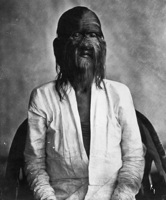
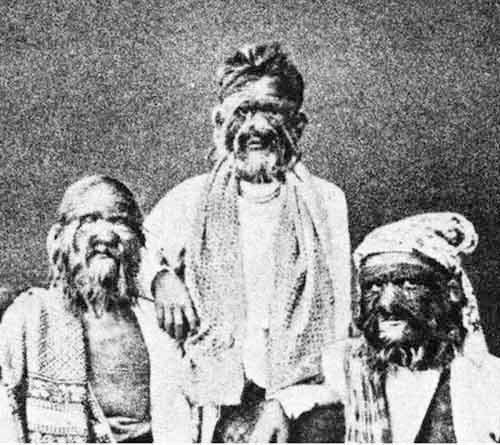
Severe hypertrichosis is quite rare, almost certainly due to unknown genetic defects, and can result in excessive or animal-like hair on both face and body. Some of these people have been displayed in carnival sideshows with names such as "dog-boy" or the "bearded lady." Fedor Jeftichew, Stephan Bibrowski and Annie Jones are well known examples.
Most of the people recently featured in the media with hypertrichosis are from the Aceves clan of Loreto, Zacatecas, Mexico, some of whom have emigrated to the United States. Many of them have worked for circuses. The brothers Victor Ramon "Danny" Ramos and Gabriel "Larry" Ramos have worked as acrobats. Their cousins, Jesus "Chuy" Aceves, and his sister, Lili, have worked in sideshows.
Localized hypertrichosis
In some cases an area of skin can react to repeated trauma or to some other asymmetric stimulus (such as wearing of a cast) with increased hair growth.
Causes
- Drugs
Treatment
In the vast majority of cases, hypertrichosis is a cosmetic problem. The treatments range from camouflage (e.g., bleaching with hydrogen peroxide), to temporary removal by waxing, or permanent removal by electrolysis or laser destruction of hair follicles.
See also
External links
Pictures



Other
- The Wolf People
- Barry Yeoman, When a Woman Goes Bald, Discover
- Close up picture Jesus "Chuy" Fajardo Aceves #1
- Jesus Fajardo Aceves picture #2
- Interview with Jesus "Chuy" Fajardo Aceves
- JoJo the Dog Faced Boy
- Larry and Danny Ramos Gomez, acrobats in the Mexican circus
- Danny featured, along with some relatives, on ABC's Medical Mysteries
- Article on Supatra Sasuphan of Bangkok, Thailand
- "Thailand's one-in-10-billion schoolgirl" by Peter Janssen, "Bangkok Post", retrieved September 13, 2006.
de:Hypertrichose
it:Ipertricosi
he:היפרטריכוזיס
nl:Hypertrichose
no:Hypertrikose