Extensor hallucis longus muscle
You don't need to be Editor-In-Chief to add or edit content to WikiDoc. You can begin to add to or edit text on this WikiDoc page by clicking on the edit button at the top of this page. Next enter or edit the information that you would like to appear here. Once you are done editing, scroll down and click the Save page button at the bottom of the page.
| Extensor hallucis longus muscle | |
|---|---|
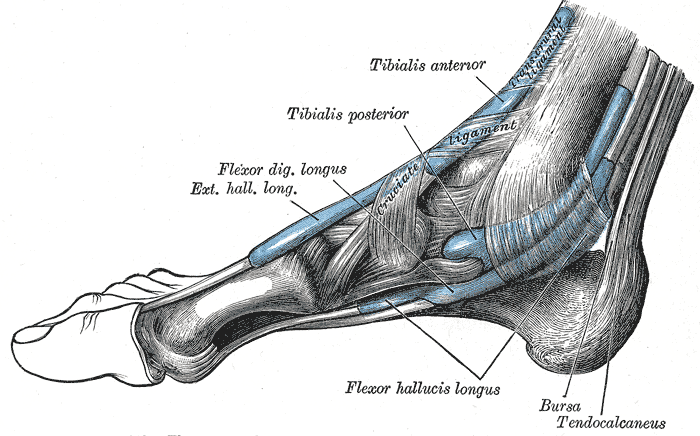
| The mucous sheaths of the tendons around the ankle. Lateral aspect. (Ext. hall. long. labeled at upper left.) | |
| Cross-section through middle of leg. (Extensores longi digitorum et hallucis labeled at upper left.) | |
| Latin | musculus extensor hallucis longus |
| Gray's | subject #129 481 |
| Origin | Arises from the middle portion of the fibula on the anterior surface and the interosseous membrane |
| Insertion | Inserts on the dorsal side of the base of the distal phalanx of the big toe |
| Artery: | anterior tibial artery |
| Nerve: | peroneal nerve |
| Action: | Extends the big toe and assists in dorsiflexion of the foot at the ankle. Also is a weak invertor |
| Antagonist: | Flexor hallucis longus, Flexor hallucis brevis |
| Dorlands /Elsevier | m_22/12548925 |
Please Take Over This Page and Apply to be Editor-In-Chief for this topic: There can be one or more than one Editor-In-Chief. You may also apply to be an Associate Editor-In-Chief of one of the subtopics below. Please mail us [1] to indicate your interest in serving either as an Editor-In-Chief of the entire topic or as an Associate Editor-In-Chief for a subtopic. Please be sure to attach your CV and or biographical sketch.
Overview
The Extensor hallucis longus is a thin muscle, situated between the Tibialis anterior and the Extensor digitorum longus that functions to extend the big toe, dorsiflex the foot, and assists with foot inversion.
It arises from the anterior surface of the fibula for about the middle two-fourths of its extent, medial to the origin of the Extensor digitorum longus; it also arises from the interosseous membrane to a similar extent.
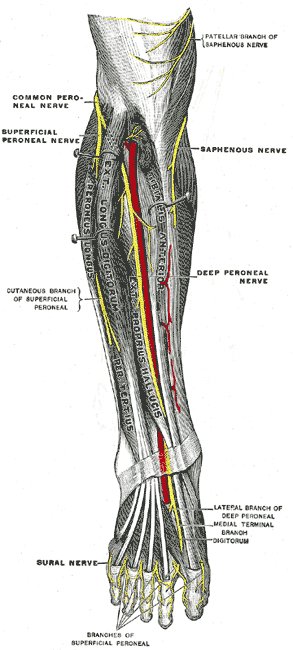
The anterior tibial vessels and deep peroneal nerve lie between it and the Tibialis anterior.
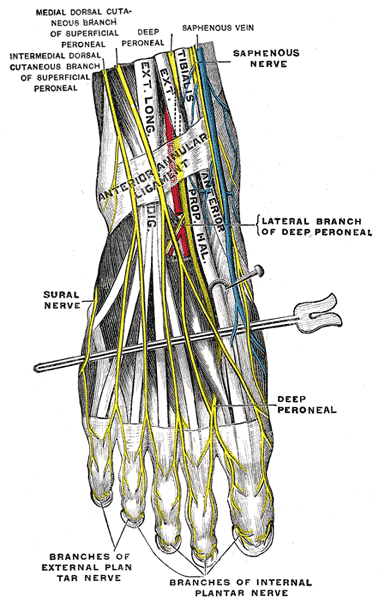
The fibers pass downward, and end in a tendon, which occupies the anterior border of the muscle, passes through a distinct compartment in the cruciate crural ligament, crosses from the lateral to the medial side of the anterior tibial vessels near the bend of the ankle, and is inserted into the base of the distal phalanx of the great toe.
Opposite the metatarsophalangeal articulation, the tendon gives off a thin prolongation on either side, to cover the surface of the joint.
An expansion from the medial side of the tendon is usually inserted into the base of the proximal phalanx.
Variations
Occasionally united at its origin with the Extensor digitorum longus.
Extensor ossis metatarsi hallucis, a small muscle, sometimes found as a slip from the Extensor hallucis longus, or from the Tibialis anterior, or from the Extensor digitorum longus, or as a distinct muscle; it traverses the same compartment of the transverse ligament with the Extensor hallucis longus.
Additional images
Extensor hallucis longus.png
|
External links
- -1657470947 at GPnotebook
- SUNY Labs 15:st-0402 - "The Leg: Muscles"
- LUC exhl
- Extensor+hallucis+longus at eMedicine Dictionary
- University of Washington
This article was originally based on an entry from a public domain edition of Gray's Anatomy. As such, some of the information contained herein may be outdated. Please edit the article if this is the case, and feel free to remove this notice when it is no longer relevant.
de:Musculus extensor hallucis longus
Acknowledgement and Attribution Regarding Sources of Content
Some of the initial content on this page may be incorporated in part from copyleft sources in the public domain including wikis such as Wikipedia and AskDrWiki. Drug information for patients came from the The National Library of Medicine. Infectious disease information may have come from the Centers for Disease Control (CDC). Differential Diagnoses are drawn from clinicians as well as an amalgamation of 3 sources: 1.The Disease Database; 2. Kahan, Scott, Smith, Ellen G. In A Page: Signs and Symptoms. Malden, Massachusetts: Blackwell Publishing, 2004:3; 3. Sailer, Christian, Wasner, Susanne. Differential Diagnosis Pocket. Hermosa Beach, CA: Borm Bruckmeir Publishing LLC, 2002:7 .