Erectores pilorum
You don't need to be Editor-In-Chief to add or edit content to WikiDoc. You can begin to add to or edit text on this WikiDoc page by clicking on the edit button at the top of this page. Next enter or edit the information that you would like to appear here. Once you are done editing, scroll down and click the Save page button at the bottom of the page.
Editor-In-Chief: C. Michael Gibson, M.S., M.D. [1] Phone:617-632-7753
Please Take Over This Page and Apply to be Editor-In-Chief for this topic: There can be one or more than one Editor-In-Chief. You may also apply to be an Associate Editor-In-Chief of one of the subtopics below. Please mail us [2] to indicate your interest in serving either as an Editor-In-Chief of the entire topic or as an Associate Editor-In-Chief for a subtopic. Please be sure to attach your CV and or biographical sketch.
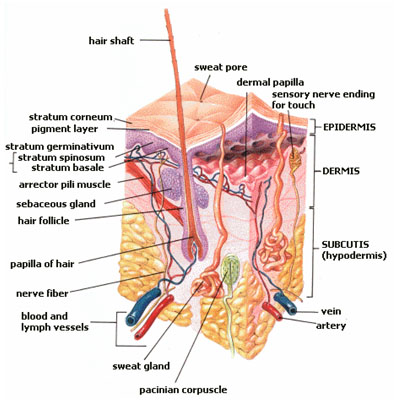
Erectores pilorum (singular Erector pili) are tiny muscle fibers attached to each hair follicle, which contract to make the hairs stand on end, causing goose bumps. They exist in most mammals including humans.
Erectores pilorum are smooth muscle, not skeletal muscle, which explains why humans cannot voluntarily give themselves goose bumps. In other animals with more hair than humans, they serve an important function — they raise the hairs so air gets trapped between them, providing a layer of insulation to keep the animal warm. Some animals also contract their erectores pilorum when they are cornered, in order to appear larger and more threatening. A prominent example of this function is the porcupine which uses erectores pilorum to raise its quills when threatened. Although humans' erectores pilorum also contract in response to cold or arousal, they are vestigial because humans do not have enough hair to make them effective.
The erectores pilorum are controlled by the sympathetic nervous system which is in general responsible for many fight-or-flight responses.
Additional images
Acknowledgement and Attribution Regarding Sources of Content
Some of the initial content on this page may be incorporated in part from copyleft sources in the public domain including wikis such as Wikipedia and AskDrWiki. Drug information for patients came from the The National Library of Medicine. Infectious disease information may have come from the Centers for Disease Control (CDC). Differential Diagnoses are drawn from clinicians as well as an amalgamation of 3 sources: 1.The Disease Database; 2. Kahan, Scott, Smith, Ellen G. In A Page: Signs and Symptoms. Malden, Massachusetts: Blackwell Publishing, 2004:3; 3. Sailer, Christian, Wasner, Susanne. Differential Diagnosis Pocket. Hermosa Beach, CA: Borm Bruckmeir Publishing LLC, 2002:7 .