Cavernous sinus
|
WikiDoc Resources for Cavernous sinus |
|
Articles |
|---|
|
Most recent articles on Cavernous sinus Most cited articles on Cavernous sinus |
|
Media |
|
Powerpoint slides on Cavernous sinus |
|
Evidence Based Medicine |
|
Clinical Trials |
|
Ongoing Trials on Cavernous sinus at Clinical Trials.gov Trial results on Cavernous sinus Clinical Trials on Cavernous sinus at Google
|
|
Guidelines / Policies / Govt |
|
US National Guidelines Clearinghouse on Cavernous sinus NICE Guidance on Cavernous sinus
|
|
Books |
|
News |
|
Commentary |
|
Definitions |
|
Patient Resources / Community |
|
Patient resources on Cavernous sinus Discussion groups on Cavernous sinus Patient Handouts on Cavernous sinus Directions to Hospitals Treating Cavernous sinus Risk calculators and risk factors for Cavernous sinus
|
|
Healthcare Provider Resources |
|
Causes & Risk Factors for Cavernous sinus |
|
Continuing Medical Education (CME) |
|
International |
|
|
|
Business |
|
Experimental / Informatics |
Editor-In-Chief: C. Michael Gibson, M.S., M.D. [1]
The cavernous sinus (or lateral sellar compartment) is a large collection of thin-walled veins creating a cavity bordered by the sphenoid bone and the temporal bone of the skull.
Contents
Each cavernous sinus (one for each hemisphere of the brain) contains the following:
- vertically, from superior to inferior
- oculomotor nerve (CN III)
- trochlear nerve (CN IV)
- ophthalmic nerve, the V1 branch of the trigeminal nerve (CN V)
- maxillary nerve, the V2 branch of CN V
- horizontally
- internal carotid artery (and sympathetic plexus). See also cavernous part of internal carotid artery.
- abducens nerve (CN VI)
One mnemonic for remembering the contents is "OTOM CAT"[1]
Venous connections
It receives tributaries from:
- Superior and inferior ophthalmic veins
- Superior parietal sinus
- Superior and middle cerebral veins
The veins of exit are to the superior and inferior petrosal sinuses as well as via the emissary veins through the foramina of the skull. There are also connections with the pterygoid plexus of veins via inferior ophthalmic vein, deep facial vein and emissary veins.
Clinical significance
It is the only anatomic location in the body in which an artery travels completely through a venous structure. If the internal carotid artery ruptures within the cavernous sinus, an arteriovenous fistula is created (more specifically, a carotid-cavernous fistula).
The pituitary gland lies directly below the cavernous sinus. An abnormally growing pituitary adenoma, surrounded on all other sides by the bony walls of the sella turcica, will expand in the direction of least resistance and eventually compress the cavernous sinus. Cavernous sinus syndrome may result from mass effect of these tumors and cause ophthalmoplegia (from compression of the oculomotor nerve, trochlear nerve, and abducens nerve), ophthalmic sensory loss (from compression of the ophthalmic nerve), and maxillary sensory loss (from compression of the maxillary nerve).
Additional images
-
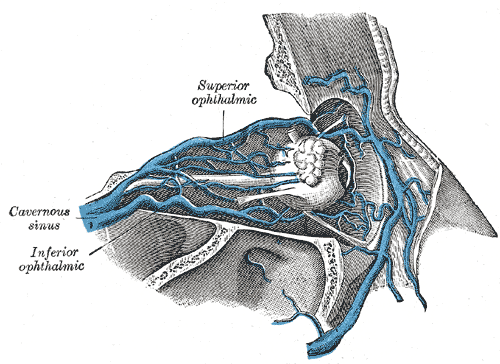
Veins of orbit.
-
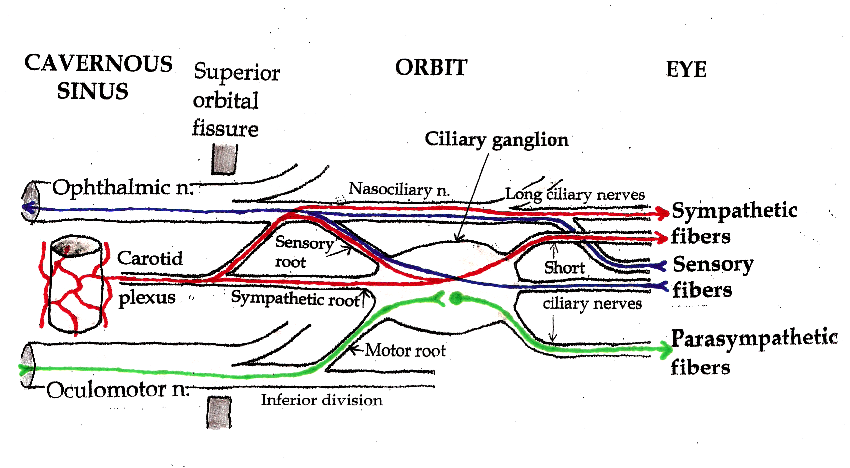
Pathways in the Ciliary Ganglion.


See also
References
External links
- Template:LoyolaMedEd
- Template:SUNYAnatomyFigs - "Venous dural sinuses."
- Cavernous+Sinus at the US National Library of Medicine Medical Subject Headings (MeSH)
- Template:NormanAnatomy
- UMichAtlas|n3a8p1
- Template:EMedicineDictionary