Basophil granulocyte

You don't need to be Editor-In-Chief to add or edit content to WikiDoc. You can begin to add to or edit text on this WikiDoc page by clicking on the edit button at the top of this page. Next enter or edit the information that you would like to appear here. Once you are done editing, scroll down and click the Save page button at the bottom of the page.

(Redirected from Basophils)
Jump to: navigation, search
Basophil granulocyte

WikiDoc Resources for

Basophil granulocyte

Articles

Most recent articles on Basophil granulocyte

Most cited articles on Basophil granulocyte

Review articles on Basophil granulocyte

Articles on Basophil granulocyte in N Eng J Med, Lancet, BMJ

Media

Powerpoint slides on Basophil granulocyte

Images of Basophil granulocyte

Photos of Basophil granulocyte

Podcasts & MP3s on Basophil granulocyte

Videos on Basophil granulocyte

Evidence Based Medicine

Cochrane Collaboration on Basophil granulocyte

Bandolier on Basophil granulocyte

TRIP on Basophil granulocyte

Clinical Trials

Ongoing Trials on Basophil granulocyte at Clinical Trials.gov

Trial results on Basophil granulocyte

Clinical Trials on Basophil granulocyte at Google

Guidelines / Policies / Govt

US National Guidelines Clearinghouse on Basophil granulocyte

NICE Guidance on Basophil granulocyte

NHS PRODIGY Guidance

FDA on Basophil granulocyte

CDC on Basophil granulocyte

Books

Books on Basophil granulocyte

News

Basophil granulocyte in the news

Be alerted to news on Basophil granulocyte

News trends on Basophil granulocyte

Commentary

Blogs on Basophil granulocyte

Definitions

Definitions of Basophil granulocyte

Patient Resources / Community

Patient resources on Basophil granulocyte

Discussion groups on Basophil granulocyte

Patient Handouts on Basophil granulocyte

Directions to Hospitals Treating Basophil granulocyte

Risk calculators and risk factors for Basophil granulocyte

Healthcare Provider Resources

Symptoms of Basophil granulocyte

Causes & Risk Factors for Basophil granulocyte

Diagnostic studies for Basophil granulocyte

Treatment of Basophil granulocyte

Continuing Medical Education (CME)

CME Programs on Basophil granulocyte

International

Basophil granulocyte en Espanol

Basophil granulocyte en Francais

Business

Basophil granulocyte in the Marketplace

Patents on Basophil granulocyte

Experimental / Informatics

List of terms related to Basophil granulocyte

Editor-In-Chief: C. Michael Gibson, M.S., M.D. [1] Phone:617-632-7753

Please Take Over This Page and Apply to be Editor-In-Chief for this topic: There can be one or more than one Editor-In-Chief. You may also apply to be an Associate Editor-In-Chief of one of the subtopics below. Please mail us [2] to indicate your interest in serving either as an Editor-In-Chief of the entire topic or as an Associate Editor-In-Chief for a subtopic. Please be sure to attach your CV and or biographical sketch.

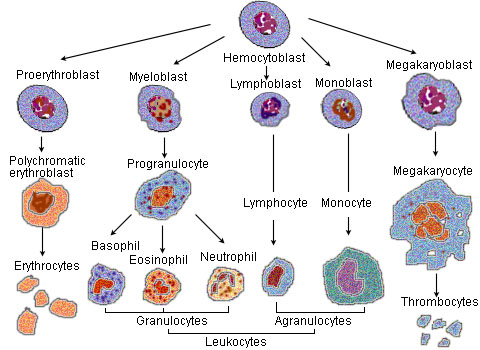
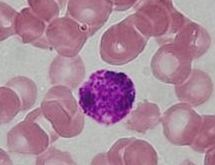
Basophils are the least common of the granulocytes, representing about 0.01% to 0.3% of circulating leukocytes (white blood cells). They contain large cytoplasmic granules which obscure the cell nucleus under the microscope. However, when unstained, the nucleus is visible and it usually has 2 lobes. The mast cell, a cell in tissues, has many similar characteristics. For example, both cell types store histamine, a chemical that is secreted by the cells when stimulated in certain ways (histamine causes some of the symptoms of an allergic reaction). Like all circulating granulocytes, basophils can be recruited out of the blood into a tissue when needed.

Secretions

When activated, basophils degranulate to release histamine, proteoglycans (e.g. heparin and chondroitin), and proteolytic enzymes (e.g. elastase and lysophospholipase). They also secrete lipid mediators like leukotrienes, and several cytokines. Histamine and proteoglycans are pre-stored in the cell's granules while the other secreted substances are newly generated. Each of these substances contributes to inflammation. Recent evidence suggests that basophils are an important source of the cytokine, interleukin-4, perhaps more important than T cells. Interleukin-4 is considered one of the critical cytokines in the development of allergies and the production of IgE antibody by the immune system. There are other substances that can activate basophils to secrete which suggests that these cells have other roles in inflammation.[1]

Basopenia (a low basophil count) is difficult to demonstrate as the normal basophil count is so low; it has been reported in association with autoimmune urticaria (a chronic itching condition). Basophilia is also uncommon but may be seen in some forms of leukaemia or lymphoma.

References

  1. Janeway CA, Jr. et al (2001). Immunobiology., 5th ed., Garland Publishing. (electronic full text via NCBI Bookshelf) ISBN 0-8153-3642-X. 

Additional images

bs:Bazofilni granulociti

ca:Basòfil de:Basophiler Granulozyt dv:ބޭސަފިލްit:Granulocita basofilo he:באזופיל lt:Bazofilas nl:Basofiele granulocytsv:Basofil granulocytuk:Базофіли


WikiDoc Help Menu

Quick Start..

Editing basics

Advanced editing

Communicating your edits

Help Videos You Can Watch

Acknowledgement and Attribution Regarding Sources of Content

Some of the initial content on this page may be incorporated in part from copyleft sources in the public domain including wikis such as Wikipedia and AskDrWiki. Drug information for patients came from the The National Library of Medicine. Infectious disease information may have come from the Centers for Disease Control (CDC). Differential Diagnoses are drawn from clinicians as well as an amalgamation of 3 sources: 1.The Disease Database; 2. Kahan, Scott, Smith, Ellen G. In A Page: Signs and Symptoms. Malden, Massachusetts: Blackwell Publishing, 2004:3; 3. Sailer, Christian, Wasner, Susanne. Differential Diagnosis Pocket. Hermosa Beach, CA: Borm Bruckmeir Publishing LLC, 2002:7 .