Amputation toe
|
WikiDoc Resources for Amputation toe |
|
Articles |
|---|
|
Most recent articles on Amputation toe Most cited articles on Amputation toe |
|
Media |
|
Powerpoint slides on Amputation toe |
|
Evidence Based Medicine |
|
Clinical Trials |
|
Ongoing Trials on Amputation toe at Clinical Trials.gov Trial results on Amputation toe Clinical Trials on Amputation toe at Google
|
|
Guidelines / Policies / Govt |
|
US National Guidelines Clearinghouse on Amputation toe NICE Guidance on Amputation toe
|
|
Books |
|
News |
|
Commentary |
|
Definitions |
|
Patient Resources / Community |
|
Patient resources on Amputation toe Discussion groups on Amputation toe Patient Handouts on Amputation toe Directions to Hospitals Treating Amputation toe Risk calculators and risk factors for Amputation toe
|
|
Healthcare Provider Resources |
|
Causes & Risk Factors for Amputation toe |
|
Continuing Medical Education (CME) |
|
International |
|
|
|
Business |
|
Experimental / Informatics |
In addition to the common indications for any amputation (e.g., infection, arteriosclerosis with gangrene, etc.), specific indications for toe amputations exist as well. For example, the fifth toe (the most commonly amputated toe) is usually removed for being overriding on the fourth toe. This toe can be amputated with impunity and this is usually preferred over reconstructive procedures because it is easy and definitive. Complications of toe amputations with regards to gait are minimal. For example, any single toe can be removed with little gait or stance disturbance. This is true for amputation of the great toe during standing or walking at a normal pace. However, if the patient walks rapidly a limp appears from the loss of the normal push-off provided by the great toe. With amputations of all toes, the patients gait is likewise normal with slow, but impaired with rapid locomotion. Additional complications specific to the toes include a severe hallux valgus deformity seen in amputations of the second (see below).
Diagnostic Images
Osteomyelitis
The below images show both the pre-operative and post-operative left foot of the same patient. The pre-op film demonstrate osteomyelitis of the distal first phalanx that was treated with a great toe amputation. (Courtesy of A. Gentili MD)
-
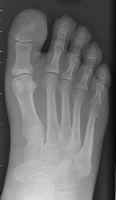
Before amputation
-
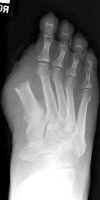
After amputation


Hallux Valgus
-
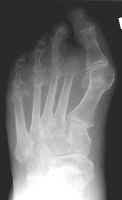
Second toe amputation with resultant hallux valgus deformity. This is a common complication of second toe amputations and occurs because the great toe tends to drift toward the third to fill the gap left by the amputation. (Courtesy of A. Gentili MD)

External Links
Acknowledgments
This page is first contributed by Michael Harpur Edwards MD.